


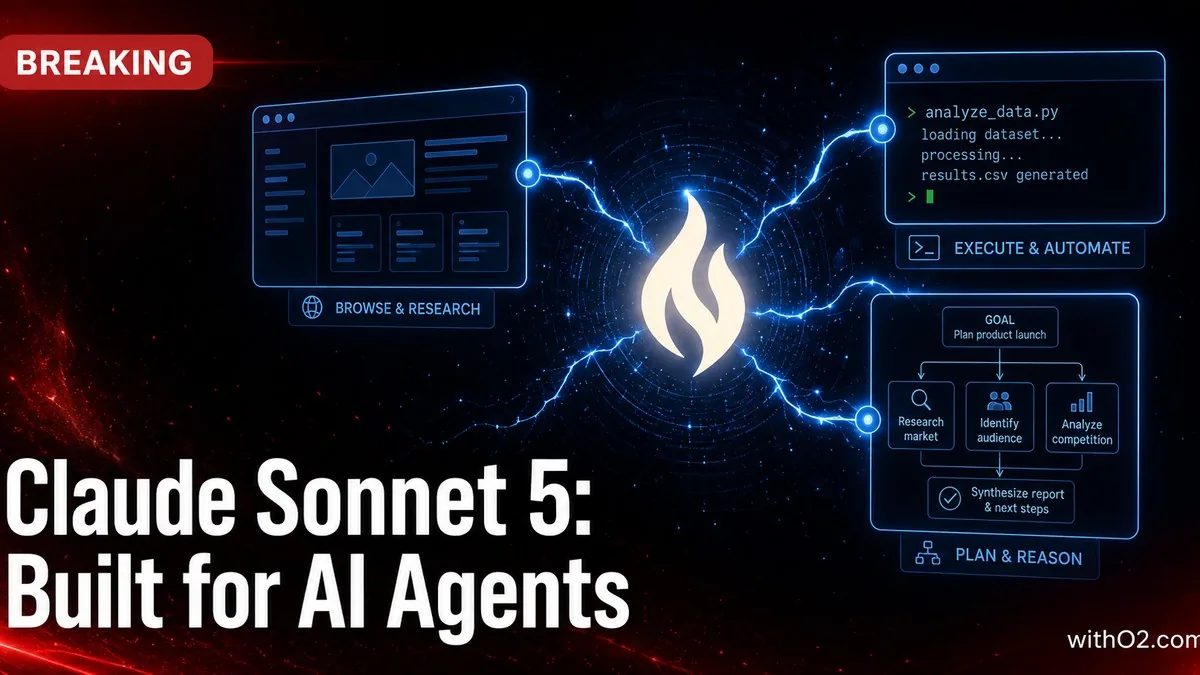
Claude Sonnet 5 is Anthropic’s new default model on Free and Pro plans, designed to run agentic tasks — browser use, terminal operations, autonomous planning — that previously required larger, more expensive models. Pricing is $2 per million input tokens and $10 per million output tokens — now confirmed permanent after Anthropic reversed a planned September 1 rate increase.
Anthropic officially launched Claude Sonnet 5 on June 30, 2026, describing it as its most capable mid-tier model to date. The model is available immediately on the Claude API (model string: claude-sonnet-5), Amazon Bedrock, and Google Cloud Vertex AI. It replaces the previous Sonnet as the default for Free and Pro users while remaining available on Max, Team, and Enterprise plans.


The Agentic Shift Behind Claude Sonnet 5
The headline capability for Sonnet 5 is not raw benchmark performance — it is agentic reliability. Anthropic designed the model to handle multi-step autonomous tasks: navigating browsers, executing terminal commands, making sequential plans across long workflows, and recovering from errors without needing to hand control back to the user.
Previously, running those kinds of tasks with confidence required Opus 4.8, Anthropic’s largest and most expensive model. Sonnet 5 is described as matching Opus 4.8 closely on capability benchmarks while costing significantly less. For developers running high-volume agent pipelines, that delta matters.
This positions Sonnet 5 directly against OpenAI’s mid-tier agent models and Google’s Gemini 3.5 Flash, which became the default in Google’s AI Mode the same week.
Claude Sonnet 5 Pricing: $2/$10 Now Permanent
✅ Update Aug 10, 2026: Pricing confirmed permanent
Anthropic has made $2 input / $10 output per million tokens the permanent rate for Claude Sonnet 5 — the scheduled September 1 increase to $3/$15 will not happen. One important factor remains: Sonnet 5’s new tokenizer encodes text more granularly than previous Claude models, producing approximately 30% more tokens on equivalent input, so actual token consumption will be higher than with earlier Sonnet versions. Source: Anthropic official pricing page.
The $2 per million input tokens and $10 per million output tokens rate is now the standard long-term price for Sonnet 5. For context, OpenAI’s GPT-5.6 Luna — their lightest model in the current family — is priced at $1 per million input and $6 per million output, undercutting Sonnet 5 on price. But Luna is positioned as a lightweight tier. Sonnet 5 competes more directly with GPT-5.6 Terra at $2.50/$15, where Anthropic’s rate is genuinely competitive.
Developers planning long-running agentic pipelines on Sonnet 5 should still account for the tokenizer difference: the same prompts that cost X on earlier Claude models will produce roughly 30% more tokens on Sonnet 5, so effective costs are higher than a direct per-token comparison suggests.
Where It Fits in Anthropic’s Current Model Stack
Sonnet 5 slots below Claude Fable 5, Anthropic’s flagship research model, and above the Haiku tier designed for lightweight, cost-sensitive applications. The Sonnet tier has historically been the most popular choice for developers who need real capability without paying Opus-level prices — Sonnet 3.5 was widely adopted across agent frameworks, IDE plugins, and API products.
Sonnet 5 continues that pattern with a sharper agentic focus. The best AI coding tools — including Claude Code itself — are likely to integrate Sonnet 5 as a default agent execution layer given the confirmed permanent pricing.
The June 30 release also coincided with the Claude Fable 5 export control lift and the Claude Science announcement, suggesting Anthropic coordinated a multi-product push in the final day of the month.
What Developers Need to Know Right Now
To access Sonnet 5 via the API, use the model string claude-sonnet-5. The model is available on all major cloud platforms: Anthropic’s own API, Amazon Bedrock, and Google Cloud Vertex AI. No special access or allowlisting is required for existing API users.
Free and Pro users on Claude.ai will see Sonnet 5 as the default starting June 30. Max, Team, and Enterprise users can switch between models. The $2/$10 per million token rate is now permanent — there is no longer a deadline to act on.
Frequently Asked Questions
What is Claude Sonnet 5?
Claude Sonnet 5 is Anthropic’s latest mid-tier AI model, released June 30, 2026. It is the new default model for Free and Pro users on Claude.ai, and available via API using the model string claude-sonnet-5. It is designed specifically for agentic tasks including browser use, terminal operations, and autonomous multi-step planning.
How much does Claude Sonnet 5 cost?
Claude Sonnet 5 costs $2 per million input tokens and $10 per million output tokens — a rate Anthropic confirmed as permanent on August 10, 2026, reversing a previously announced September 1 increase to $3/$15. Enterprise pricing may differ. These rates apply to the Anthropic API; Amazon Bedrock and Google Cloud may have different pricing structures. Note that Sonnet 5’s tokenizer produces approximately 30% more tokens on the same text compared to earlier Claude models.
What is the Claude Sonnet 5 model string?
The API model string for Claude Sonnet 5 is claude-sonnet-5. This is used in the model parameter of any API request to Anthropic’s platform, as well as on Amazon Bedrock and Google Cloud Vertex AI where the model is also available.
How does Claude Sonnet 5 compare to Claude Opus 4.8?
Anthropic describes Sonnet 5 as performing close to Opus 4.8 on capability benchmarks, particularly for agentic tasks, while costing significantly less. Opus 4.8 remains Anthropic’s premium tier for the most demanding reasoning and research tasks. Sonnet 5 is the better choice for high-volume agent workloads where cost per call matters.
Is Claude Sonnet 5 available on Amazon Bedrock and Google Cloud?
Yes. Claude Sonnet 5 is available on Amazon Bedrock and Google Cloud Vertex AI in addition to Anthropic’s own API. Developers already using Claude models on those platforms can access Sonnet 5 using the claude-sonnet-5 model identifier without any additional setup or access request.
Claude Sonnet 5 is available now across all Anthropic platforms at a permanently confirmed $2/$10 per million token rate. Updated: August 10, 2026


