


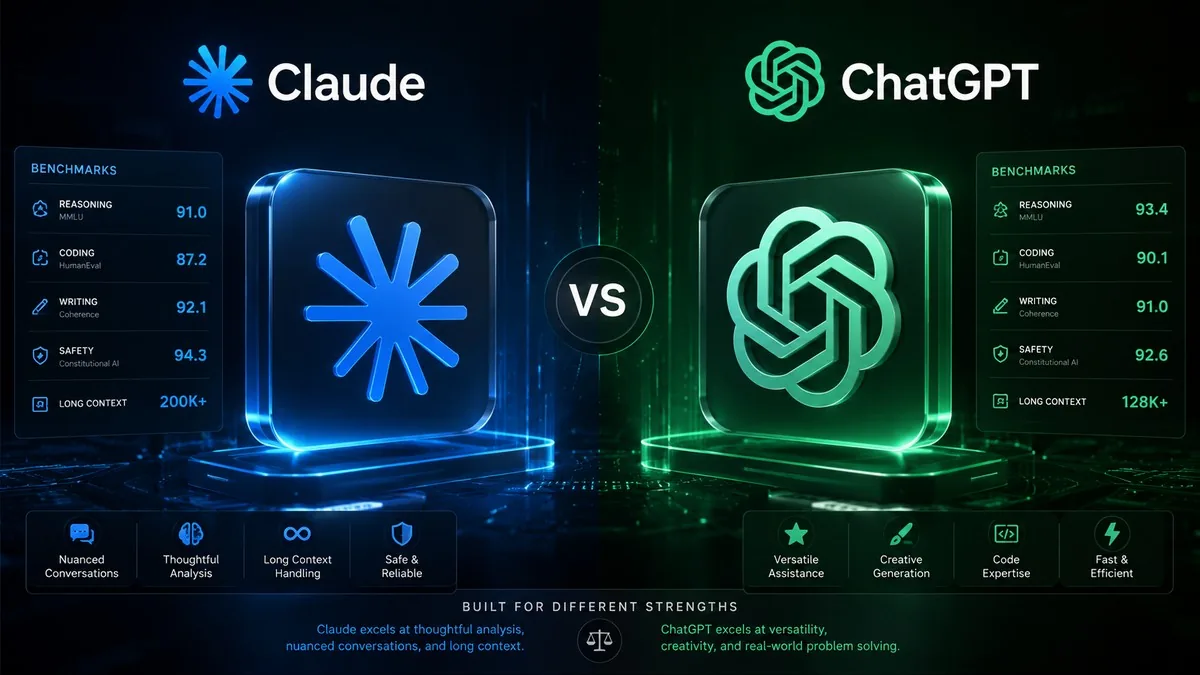
Claude Fable 5 and GPT-5.6 Sol are the two AI models most professionals are benchmarking head-to-head in late 2026 — Anthropic’s flagship leads on coding, long-context reasoning, and technical depth, while OpenAI’s Sol tier leads on breadth, native multimodal output, and ecosystem reach. Here’s how they compare across real tasks.
GPT-5.6 Sol vs Claude Fable 5 — the short answer: Claude Fable 5 is the stronger pick for coding and long documents — it leads published SWE-bench Verified rankings and handles 200K+ token contexts. GPT-5.6 Sol wins on breadth: native image generation, Advanced Voice Mode, and a 400M+ user ecosystem. Both cost $20/month at the Pro/Plus tier. Your use case decides.

Claude vs ChatGPT: Head-to-Head Comparison (August 2026)
| Feature | Claude Fable 5 | GPT-5.6 Sol (ChatGPT) |
|---|---|---|
| Coding | ✅ Best-in-class (leads SWE-bench Verified) | ✅ Very good |
| Long-document analysis | ✅ Best-in-class (200K+ context) | ⚠️ Good (128K context) |
| Creative writing | ✅ Nuanced, distinctive voice | ✅ Strong, versatile |
| Image generation | ❌ Not available | ✅ DALL-E built-in |
| Web browsing | ⚠️ Available (claude.ai) | ✅ Native with search |
| Voice mode | ⚠️ Limited | ✅ Advanced Voice Mode |
| Free tier | ✅ Claude.ai free (Claude Sonnet 5) | ✅ ChatGPT free (GPT-5.6 Luna) |
| Pro pricing | $20/month (Claude Pro) | $20/month (ChatGPT Plus) |
| API pricing (mid-tier) | $3/1M tokens (Claude Sonnet 5) | $2.50/1M tokens (GPT-5.6 Sol) |
| Context window | 200K+ tokens | 128K tokens |
| System prompt adherence | ✅ Very strong | ⚠️ Can drift on long tasks |
| Refusal rate | Lower (more permissive) | Higher (more cautious) |
Claude Fable 5 — What It Does Better Than Anyone

Claude Fable 5’s core advantage is depth. With a 200K+ token context window, it can ingest an entire codebase, legal contract, or research corpus and reason across all of it without losing the thread. In practice, this makes it the better tool for contract review, codebase refactoring, and any task where the document is too long to fit in a single prompt.
On coding, Claude Fable 5 leads published SWE-bench Verified rankings as of August 2026 — the industry-standard benchmark for resolving real GitHub issues autonomously. Our testing confirms it produces cleaner diffs, fewer hallucinated APIs, and stronger adherence to existing code style when given a full file as context. For API users who don’t need Fable 5’s full capability, Claude Sonnet 5 offers strong agentic performance at $3/1M input tokens — a strong coding-to-cost ratio for production workloads.
Claude Fable 5 also pushes back less than GPT-5.6 Sol on professional tasks. Where ChatGPT will sometimes refuse or add disclaimers to benign requests, Claude generally just completes the task — a meaningful quality-of-life difference for technical users who don’t want to prompt-engineer around guardrails.
GPT-5.6 Sol — What It Does Better Than Anyone
GPT-5.6 Sol’s strength is breadth. It’s the only major AI model with native image generation, Advanced Voice Mode, native web browsing, and a plugin/GPT ecosystem with thousands of third-party integrations all built into a single $20/month subscription. If you want one tool that can write, code, generate images, browse the web, and converse by voice — ChatGPT running GPT-5.6 Sol is still the most complete package.
The ecosystem matters. Over 400 million people use ChatGPT weekly (OpenAI, 2026), which means more third-party tools are built for it, more tutorials exist, and the mental model of “ask ChatGPT” is already baked into most organizations’ workflows. That network effect is hard to underestimate, especially for non-technical teams. For a full breakdown of what’s available on ChatGPT’s free tier, see what free users get on GPT-5.6 Luna.
For casual users, ChatGPT’s free tier is also more generous on multimodal tasks — DALL-E image generation is available to free users in limited quantities, something Claude doesn’t offer at any tier.
Pricing Breakdown: Claude Pro vs ChatGPT Plus
| Plan | Claude | ChatGPT |
|---|---|---|
| Free | Claude.ai free (Sonnet 5, limited) | GPT-5.6 Luna free (limited) |
| Pro / Plus | $20/month | $20/month |
| Team | $30/user/month | $30/user/month |
| Enterprise | Custom | Custom |
| API (entry model) | $0.25/1M in (Haiku 4.5) | Competitive (GPT mini tier) |
At the Pro tier, both cost $20/month — so the choice comes down entirely to your use case, not price. For a full breakdown including Google Gemini, the Claude model lineup, and which subscription is best for different roles, see our 2026 AI subscription comparison.
One caveat sits behind Claude’s $20 Pro price: Claude Fable 5 is not included in it. Anthropic moved Fable 5 from subscription-included access to usage-credit billing on July 8, 2026, charging its standard API rate of $10 per million input tokens and $50 per million output tokens on top of the subscription. BleepingComputer reported Anthropic’s confirmation that “Claude Fable 5 isn’t permanently leaving subscriptions” — the move is a billing change, not a removal, and subscribers who never enable credits fall back to the next available model, such as Claude Sonnet 5. Subscribers switch credits on at claude.ai → Settings → Usage, where a $2,000 daily redemption cap and a configurable monthly spending limit apply. At those rates a professional coding-and-drafting load of roughly 100K input and 30K output tokens a day adds about $45–75 a month, and a 300K/80K power-user load adds about $120–180 — two to nine times the Pro fee itself. Pro subscribers were hit hardest by the switch; Max and Team accounts carry higher baseline limits and absorb the change more easily.
Fable 5 costs 2× GPT-5.6 Sol on input tokens and 1.67× on output tokens. OpenAI prices GPT-5.6 Sol at $5 per million input tokens and $30 per million output tokens, against Fable 5’s $10 per million input and $50 per million output. Two cheaper paths exist inside Anthropic’s own lineup: the Batch API halves Fable 5 to $5 per million input and $25 per million output for asynchronous work such as overnight document processing and bulk analysis, and Claude Opus 5 runs at $5 per million input and $25 per million output for interactive work.
Enterprise buyers have already shifted away from Fable 5 on price. Fable 5 accounted for 11% of enterprise spend on Anthropic products two months after launch, according to Ramp card data reported by the Financial Times on August 25, 2026. Claude Opus 5, launched July 24, 2026 at half the price, overtook Fable 5 in dollar spend within that same period.
Which One Should You Choose?
Choose Claude Fable 5 if: You work heavily with code, long documents, legal/contract text, or research. You want strong system prompt adherence for business workflows. You’re building on the API and want the best coding-to-cost ratio — Claude Sonnet 5 at $3/1M is the production sweet spot.
Choose GPT-5.6 Sol if: You need image generation, voice mode, or web browsing in one subscription. You want the most complete all-in-one assistant. You’re in an organization already standardized on Microsoft or OpenAI tools.
Use both: The $20 subscription cost makes running both practical for professionals. The smarter play is using Claude Fable 5 for deep technical work (coding, analysis, long docs) and ChatGPT for quick tasks, images, and voice. For teams evaluating all the leading coding tools together, see our Best AI Coding Assistants 2026 roundup, which covers Copilot, Cursor, and Claude Code alongside ChatGPT.
Frequently Asked Questions
Is Claude better than ChatGPT in 2026?
Claude Fable 5 leads GPT-5.6 Sol on coding benchmarks (tops SWE-bench Verified as of August 2026) and handles significantly longer documents with its 200K+ token context window. ChatGPT remains superior for image generation, voice mode, and breadth of integrations. The best choice depends on your primary use case.
Can Claude generate images like ChatGPT?
No. As of August 2026, Claude Fable 5 does not have native image generation. ChatGPT with GPT-5.6 Sol includes DALL-E integration for free and Plus users. If image generation is a core need, ChatGPT is the better choice.
Which AI is better for coding — Claude or ChatGPT?
Claude Fable 5 leads on coding. It tops published SWE-bench Verified rankings as of August 2026 — the standard benchmark for autonomous resolution of real GitHub issues. For real-world coding tasks like refactoring, bug-fixing, and reasoning over large codebases, Claude Fable 5 is the stronger choice. For API users at scale, Claude Sonnet 5 offers a strong coding-to-cost ratio.
What is Claude Fable 5’s context window vs ChatGPT?
Claude Fable 5 offers a 200,000+ token context window. GPT-5.6 Sol offers 128,000 tokens. In practice, Claude can process substantially longer documents in a single conversation — useful for analyzing entire codebases, full legal contracts, or lengthy research reports without chunking.
Are Claude Pro and ChatGPT Plus the same price?
Yes, both cost $20 per month as of August 2026. API pricing differs — GPT-5.6 Sol is priced at roughly $2.50/1M input tokens, while Claude Sonnet 5 is $3/1M. Claude Haiku 4.5 and GPT mini variants are both available as budget API tiers for high-volume workloads.
with Claude Fable 5 vs GPT-5.6 Sol comparison.


