


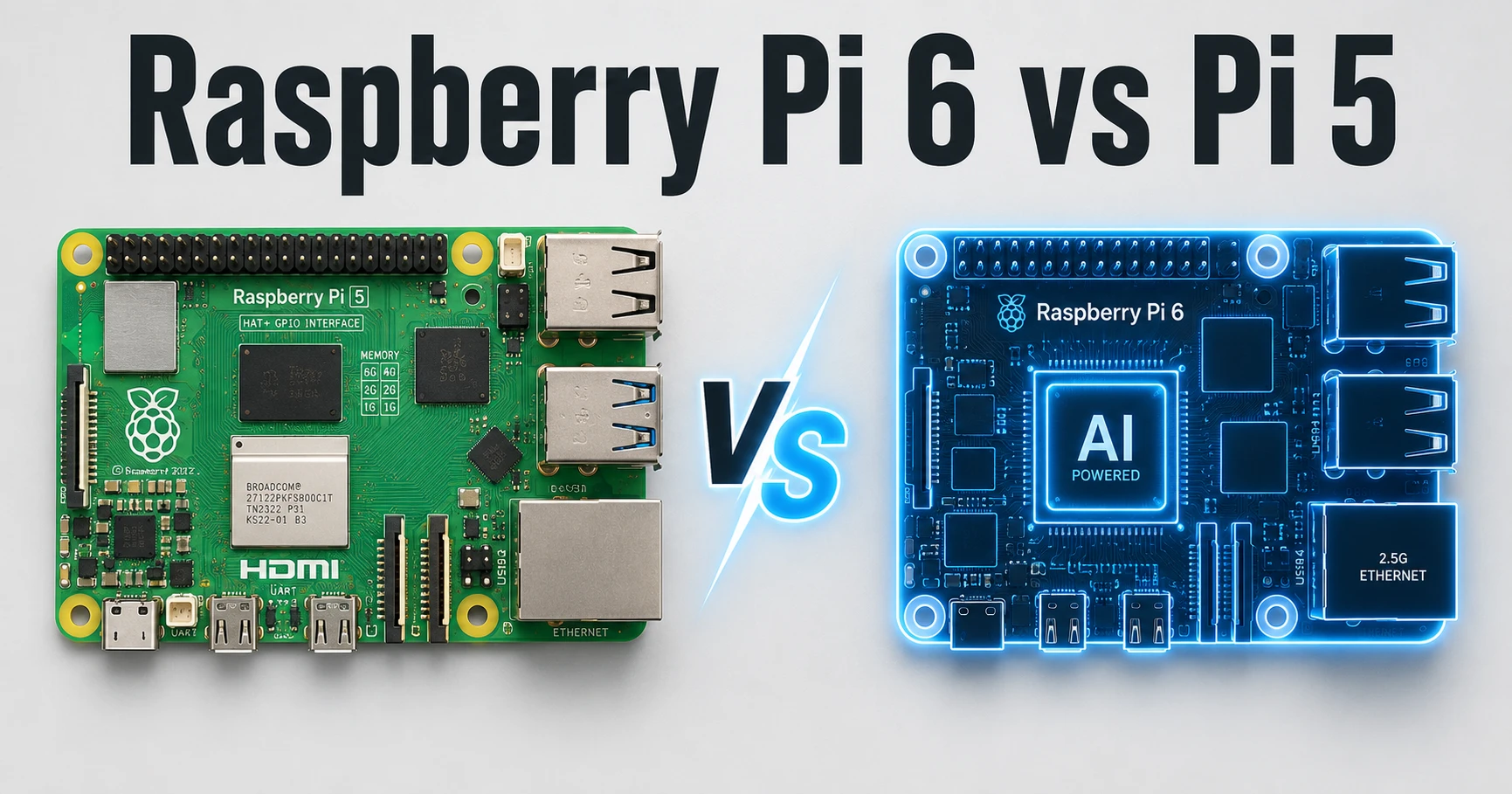
Raspberry Pi 6 is expected in Q4 2026, bringing a native AI neural processing unit, PCIe Gen 3 lanes, and up to 16GB of LPDDR5 RAM — a significant jump over the Pi 5’s 2.4 GHz Cortex-A76 chip and 8GB memory ceiling. No official specs or price have been confirmed by the Raspberry Pi Foundation, but leaked roadmap details and industry analysis paint a clear enough picture to decide whether to buy now or hold off.
| Spec | Raspberry Pi 5 (Current) | Raspberry Pi 6 (Expected) |
|---|---|---|
| CPU | Quad-core ARM Cortex-A76 @ 2.4 GHz | Quad-core ARM Cortex-A78 @ 3.0 GHz (rumored) |
| RAM | 4GB / 8GB LPDDR4X | Up to 16GB LPDDR5 (rumored) |
| AI Accelerator | None (requires AI HAT+) | Native 12 TOPS NPU on-chip (rumored) |
| PCIe | PCIe Gen 2 (1×) | PCIe Gen 3 (4× lanes) (rumored) |
| Storage | microSD + PCIe HAT | Native M.2 NVMe boot (rumored) |
| Wi-Fi | Wi-Fi 5 (802.11ac) | Wi-Fi 6 (rumored) |
| Bluetooth | Bluetooth 5.0 | Bluetooth 5.2 (rumored) |
| USB | 2× USB 3.0, 2× USB 2.0 | Faster USB 3 + USB-C data (rumored) |
| Price (base) | $60 (4GB) / $80 (8GB) | ~$70–$100 estimated |
| Availability | Available now | Expected Q4 2026 |
Pi 6 specs based on industry leaks and roadmap analysis. The Raspberry Pi Foundation has not made any official announcement. Specifications and pricing could change significantly.
Raspberry Pi 5 — The Board That Raised the Bar
The Pi 5, released in October 2023, was a bigger generational leap than any previous Raspberry Pi. The Cortex-A76 CPU delivered roughly 2.2 times the Geekbench 6 score of the Pi 4, according to official Raspberry Pi Foundation benchmarks. It was the first Pi to feel genuinely fast for desktop tasks — web browsing, video playback, light coding — without constant frustration.
The Pi 5 also introduced PCIe Gen 2 via the FPC connector, unlocking NVMe SSD boot through a HAT. That changed the storage equation completely: replacing a microSD card with an NVMe drive cuts boot time from around 20 seconds to under 5. For anyone running a Pi 5 as a home server or retro gaming console, it’s the single highest-impact upgrade available today.
At $60 for the 4GB model and $80 for 8GB, the Pi 5 remains excellent value. For projects you want to ship now, it’s a safe choice.
The One Thing Pi 6 Gets Right That Pi 5 Simply Can’t Match
The native 12 TOPS NPU is the headline upgrade that makes Pi 6 categorically different from its predecessor — not just incrementally faster. Running local AI inference on Pi 5 requires an external AI HAT+ (around $70), which occupies the PCIe slot, adds complexity, and caps performance at 26 TOPS through a separate board.
Pi 6’s integrated NPU changes the calculus for anyone building edge AI applications: robotics with real-time vision, local voice assistants, IoT devices that need on-device inference without cloud dependency. The NPU sits on the same SoC as the CPU, so there’s no PCIe bandwidth bottleneck between compute and inference.
PCIe Gen 3 is the other upgrade that matters for power users. Gen 3 doubles the theoretical bandwidth of Pi 5’s Gen 2 connection. Pair it with an NVMe SSD and native M.2 boot support (rumored to be built into the board rather than requiring a HAT) and Pi 6 starts looking like a genuinely capable mini-PC, not just a hobby board.
The Case for Just Buying a Pi 5 Today
Q4 2026 is the earliest realistic window for Pi 6. Supply constraints have historically delayed Raspberry Pi launches by months — the Pi 4 was chronically out of stock for most of 2021 and 2022, and the Pi 5 faced its own supply squeeze at launch. Even if Pi 6 ships on schedule, you may wait until early 2027 to actually receive one.
The Pi 5’s ecosystem is mature right now. Cases, HATs, OS images, and community support are all dialed in. Pi 6 will inherit most of that eventually, but early adopters will hit rough edges that Pi 5 owners resolved two years ago.
For projects that don’t need AI inference — media centers, retro gaming, basic home servers, learning Linux — the Pi 5’s performance is already more than sufficient. Waiting 6–9 months (minimum) to gain AI NPU capability that you may never use is a poor trade.
Who Should Wait for Pi 6 and Who Shouldn’t
Buy Pi 5 now if: You have a project to build today, you don’t need on-device AI inference, you’re running a server or media center, or you want battle-tested ecosystem support.
Wait for Pi 6 if: Your project requires on-device AI inference (vision, voice, real-time ML), you want native NVMe without a HAT, you’re planning a multi-year deployment and want the latest SoC, or you’re comfortable with a 6–12 month wait for an unconfirmed release.
Frequently Asked Questions
When will Raspberry Pi 6 be released?
Raspberry Pi 6 is expected in Q4 2026 based on the historical four-year release cycle between flagship models (Pi 4 in 2019, Pi 5 in 2023). The Raspberry Pi Foundation has not officially announced Pi 6, its specs, or its release date. Early 2027 is a realistic expectation accounting for typical supply ramp-up.
What CPU will Raspberry Pi 6 use?
Leaked roadmap analysis points to a quad-core ARM Cortex-A78 processor running at approximately 3.0 GHz. This would be a meaningful step up from the Pi 5’s Cortex-A76 at 2.4 GHz, offering better IPC and higher clock speeds. No official confirmation exists.
Will Raspberry Pi 6 have a built-in AI chip?
Rumored specifications indicate a 12 TOPS Neural Processing Unit (NPU) integrated directly on the SoC — eliminating the need for the external AI HAT+ that Pi 5 users require for on-device inference. This would make Pi 6 a much stronger platform for edge AI applications.
How much will Raspberry Pi 6 cost?
No official pricing has been announced. Based on the Pi 5’s pricing ($60 for 4GB, $80 for 8GB) and the expected higher-spec components, analysts estimate the Pi 6 base model will land between $70 and $100. Higher memory configurations could push past $100.
Is Raspberry Pi 5 still worth buying in 2026?
Yes. The Pi 5 is the fastest and most capable Raspberry Pi available today, with a mature ecosystem, wide OS support, and genuine desktop performance. For most projects that don’t require on-device AI inference, it remains the best value single-board computer at its price point.
For more on where AI hardware is heading, read our breakdown of NVIDIA’s Nemotron 3 Ultra launch at Computex 2026 — the hardware acceleration story extends well beyond the Raspberry Pi ecosystem. And if you’re deciding between AI tools for software projects, see our 2026 AI subscription comparison.
Last Updated: June 2026


