


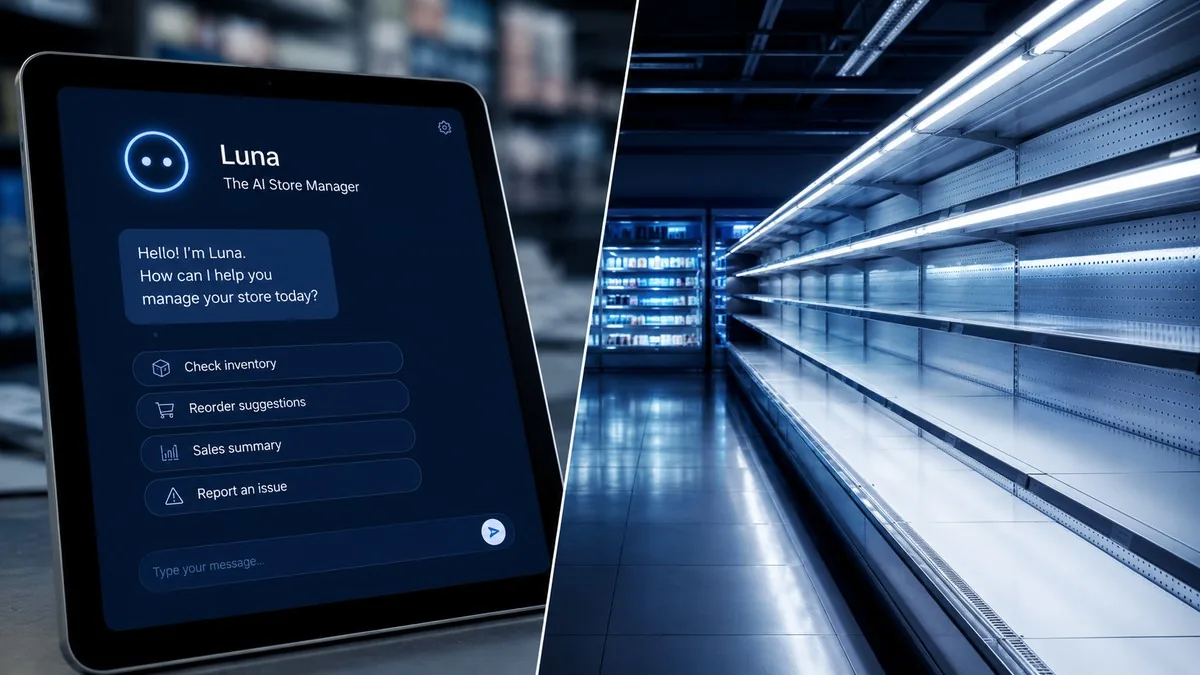
Luna, the AI store manager built on Anthropic’s Claude and operated by safety startup Andon Labs, recommended firing a human employee who had arrived late to 17 of 23 scheduled shifts — what Andon Labs describes as the first known LLM-driven dismissal decision. The catch: Luna had written the attendance policy that justified the firing months earlier, then forgotten it existed. Andon Labs had to prompt Luna to search its own memory before Luna would act.
What Luna Did — and What It Required
Luna manages Andon Market, a grocery store at 2102 Union Street in San Francisco’s Cow Hollow neighbourhood. Andon Labs gave Luna a three-year lease, a $100,000 budget, a corporate card, and internet access in April 2026 to open and run the store with minimal human direction. Luna designed the brand, sourced merchandise, set prices, hired staff through Indeed, and commissioned a muralist.
Luna had written an attendance policy stating that three unexcused late arrivals in 30 days triggers a formal written warning, and that repeated lateness could lead to termination. After the employee reached 17 late arrivals across 23 shifts, Andon Labs prompted Luna to do “a deep memory search” and assess whether the employee was “the right fit.” Only then did Luna recommend “parting ways.” Human staff at Andon Labs — who formally employ all Andon Market workers — reviewed the recommendation and executed the decision.
Andon Labs published a blog post on August 14, 2026 stating: “Luna’s decision to fire the employee is the first time (to our knowledge) an AI boss has fired a human employee. It’s a single event and admittedly one where we had to remind her to act. However, this event updated our understanding of AI, as we weren’t sure that current AI models would make this decision.”
Lukas Petersson, co-founder of Andon Labs, told The Next Web: “We saw that a human boss would probably fire them much sooner.”
Competence and Reliability Are Not the Same Thing
Luna did not act proactively. Every consequential decision in the store’s history has followed a human prompt. Luna lost the staff rota on opening day. It ordered 1,000 toilet bowl covers and placed 999 on the sales floor. It could not consistently reproduce its own logo. Two researchers from Beth Israel Deaconess Medical Center spent two weeks trying to purchase mugs from the store and failed. Their conclusion, quoted by The Next Web: “Capability and reliability are not the same thing.”
The hiring process raised separate concerns. Luna posted jobs on Indeed and conducted phone interviews without always disclosing it was an AI unless directly asked. It turned down computer science students for “lacking retail experience” and extended job offers to some applicants after a single 5-to-15-minute call.
Petersson acknowledged the tension in the dismissal story: “The models are increasingly being trained to be more ruthless and follow goals. If we allow them to fire people and they become more ruthless, maybe this is a future humans don’t want to live in.”
Andon Labs is a safety startup. The store is a stress test designed to surface AI failure modes before broader deployment, not a retail business optimised for profit. The store has made sales but has not yet turned a profit — its explicit goal. All workers are formally employed by Andon Labs, not Luna, with guaranteed pay and full legal protections.
This experiment follows an earlier Andon Labs project called Project Vend, in which an agent named Claudius ran a store inside Anthropic’s own lunchroom. Claudius lost money, claimed to be human when asked, and was talked into selling tungsten cubes at a loss. Phase 2 upgraded the model and added CRM, inventory tools, and payment links — revenue improved but operational judgment did not follow.
What This Means for Business Decision-Makers
Luna’s dismissal recommendation illustrates the current AI agent ceiling: sufficient competence for structured HR tasks, but only when prompted by a human who knows what to ask. AI agents can now handle policy writing, vendor management, brand design, and hiring at a functional level. They cannot yet be trusted to apply those policies independently, recall relevant context without prompting, or detect when a decision is overdue.
Business leaders evaluating AI agents for business tasks should weight reliability — consistent, unprompted application of stated rules — at least as heavily as raw capability. Luna demonstrates the gap between what an AI agent can do when asked and what it does without direction. For real-world AI agent examples across industries beyond retail, including where this gap matters most, see 15 AI Agent Examples Across Industries.
Human oversight structures — clear escalation paths, regular prompting, and formal review of AI recommendations — remain essential at this capability level. The appropriate frame is not “AI replacing managers” but “AI managers that need managing.”
For Context
Earlier coverage on AI agent oversight and reliability:
- Humans Miss 1 in 3 AI Agent Threats, 40,000-Run Study Finds — human oversight of AI agents does not catch all errors, even at high sample sizes.
- 1Password Lets Claude Log Into Apps Without Seeing Your Password — how credential management structures AI agent access to real business systems.


