


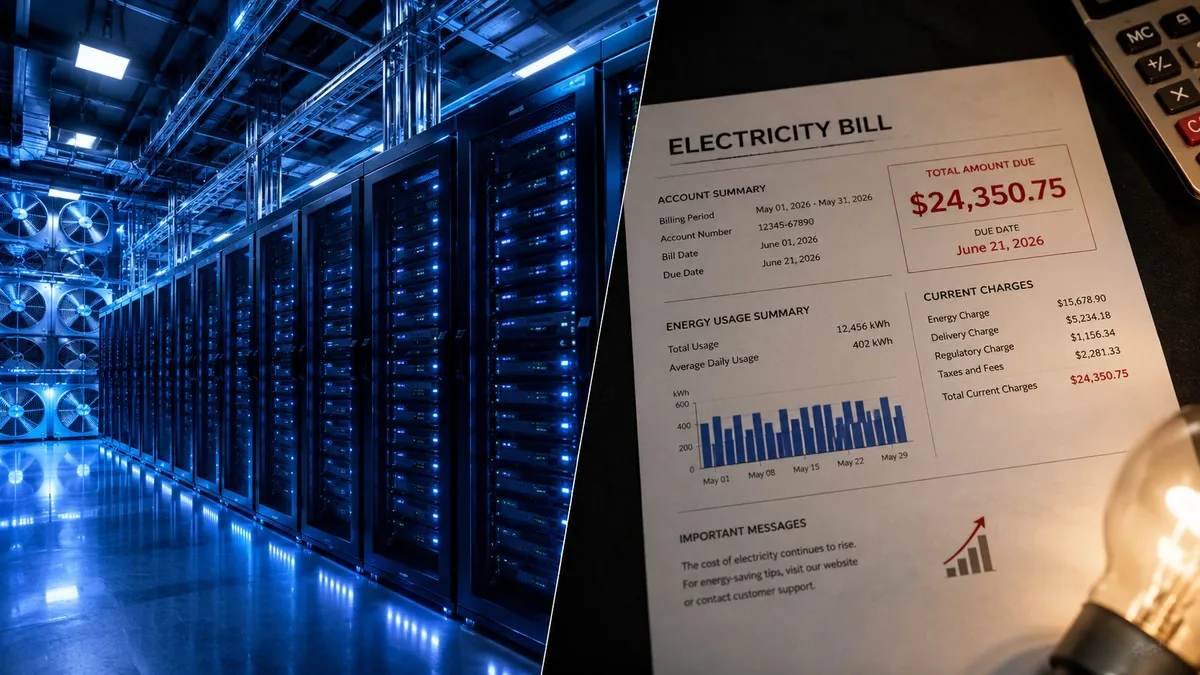
A PJM market monitoring report published July 14, 2026, found that AI data center demand has caused $23 billion in electricity price increases across 14 US states — and the higher prices will persist through at least the end of 2028, according to Fortune.
The PJM Interconnection is the largest wholesale electricity market in the United States, covering Pennsylvania, New Jersey, Maryland, Delaware, Ohio, Indiana, Illinois, Virginia, West Virginia, Kentucky, North Carolina, Tennessee, Michigan, and Washington DC. PJM’s independent market monitor attributed the surge directly to the rapid buildout of AI data center capacity concentrated in those states. The $23 billion is not a projected future risk — it is already embedded in ratepayer bills, with no relief expected until at least 2029.
What Is the $23 Billion Electricity Cost Increase?
The $23 billion figure represents the cumulative increase in electricity costs charged to customers across the PJM market due to data center-driven demand growth. According to Fortune’s reporting on the PJM market monitor’s findings, the mechanism is straightforward: AI data centers are large, continuous power consumers that require expensive new transmission capacity to serve. That capital cost is socialized across all ratepayers — residential, commercial, and small business — rather than billed to the data centers themselves.
PJM covers approximately 65 million Americans. Even distributed across a population that size, a $23 billion increase compounds to a measurable and sustained rise in monthly electricity bills — before any additional data center expansion planned for 2026–2028 is factored in.
Which States Face the Largest Increases?
The 14 states in the PJM footprint are not equally exposed. Virginia, which hosts the highest concentration of hyperscale data centers in the US (often called “data center alley”), carries disproportionate grid load. According to a May 2026 Fortune analysis of broader regional trends, some states within the PJM region could see electricity cost increases of 50% or more by 2030 if AI data center construction continues at its current pace.
Microsoft, Google, Amazon, and Meta have each announced multi-hundred-billion dollar data center expansion programs for 2025–2026, with significant portions of that capacity sited in PJM-territory states. Each new large AI training cluster draws as much power as a small city, and clusters are now being built and activated on 12–18 month cycles.
Why Can’t Data Centers Be Made to Pay Their Share?
Making data centers absorb their fair share of the grid costs they generate may be “almost impossible” under current utility rate frameworks, according to analysis published in The Conversation. The structural problem is how data centers are classified in state utility proceedings.
Data centers qualify as industrial users, which entitles them to long-term power purchase agreements at wholesale or near-wholesale rates. The transmission infrastructure, new generation capacity, and grid upgrades required to serve them are recovered through general rate cases — a process regulated by state Public Utility Commissions (PUCs) that typically runs on 1–3 year cycles. By the time a PUC approves a rate increase to recover new data center-driven infrastructure costs, the next wave of capacity is already under construction and the cycle begins again.
The White House announced expanded pledges to address AI power costs in July 2026, per TechTimes — though specific policy commitments were not detailed in the announcements reviewed for this article.
What Does This Mean for Businesses Using AI Tools?
The electricity cost surge is the direct, quantified infrastructure cost of the same data center buildout that has made AI tools for business faster and more capable since 2024. The hyperscalers running AI inference at scale are not absorbing those infrastructure costs in their own margins — utility rate structures ensure those costs flow to residential and small business electricity customers instead.
No AI platform pricing page currently reflects the electricity subsidy embedded in US rate structures. Whether that changes through regulation, litigation by state attorneys general, or federal policy reform will directly affect the long-run cost trajectory of AI services and the competitive position of US-based AI providers versus those operating in markets with different energy policy frameworks.
For business decision-makers evaluating AI platforms over a multi-year horizon, the policy risk around data center energy costs is now a documented factor — not a speculative one.
Our Take
PJM’s $23 billion figure does something that years of “AI energy demand” coverage failed to do: it quantifies who is actually paying. Data center operators are extracting a subsidy from 65 million electricity customers that does not appear on any AI vendor invoice. The utility rate framework that makes this possible was designed for 20th-century industrial users, not for infrastructure that can double its grid footprint in 18 months. Regulators are moving in years; the buildout is moving in quarters. The mismatch will not resolve itself.
For Context
AI infrastructure investment has accelerated sharply in 2026. Anthropic secured $35 billion in compute financing from Apollo and Blackstone in June 2026 — one of the largest single compute infrastructure deals ever announced — to expand the data center capacity supporting its Claude model family. That deal is one of dozens that collectively explain why PJM’s market monitor is now tracking a $23 billion demand-driven cost increase with no end date before 2028.
Sources: Fortune — July 14, 2026 | TechTimes — July 14, 2026 | The Conversation


