



Nearly 153,000 tech workers have lost jobs in 2026 — more than half the total from all of 2025. Companies from Oracle to Block cite AI as the reason. The August 2026 picture adds a sharper lens: customer service functions are being hit hardest, with Microsoft, Uber, and Commonwealth Bank all reporting significant CS workforce reductions in the past 30 days. Forrester now projects 49% of current customer service jobs will disappear by 2030.

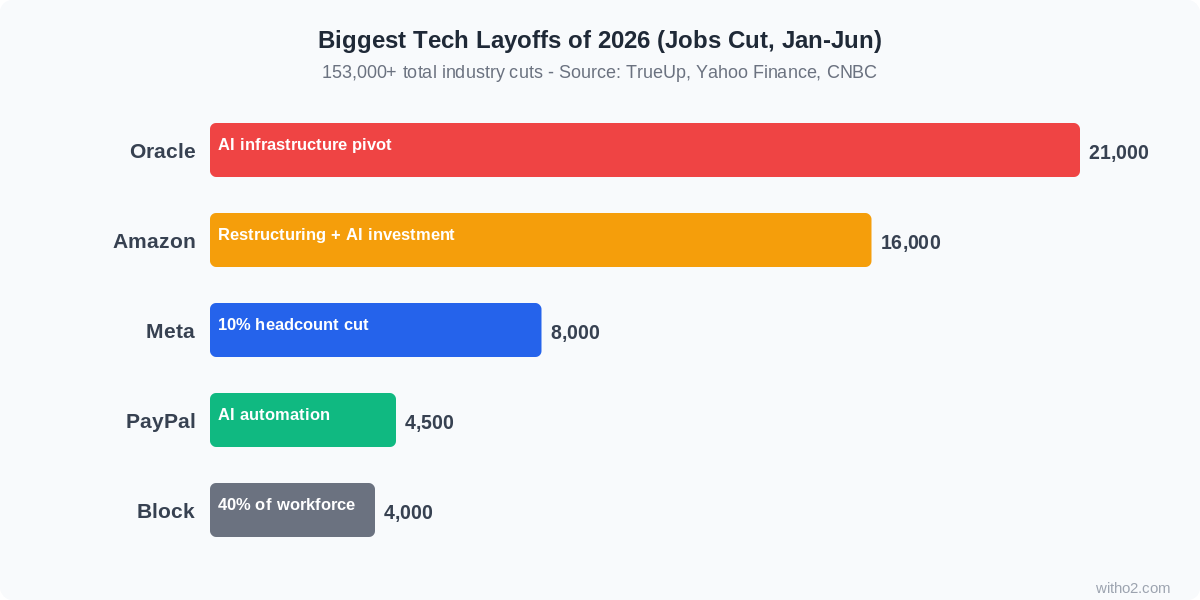
The layoff count crossed 150,000 in mid-June, according to the TrueUp tracker — faster than the pace that produced 245,000 cuts across all of 2025. Yahoo Finance’s running tracker puts the current figure at 153,000+, with Oracle, Amazon, Meta, PayPal, and Block accounting for the largest individual events.
Goldman Sachs estimates that AI-attributed payroll reductions across major U.S. employers are running at more than 16,000 per month in 2026. AI was explicitly cited as the driver in at least 20% of all Q1 reductions — and the percentage is rising, not falling.
August 2026 Update: Customer Service Is Ground Zero
New data published August 4, 2026 by Ghacks puts a specific number on what AI is doing to customer service specifically. Three major employers reported CS-specific cuts in the past month:
- Microsoft reduced its support workforce from approximately 50,000 to 40,000 — a 20% reduction it attributes to AI efficiency, saving an estimated $750 million per year (per Judson Althoff, April 2026)
- Uber cut its customer service workforce by 10%, with AI now routing all inbound requests before any human touches them
- Commonwealth Bank (Australia) eliminated hundreds of chat support positions, saving tens of millions per year
- Brinks Home reduced its call center from 800 to 400 agents after AI cut call volume by two-thirds
These cuts aren’t happening in isolation. Across industries, companies are reporting how much of their CS load AI now handles: 96% at Anthropic, 90% at Heathrow, 80% at TeamSystem, 68% at Rocket Money. Hyatt has cut 30% of its in-house guest services staff and relies on Sierra AI (founded by Bret Taylor) to handle the volume. When AI handles 90%+ of inquiries, the business case for a large human CS team collapses.
Forrester analysts Kate Leggett and Laura Ramos, in a May 20, 2026 report, projected that 49% of current customer service jobs will disappear by 2030. That is a structural forecast, not a cyclical one — and the August 2026 data suggests the timeline may compress further as more organizations report AI crossing the 80–90% automation threshold.
What the Companies Actually Said — and What They Didn’t
Block CEO Jack Dorsey was unusually direct. When he eliminated 4,000 jobs — 40% of the company’s workforce — he cited “the growing capability of AI tools to perform a wider range of tasks.” That’s a rare public attribution. Most companies describe their reductions as “restructuring toward AI priorities” rather than replacement.
Salesforce’s cuts tell the sharper story. The company laid off over 4,000 customer support staff in 2025 after deploying its Agentforce AI platform, with CEO Marc Benioff saying he needed “less heads.” In 2026, smaller follow-on cuts hit marketing, data analytics, and the Agentforce team itself — the tool that replaced the workers now requiring fewer people to maintain it.
Oracle cut approximately 21,000 positions as it pivoted toward AI infrastructure and cloud data centers. The company simultaneously announced it was hiring aggressively for AI engineering roles. The net headcount movement was down. The skill profile of who it needs shifted dramatically.
$700 Billion Going In, 153,000 Jobs Going Out
The paradox that makes 2026 different from 2023’s layoff wave: the companies cutting jobs are thriving financially. Four hyperscalers — Microsoft, Google, Amazon, and Meta — committed to a combined $700 billion in AI capital expenditure for 2026 alone. These are not companies in distress. They are companies reallocating.
The impact of generative AI on developer roles is playing out in real time: fewer people needed to maintain systems, but higher skill requirements for those who remain. Goldman Sachs’s figure — 16,000 AI-attributed cuts per month — represents a structural shift, not a cyclical downturn.
The category hit hardest isn’t software engineering. It’s support, analytics, content moderation, and mid-tier product management — roles where AI tools have crossed the threshold from “assistant” to “replacement.”
The Number That Makes This Different From 2023
In 2022–2023, tech layoffs were driven by interest rate shock: companies over-hired during zero-rate COVID-era growth and then corrected. Salesforce’s 2023 cuts fell into this category — the company had grown too fast and needed to right-size.
The 2026 wave is structurally different. The companies cutting jobs are not in financial trouble. They are profitable, often more profitable than before. The cuts are concentrated in specific function types — the ones where AI tools have become demonstrably more cost-effective than human labor.
That distinction matters for the policy debate. Retraining programs designed for cyclical unemployment don’t address structural displacement. The skills that got people into their current roles may not be the skills that get them into the roles being created on the other side of this transition.
AI’s impact on employment remains actively debated among economists. But the 2026 data is shifting the conversation from “will AI replace jobs?” to “at what rate, and in which functions, and what are companies obligated to do about it?”
Frequently Asked Questions
How many tech jobs have been cut in 2026?
The TrueUp tracker puts 2026 tech layoffs above 153,000 as of late June, with some projections suggesting the full-year total could reach 370,000. Oracle, Amazon, Meta, PayPal, and Block have announced the largest individual reduction events. AI was explicitly cited as a driver in at least 20% of Q1 2026 reductions. Customer service functions are the fastest-growing category of cuts in the August 2026 wave.
Is AI actually replacing tech workers in 2026?
AI is a confirmed driver in a significant portion of 2026 layoffs, particularly in customer support, content moderation, data analytics, and mid-tier product management. Goldman Sachs estimates AI-attributed cuts are running at over 16,000 per month in the U.S. Forrester projects 49% of CS jobs will be gone by 2030. Companies like Anthropic (96%), Heathrow (90%), and Rocket Money (68%) report AI handling the majority of customer inquiries, making large human CS teams economically difficult to justify.
Which companies have cut the most jobs in 2026?
Oracle leads with approximately 21,000 cuts tied to its AI infrastructure pivot. Amazon cut 16,000 positions, Meta reduced headcount by 8,000 (around 10% of its workforce), PayPal announced 4,500+ cuts, and Block eliminated 4,000 jobs — 40% of its workforce — with CEO Jack Dorsey explicitly attributing the decision to AI capability gains. In August 2026, Microsoft cut 10,000 from its support function (50,000 → 40,000), and Uber cut 10% of its CS team.
How is the 2026 tech layoff wave different from 2023?
The 2022–2023 layoff wave was driven by interest rate shock and over-hiring during the COVID era. Companies were cutting to survive. The 2026 wave involves mostly profitable, financially healthy companies reallocating resources toward AI infrastructure. They are not cutting to survive; they are cutting to optimize while investing heavily in AI.
What types of tech jobs are most at risk from AI in 2026?
The roles experiencing the highest displacement in 2026 are customer support, data analytics, content moderation, and mid-tier product management — functions where AI tools have crossed a cost-effectiveness threshold. Forrester projects 49% of CS jobs gone by 2030. Software engineering is less affected overall, though junior and mid-level coding roles are under growing pressure from AI coding tools.
The 153,000 figure will keep rising. The harder question isn’t whether AI is a factor — the data on that is increasingly clear — but what companies and policymakers are prepared to do about a displacement pattern that doesn’t fit the retraining playbooks designed for cyclical unemployment.
Updated: August 5, 2026. Originally published June 2026.


