


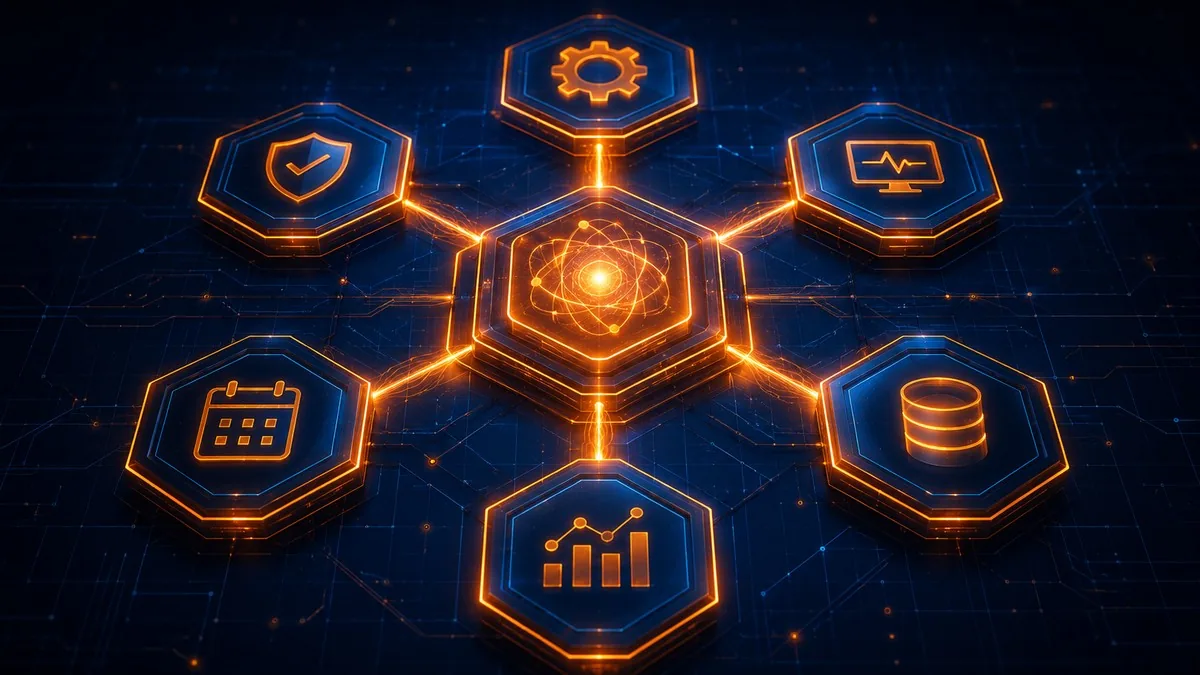
Alibaba Cloud announced Agent-Native Cloud at the World Artificial Intelligence Conference (WAIC) in Shanghai on July 18, 2026 — a managed platform for building, deploying, and governing fleets of autonomous AI agents at enterprise scale. The suite adds two new products, AgentTeams and AgentLoop, to its existing AgentRun platform, giving enterprise teams a full-stack environment to coordinate multiple agents, trace their decisions, and control inference costs.
What Is Alibaba Cloud’s Agent-Native Cloud?
Agent-Native Cloud is a managed cloud environment designed for enterprises that need to run multiple AI agents as coordinated teams, not as isolated API calls. The platform bundles three components, each covering a distinct stage of the agent lifecycle:
- AgentRun — the existing platform foundation — handles development, deployment, and operations for individual AI agents.
- AgentLoop — new at WAIC 2026 — provides real-time tracing, evaluation, and optimization of agent performance after every run.
- AgentTeams — also new — provides coordination and governance across multiple specialized agents, defining which agent can call which API and which actions require human approval before execution.
The “agent-native” framing marks a deliberate architectural positioning: Alibaba Cloud is describing its infrastructure as purpose-built for autonomous agent fleets, not as a general-purpose cloud with AI APIs added. The announcement targets the governance gap that has slowed enterprise adoption of AI agents — organizations require observability and approval controls before they can deploy agents in production workflows.
AgentTeams and AgentLoop: The Coordination and Observability Stack
AgentTeams addresses the multi-agent coordination problem. When a complex workflow requires a scheduling agent, a data-retrieval agent, and an approval agent to hand off tasks between them, AgentTeams defines the coordination rules and enforces governance boundaries — specifying which agents have which permissions and which transitions require human sign-off.
AgentLoop provides the monitoring layer: after each agent run, it surfaces what the agent did, what the run cost in tokens, and which steps are candidates for optimization. The two products work as a pair — observability (AgentLoop) shows whether agents are behaving correctly; governance (AgentTeams) enforces the constraints that make correctness verifiable at scale.
Enterprises evaluating the best AI agents for business have consistently cited these two capabilities — monitoring and governance — as the prerequisites for moving from pilot to production deployment.
TokenWorks Cuts Inference Cost; T-Head SAIL Adds Infrastructure Transparency
Alibaba Cloud also announced TokenWorks, an inference efficiency system within its PAI-EAS platform. TokenWorks integrates request routing, inference execution, compute reuse, and scheduling into a single system to reduce the per-token cost of running large-model workloads at agent-fleet scale.
The company open-sourced T-Head SAIL, its AI software stack optimized for Alibaba’s Zhenwu chips. SAIL spans operating-system support, SDKs, and interfaces, and is compatible with mainstream AI ecosystems. As of April 2026, Alibaba Cloud had shipped 560,000 Zhenwu chips to more than 400 customers across 20 industries. Open-sourcing SAIL gives enterprises access to the infrastructure layer’s source, which addresses a recurring concern about verifiability when running sensitive workloads on third-party AI infrastructure.
Alibaba also launched a team version of its Meoo platform at the same event, with centralized billing, credit allocation, shared assets, and off-peak pricing that reduces token costs to as low as 20 percent of standard rates.
What This Means for Enterprise AI Agent Decisions
Agent-Native Cloud is the first integrated stack from a major cloud provider to combine lifecycle management (AgentRun), real-time observability (AgentLoop), and multi-agent governance (AgentTeams) in a single managed environment. AWS, Google Cloud, and Microsoft Azure offer agent SDKs and model APIs but have not announced a comparable integrated governance layer as of July 2026.
For enterprises outside China evaluating AI tools for business, the practical question is whether Alibaba Cloud’s agent infrastructure is available in their required regions and whether its compliance posture — including data residency and the open-sourced SAIL stack — satisfies their security requirements.
The architectural model Alibaba is shipping — coordination layer plus real-time observability plus cost scheduler — is the right answer to the enterprise agent governance problem, regardless of vendor. Whether AWS, Azure, or Google build comparable integrated stacks is the category question for the next 12 months.
For Context: Alibaba announced a second major product at WAIC 2026: Qwen 3.8-Max-Preview, a 2.4-trillion-parameter model the company says ranks second only to Claude Fable 5 in its internal tests. That announcement is covered separately: Qwen 3.8-Max-Preview: Alibaba’s 2.4T Parameter Model.
Our Take: Alibaba Cloud answered the enterprise AI agent governance question that AWS and Azure have not yet addressed cleanly. AgentLoop plus AgentTeams forms a coordination and observability stack that converts “we have an AI agent” into “we have a fleet we can actually manage, audit, and control.” Western enterprises evaluating agent infrastructure should track whether this integrated governance model — and the architectural pattern it represents — arrives from their preferred cloud vendors, because the pattern itself is correct.


