


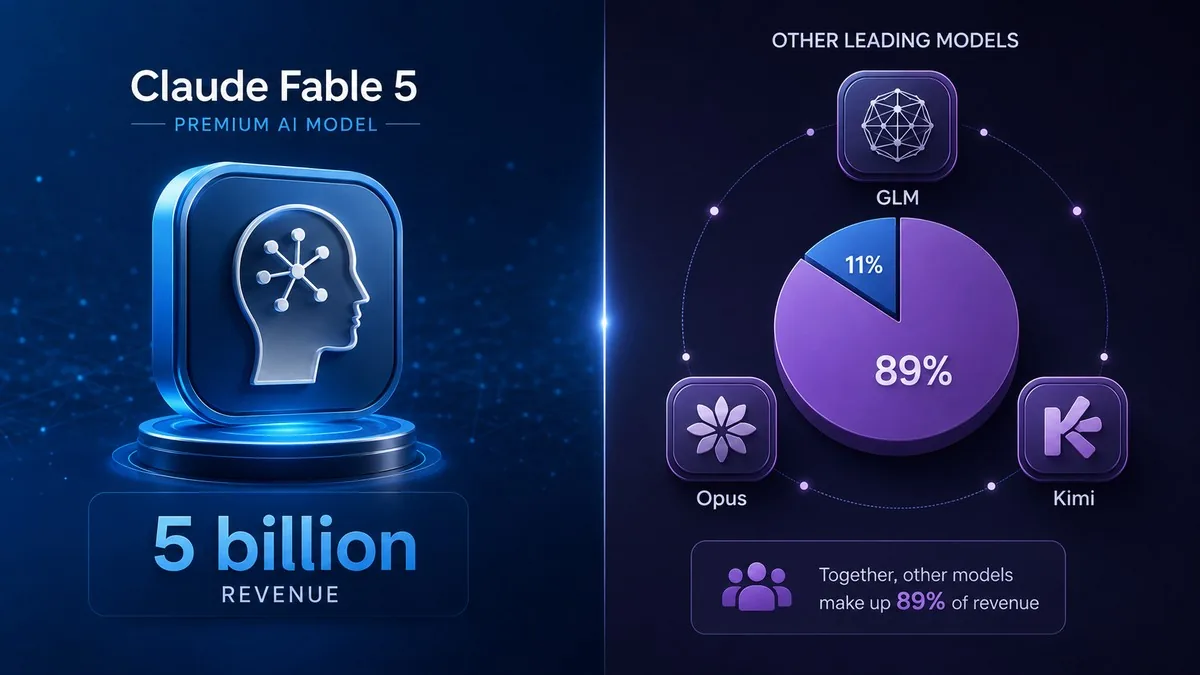
Anthropic’s annualized revenue reached $65 billion at the end of July 2026 — up sevenfold from $9 billion at the end of 2025 — yet its flagship Claude Fable 5 model accounts for only about 11 percent of enterprise Anthropic spend more than two months after launch, according to a Financial Times report cited by Hacker News readers on August 24.
Q3 2026 preliminary revenue exceeded $11.5 billion, compared with $787 million in the same quarter of 2025, per CNBC. Anthropic investors are projecting an annualized run rate of $100 billion to $120 billion by the end of 2026, according to Axios. The company is growing at record speed — but that growth is being driven by cheaper tiers and competing models, not by Fable 5 adoption.
Why Enterprises Are Skipping Fable 5
Claude Fable 5 costs $10 per million input tokens and $50 per million output tokens. Claude Opus 4.8, Anthropic’s previous flagship, costs $5 per million input tokens and $25 per million output tokens — roughly half. Claude Sonnet 5 runs at $3 input and $15 output per million tokens. GLM 5.2, a competing model, is roughly one-ninth the cost of Fable 5 for equivalent throughput, according to analyst Drew Breunig writing on dbreunig.com on August 23, 2026.
Breunig, a developer and independent analyst who tracks AI adoption, described the pricing decision businesses are making in straightforward terms:
“But the cost was so high and Opus was good enough (as was 5.6, K3, and even GLM) for most of the code we needed. So we started to think about what work went where.” — Drew Breunig, dbreunig.com, August 23, 2026
Grok 4.5 uses three to four times fewer tokens per completed task than Fable 5 for certain coding workloads, according to benchmarks cited by Emergent.sh. For enterprises running thousands of automation tasks per day, that token efficiency gap translates directly into monthly cost differences of tens of thousands of dollars.
The End of the AI “Free Lunch”
Since 2020, AI model costs fell fast enough that enterprises rarely needed to optimize — each new quarter brought a model that was both better and cheaper. Fable 5 broke that pattern. It is dramatically more capable than Opus 4.8 and Sonnet 5, but also dramatically more expensive, which forces businesses to decide which tasks genuinely require top-tier reasoning and which do not.
Breunig described the structural shift this way:
“Fable’s access controls, dynamic degradation, and required data retention spooked enough companies (and countries!) into thinking about where they send their traces and where they get their tokens.” — Drew Breunig, dbreunig.com, August 23, 2026
Fable 5’s data retention requirements and access control policies raised compliance concerns with enterprise legal and security teams, particularly for companies operating under EU data-sovereignty rules or in regulated industries. The model’s capabilities are not in question — its governance requirements are.
What This Means for Businesses Choosing AI Tools
The Fable 5 adoption paradox reflects a structural shift in how enterprises buy AI. Rather than committing to a single premium model, businesses now run model portfolios — assigning Claude Fable 5 to tasks that require its reasoning depth, Opus 4.8 or Sonnet 5 to standard automation workflows, and GLM 5.2 or Kimi K3 to high-volume rote coding and data processing.
Anthropic’s $65 billion revenue milestone proves the model: diversified enterprise AI spend creates a larger overall market, even if no single model captures the majority of that spend. This is the same pattern seen when cloud computing moved from single-provider commitments to multi-cloud deployments.
For business decision-makers evaluating AI tools, the Fable 5 pricing structure makes the task-routing question unavoidable: which workflows justify $50 per million output tokens, and which can run on a $15 or $5.50 alternative? The answer to that question is now a budget line item, not a preference.
For a full comparison of models suited to different business tasks, see the site’s guide to the 15 best AI tools for business in 2026, which covers cost-per-task benchmarks across the leading models. Enterprises evaluating agent deployments specifically will find context in the guide to the 12 best AI agents for business tasks, which covers how multi-agent setups distribute workloads across models by complexity.
For Context: Anthropic’s 2026 Milestones
Anthropic’s annualized revenue trajectory in 2026: $9 billion at end-2025, $47 billion in May 2026, and $65 billion at end of July 2026. Claude Fable 5 launched in June 2026 as the company’s most capable model to date. The FT report on enterprise spend distribution appeared on August 24, 2026, and reached the top of Hacker News with a score of 576 — the highest score of any AI business story that week.


