


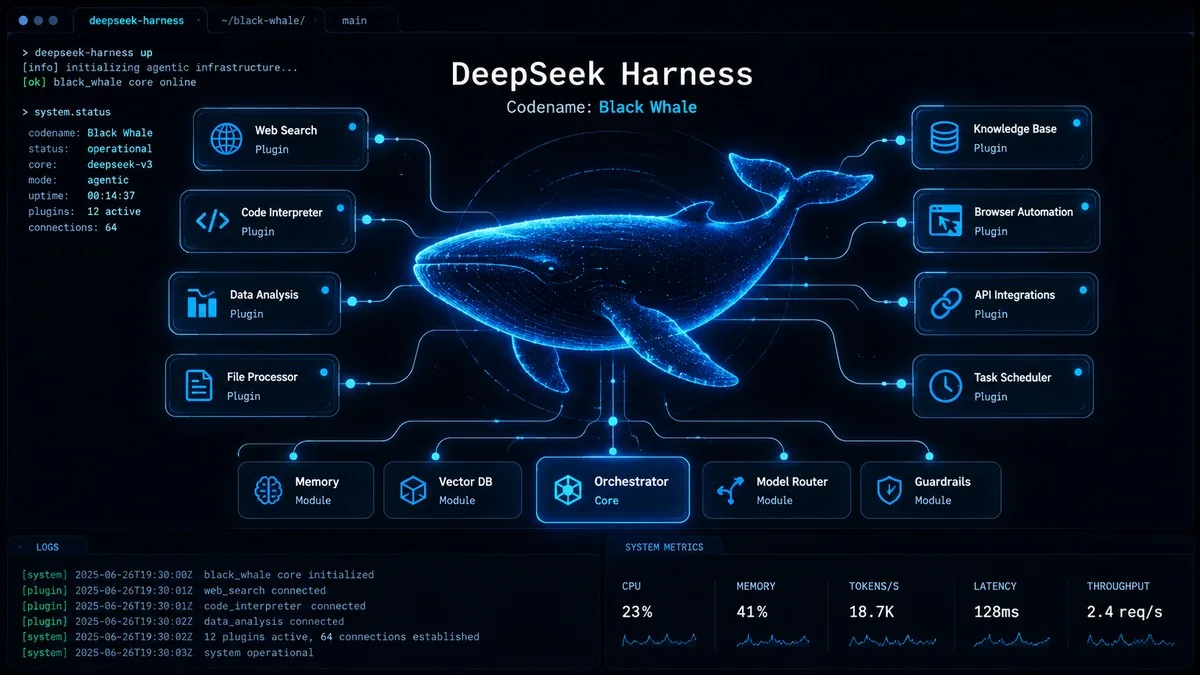
DeepSeek released Harness v0.1 on August 13, 2026, an MIT-licensed open-source AI agent runtime designed to sit between a large language model and the tools, files, and environments an agent needs to complete multi-step tasks. The release, codenamed “Black Whale,” is an explicit developer preview that frames Harness as a modular, self-hostable alternative to closed coding-agent environments like Claude Code.
The launch landed on the same day as the general availability of DeepSeek V4-Pro on the API. Harness drew 608 points and 261 comments on Hacker News by August 14, making it one of the top developer discussions of the week.
What “Everything Is a Plugin” Means in Practice
Harness is built around a single architectural principle: every component of an AI agent system is a swappable plugin. Models, tools, skills, sessions, sandboxes, storage, loops, scheduling, and the UI each slot in as independent modules with no change to the surrounding system.
The design has a direct implication for businesses evaluating vendor lock-in: a team running DeepSeek V4-Pro as the underlying model can, in principle, swap to Gemini 3.7 Flash or any other API-accessible model at the model plugin layer without rewriting the agent orchestration logic. Harness is designed specifically to transform DeepSeek V4 series models into autonomous coding agents capable of multi-step workflows and tool use, according to Cryptobriefing’s coverage of the release.
The MIT license and self-hosting architecture also open an alternative to routing code or sensitive workflows through Anthropic’s or OpenAI’s US-based cloud API — relevant for businesses with data residency requirements or vendor-independence mandates. For a view of how self-hosted agent runtimes fit real business operations, see AI agent examples across industries.
What Harness v0.1 Offers — and What It Cannot Yet Deliver
Harness v0.1 is a developer preview carrying a single explicit warning from the DeepSeek repository: “THERE WILL BE COMPATIBILITY-BREAKING CHANGES.” This is not a production-ready release. Businesses reviewing it for deployment should treat Harness as a technology-watch item, not a migration decision.
What the v0.1 release does not include: no published benchmarks against Claude Code on coding task completion, no enterprise support tier or SLA, and no confirmed compatibility with non-DeepSeek models beyond the V4 series. Compute costs are not covered by the MIT license — the runtime is free; the underlying model API costs are not.
What the release does establish: DeepSeek is shipping a coherent vertical stack. DeepSeek V4-Flash and V4-Pro serve as the model layer; Harness provides the agent runtime layer. Together, they give cost-sensitive teams a path toward a self-hosted AI agent workflow that does not require a US cloud API contract at the foundation.
Where Harness Sits in the Open-Source Agent Market
Harness enters a market that already has modular open-source agent frameworks. YC released the QM agent harness earlier this year, targeting company-wide workflow orchestration. The two frameworks address different layers: QM targets orchestration across teams and business processes; Harness targets the coding-agent and tool-use runtime infrastructure beneath that level. They are not direct substitutes.
Both releases reflect the same market direction: the runtime and orchestration layer of AI agents is becoming open-source commodity software rather than a proprietary moat. Closed alternatives such as Claude Code compete on model integration quality and stability, not on runtime openness. For a benchmark-based comparison of AI agents suited to business task automation, see our guide to the best AI agents for business tasks.
The broader pattern — lower-cost models combined with free open-source agent infrastructure — is also visible in AI agent infrastructure cost reduction, a category that has seen multiple releases in Q3 2026.
For Context: DeepSeek and AI Agent Coverage on WithO2
- DeepSeek V4-Flash benchmark results — the model that anchors the Harness runtime and what its agent scores mean for production use.
- YC’s QM agent harness — the open-source company-wide orchestration framework released earlier this year, and how it compares to Harness.
- AI agent infrastructure costs — Cloudflare Kitesurf’s approach to reducing agent runtime costs, a parallel development from the same Q3 2026 window.
DeepSeek is assembling a complete vertical stack from the bottom up: the cheapest near-frontier API model (V4-Pro) paired with a free open-source agent runtime (Harness). The plugin-first architecture is genuinely useful for teams that need vendor independence in their AI automation infrastructure — the model swap capability alone is worth evaluating. The gap is production readiness: a v0.1 preview with explicit breaking-change warnings is a stake in the ground, not infrastructure you deploy. Watch Harness through its first stable release; do not build production agent workflows on it today.


