


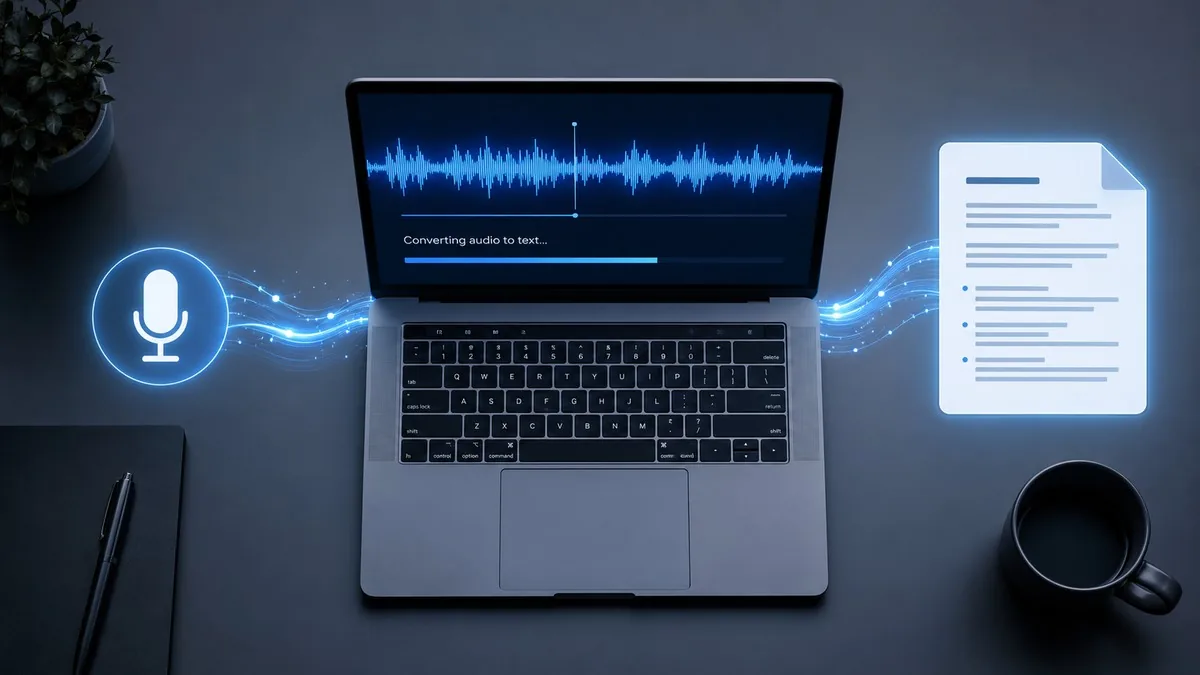
Google DeepMind launched Gemini 3.5 Transcribe on August 26, 2026 — a speech-to-text model that achieves 2.6% Word Error Rate (WER) for non-streaming transcription, supports 85 or more languages with automatic detection, and converts unstructured speech into formatted text by removing filler words and handling self-corrections.
What Gemini 3.5 Transcribe Does
Gemini 3.5 Transcribe is Google DeepMind’s most precise speech recognition model to date. It transcribes spoken audio with a 4% average WER in streaming mode and 2.6% WER in non-streaming mode, according to Google’s official announcement authored by Diego Melendo Casado and Luke Leonhard of Google DeepMind. Time to final transcription is 70% faster than its predecessor Chirp 3, per reporting by 9to5Google covering the August 26 launch.
The model goes beyond converting audio to text. Gemini 3.5 Transcribe removes filler words such as “um” and “uh,” auto-formats rambling speech into structured paragraphs, and handles mid-speech self-corrections — treating the revised statement as the intended output rather than transcribing both versions. These capabilities make it directly applicable to business workflows such as meeting notes, customer call summaries, and voice-to-document drafting.
Where It Is Available Now
Gemini 3.5 Transcribe is available to developers through the Gemini API as of the August 26 launch date, listed in the Gemini API changelog at ai.google.dev. The model is already powering Gboard Rambler — a Google Pixel feature that converts natural speech directly into clean, formatted notes — which signals the model is production-tested at consumer scale.
Google has stated the model is coming to Chrome, Search Live, Gemini Live, Google Docs, Keep, and Gmail, though specific availability dates for each surface have not been announced. For organizations using Google Workspace, access through Docs and Gmail would mean no additional integration is required to use the transcription capabilities in existing document and email workflows.
How It Compares to Existing Speech-to-Text Options
Speech-to-text is a competitive market that includes OpenAI Whisper (a widely used open-source baseline), AssemblyAI, and Deepgram, among the options businesses evaluating best AI tools for business currently consider. Whisper converts audio to text accurately but does not remove filler words or auto-format output without additional post-processing steps. AssemblyAI and Deepgram both offer filler-word removal and formatting via paid APIs.
Gemini 3.5 Transcribe combines those formatting capabilities with a 2.6% WER benchmark and Google’s API pricing. No direct WER comparison against Whisper or competitors has been published by Google.
What This Means for Business Productivity
For companies running call center analytics, meeting transcription, or voice command interfaces, the combination of low error rate and built-in formatting reduces post-processing overhead. Standard speech-to-text outputs require a second pass to clean up filler words and restructure sentences before the text is usable in documents or CRM systems. Gemini 3.5 Transcribe does that work at the model layer.
Google Workspace organizations gain the clearest near-term benefit: when the Docs and Gmail integration ships, transcription inside those tools will improve without configuration changes. Teams already comparing the best AI subscription for 2026 between Google, OpenAI, and Anthropic gain another differentiator in Google’s productivity stack through native transcription capability.
For Context
Google’s Gemini model family has expanded rapidly across modalities in 2026, with each release targeting specific workflow gaps rather than general-purpose upgrades. Gemini 3.5 Transcribe follows the same pattern: purpose-built for audio-to-structured-text conversion across business and consumer applications rather than as a general reasoning upgrade.
Our Take
Gemini 3.5 Transcribe is the first transcription model that acts on what a speaker intended, not only what was said. For businesses already paying for Google Workspace, this may make third-party speech-to-text vendors redundant for standard meeting and document workflows once the Docs and Gmail integrations ship. Teams that have avoided voice-to-text workflows due to cleanup overhead have a concrete reason to re-evaluate that decision now.


