



Google released Gemma 4 12B on June 3, 2026 — a 12-billion-parameter multimodal model that processes text, images, video, and audio natively, and runs entirely on a consumer laptop with 16GB of RAM. It’s free, open-source under Apache 2.0, and available now on Hugging Face and Kaggle. For developers who’ve been locked out of capable multimodal AI by hardware requirements, this changes the math significantly.

The Architecture Breakthrough — No Encoders, Less Memory
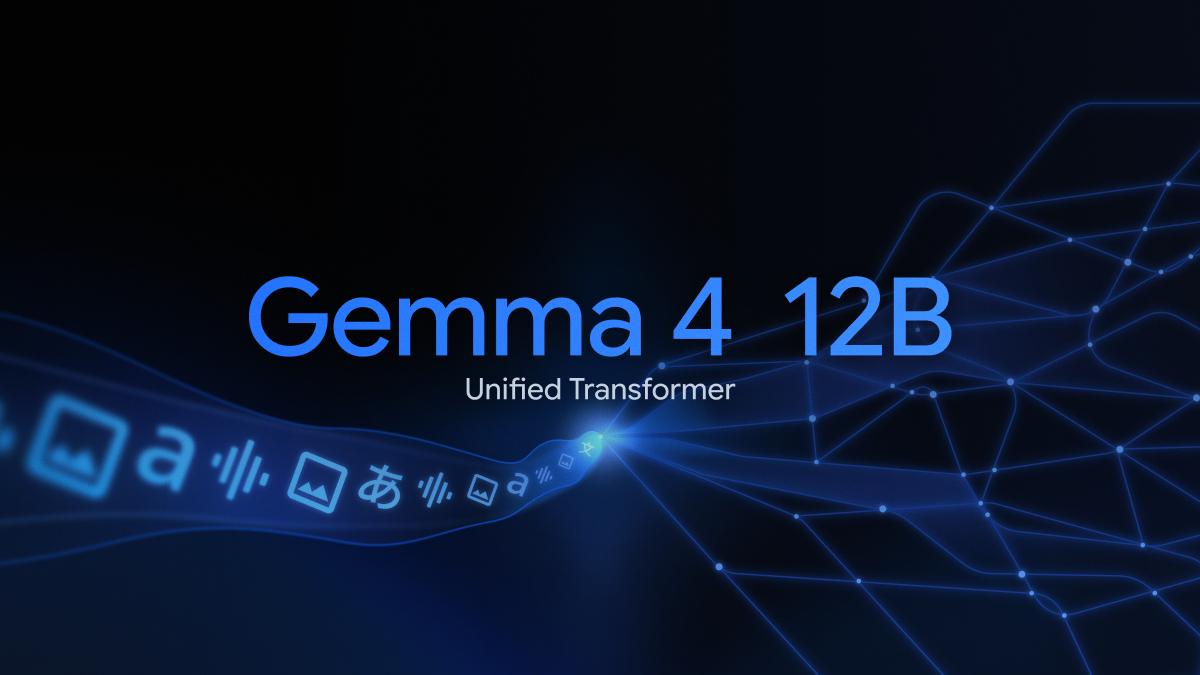
Every multimodal AI model before this one relied on separate encoders to translate images and audio into a language the core model could understand. Gemma 4 12B skips all of that. Vision inputs flow directly into the LLM backbone through a lightweight embedding module — a single matrix multiplication. Audio is projected raw into the same dimensional space as text tokens, with no audio encoder at all. The result is lower latency, smaller memory footprint, and what Google calls a “unified architecture” that treats all modalities as equals.
In practical terms: the model weighs in at roughly 6.7GB in Q4 quantized form and benchmarks near Google’s own 26B Mixture-of-Experts model — a significantly larger system — at less than half the total memory. It’s Google’s first mid-sized Gemma with native audio, and it handles clips up to 30 seconds. Video support covers up to 60 seconds at approximately one frame per second. The context window is 256K tokens. These numbers come directly from Google’s official announcement published on June 3, 2026.
Who It’s For — and How to Run It Today
If you have a laptop with 16GB of unified memory or VRAM, you can run Gemma 4 12B right now. Google has confirmed support across Ollama, LM Studio, llama.cpp, MLX, vLLM, and SGLang. You can also pull the instruction-tuned checkpoint directly from Hugging Face at google/gemma-4-12B-it. For agentic workflows, Google launched a companion Skills Repository at github.com/google-gemma/gemma-skills — pre-built agent capabilities for the Gemma 4 family. The total Gemma 4 download count has now crossed 150 million, according to the announcement.
Developers who want local AI agents for coding, document analysis, or multimodal reasoning now have a free, laptop-friendly option that rivals paid cloud APIs in several benchmarks. Compare that to where things stood a year ago, when running a capable multimodal model locally required dedicated workstation GPU setups. For context on how the broader open-weights race is developing, see our coverage of NVIDIA’s Nemotron 3 Ultra and OpenAI’s open-weights release.
Why This Matters Now — The Local AI Arms Race
The release lands one week after Google made Gemini 3.5 Flash generally available — its fastest cloud model. Gemma 4 12B fills the other end: powerful, private, on-device. It signals that Google is betting on local AI as a serious distribution channel, not just a demo. Developers who need data privacy, offline capability, or want to avoid API costs now have a compelling option from a Tier 1 AI lab. That pressure is real: for more on the cloud-vs-local cost debate, see our analysis of Gemini 3.5 Flash pricing and what it costs at scale.
Frequently Asked Questions
- What is Gemma 4 12B?
- Gemma 4 12B is an open-source 12-billion-parameter multimodal AI model from Google DeepMind, released June 3, 2026 under an Apache 2.0 license. It processes text, images, video, and audio natively and runs on consumer laptops with 16GB of RAM.
- How do I run Gemma 4 12B locally?
- Download the instruction-tuned weights from Hugging Face (
google/gemma-4-12B-it) or Kaggle. Run it via Ollama, LM Studio, llama.cpp, or vLLM. You need at least 16GB of VRAM or unified memory. Q4 quantized weights are approximately 6.7GB. - Is Gemma 4 12B free to use commercially?
- Yes. Gemma 4 12B is released under the Apache 2.0 license, which permits commercial use with no restrictions on API calls or outputs.
- How does Gemma 4 12B compare to larger models?
- Google states that Gemma 4 12B benchmarks near their 26B Mixture-of-Experts model while using less than half the memory. It is not intended to match the top closed models (GPT-5.5, Claude Opus 4.8) but outperforms most models of similar size.
- What makes Gemma 4 12B’s architecture different?
- Unlike traditional multimodal models, Gemma 4 12B has no separate vision or audio encoders. Visual and audio inputs feed directly into the language model backbone, reducing latency and memory usage while simplifying the overall system.


