


Published:
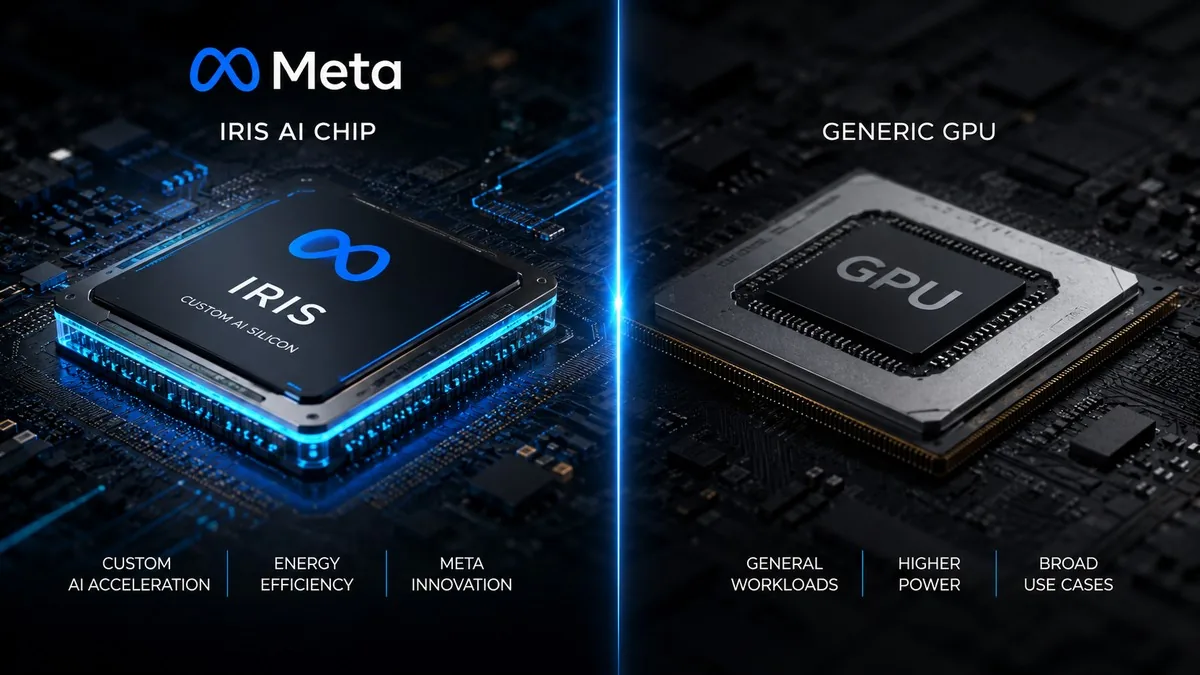
Meta will begin mass production of its fourth-generation custom AI chip, called Iris, in September 2026, after an internal memo obtained by Reuters confirmed the chip completed a six-week testing phase with no major issues.
The chip is the latest iteration of Meta’s MTIA (Meta Training and Inference Accelerator) program, which the company launched in 2023. Meta designed Iris in partnership with Broadcom and is manufacturing it at TSMC. Supporting suppliers include Samsung for RAM, Sandisk for storage, and Sumitomo Electric for fiber optic interconnects. Iris targets ranking and recommendation algorithms, inference workloads for Meta’s consumer apps — such as Facebook, Instagram, and WhatsApp — and broader AI tasks across Meta’s infrastructure. It is not designed for frontier model training, which will continue to use Nvidia GPUs and third-party hardware.
What Iris Will Power and What Meta Is Spending
Iris is central to Meta’s plan to deploy 7 gigawatts of AI compute capacity across its data centers in 2026, then double that figure to 14 gigawatts by 2027. That expansion is funded by Meta’s 2026 capital expenditure guidance of $125–145 billion, announced in Meta’s Q1 2026 investor release — the largest annual capex in the company’s history and one of the largest single-year capital commitments ever made by any corporation.
Meta’s chip strategy is one layer in a larger infrastructure bet. According to TechCrunch, Meta has also signed multi-billion-dollar supply agreements with AMD for Instinct GPUs and with Amazon for custom CPUs. Iris handles inference and recommendation workloads specifically, freeing Nvidia GPU capacity for the heavier training compute those chips are best suited for.
“Each MTIA generation builds on the last, using modular chiplets, incorporating the latest AI workload insights and hardware technologies, and deploying on a shorter cadence,” Meta wrote in its March 2026 AI blog post. Previous MTIA generations saw limited deployment; the Reuters memo signals a new level of internal confidence in Iris, citing the clean six-week test window as the basis for the September production decision.
Every Major AI Lab Is Now Building Custom Silicon
Meta’s Iris chip is one front in an accelerating war among AI companies to build their own silicon and reduce dependence on Nvidia, whose GPU margins and supply constraints have made self-built chips economically attractive for large-scale buyers. The AI tools businesses deploy — for customer service, marketing automation, and sales — run on the compute infrastructure these chip programs produce; the companies that control their own silicon supply can scale AI features faster and at lower marginal cost than those that cannot.
OpenAI announced a custom inference chip partnership with Broadcom in June 2026. Anthropic is in discussions with Samsung for a dedicated chip, according to TechCrunch reporting from July 2, 2026. Google has operated Tensor Processing Units (TPUs) since 2016. Amazon runs Trainium chips in AWS data centers for AI training. The pattern is now consistent across every company operating at frontier AI scale: internal silicon reduces both cost and exposure to external supply chain risk.
Nvidia’s dominance rests on its CUDA software ecosystem, which has locked most AI training workflows to its hardware. Custom chips from Meta, OpenAI, and Anthropic are primarily targeting inference — the step where trained models respond to user queries — where CUDA lock-in is weaker and volume is highest. Meta’s Iris program directly targets this gap: high-volume, latency-sensitive workloads where a purpose-built chip outperforms a general-purpose GPU on cost per query.
Meta will still purchase Nvidia GPUs for frontier model training, according to the Reuters memo. The company is not replacing Nvidia; Iris supplements its GPU fleet by taking over the workloads where GPU utilization is least efficient.
Our Take
Meta’s Iris chip marks the first time in the MTIA program’s history that internal confidence — as signaled by a clean six-week test window — has been strong enough to move directly to mass production. If Iris delivers on its 14-gigawatt compute target by 2027, Meta becomes one of a handful of companies that can run AI inference at scale without depending on Nvidia supply. That structural independence compounds in value with every new AI feature Meta ships. The $125–145 billion capex commitment is large enough to reshape the chip supply chain if the program succeeds.
For Context: Custom Silicon Coverage on WithO2
- DeepSeek Is Building Its Own AI Chip to Break Free From NVIDIA — DeepSeek’s parallel custom silicon effort and why Nvidia dependency is now a strategic liability for AI labs
- Apple’s $30B Broadcom Deal Will Build 15 Billion US Chips — Apple and Broadcom’s $30 billion chip partnership using the same TSMC manufacturing ecosystem that Meta is using for Iris
- Anthropic Gets $35B Compute Financing from Apollo and Blackstone — Anthropic’s $35 billion compute financing approach, contrasting Meta’s vertical integration strategy with an external capital model
Sources: TechCrunch · Reuters via Yahoo Finance · Meta AI Blog · Meta Q1 2026 Investor Release


