


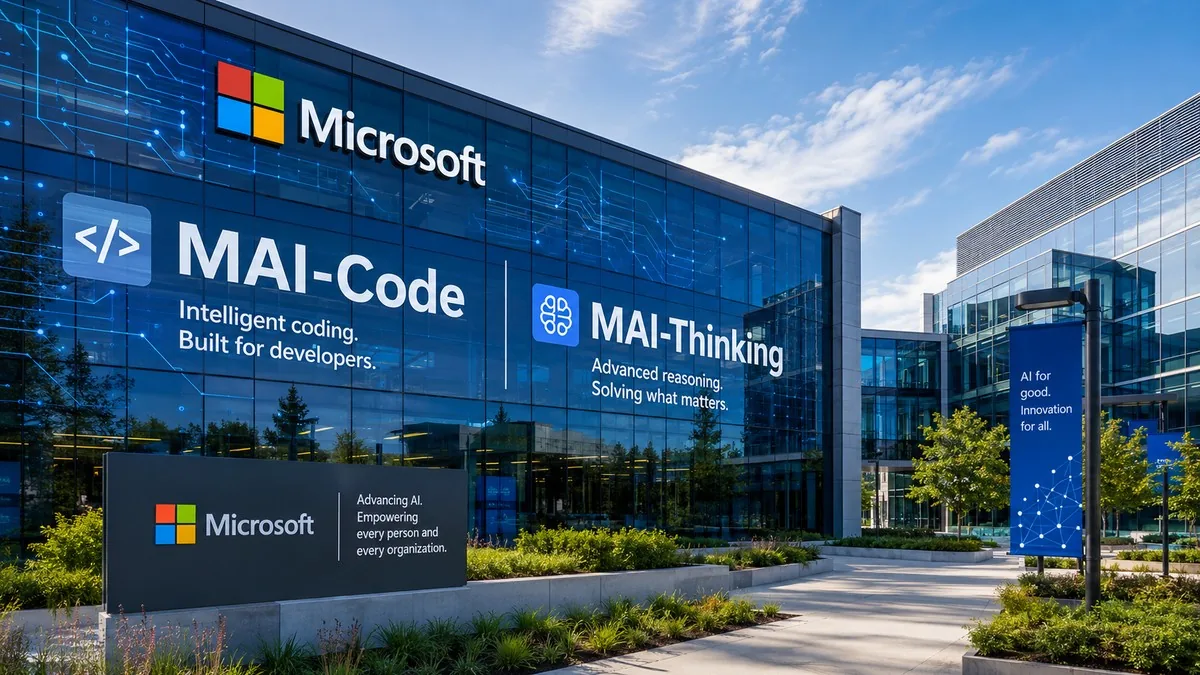
Microsoft just made its most aggressive move yet against its biggest AI partner. At Build 2026 in San Francisco (June 2–3), the company unveiled four in-house AI models under the MAI brand — and one of them already benchmarks on par with Anthropic’s Claude Opus 4.6 on coding tasks, at a fraction of the cost.
The models announced are:
- MAI-Code-1-Flash — Microsoft’s first proprietary coding model, designed for code completion, bug fixing, and autonomous code generation.
- MAI-Thinking-1 — A reasoning model in private preview through Microsoft Foundry. According to Microsoft, it matches Claude Opus 4.6 on SWE-Bench Pro — the industry’s toughest software engineering benchmark — while costing significantly less per inference.
- MAI-Image-2.5 — A multimodal image generation and understanding model.
- MAI-Transcribe-1.5 — A speech transcription model optimized for enterprise meeting workflows.
Why Microsoft Is Building Its Own Models
Microsoft has been OpenAI’s exclusive cloud partner since 2019, committing over $13 billion to the startup. But as OpenAI’s pricing remains high and its roadmap diverges from Microsoft’s enterprise priorities, Redmond has quietly been building an exit ramp.
“We want to give developers choice,” Microsoft CEO Satya Nadella said at the Build keynote. “The best model for any task isn’t always the most expensive one — and enterprise customers shouldn’t be locked into a single vendor.”
MAI-Thinking-1 is the most significant of the four. By matching Claude Opus 4.6 on SWE-Bench Pro while running cheaper via Microsoft’s own Azure infrastructure, it gives enterprise customers a reason to route high-volume coding workloads through Microsoft’s stack instead of calling OpenAI’s API at full price.
GitHub Copilot Gets the Upgrade
The MAI models aren’t just available via API. GitHub Copilot — Microsoft’s AI coding assistant with over 15 million developers — is being upgraded with autonomous coding capabilities powered by the new models. Copilot can now accept multi-step task descriptions, plan a series of code changes, and execute them across a repository without step-by-step human prompting.
This puts Copilot in direct competition with Anthropic’s Claude Code, which has become the tool of choice for many developers running autonomous coding workflows. The race for the AI coding market — estimated at over $30 billion by 2028 — just intensified.
GPT-5.5 Also Lands in Microsoft Foundry
Alongside the MAI models, Microsoft confirmed that OpenAI’s GPT-5.5 is now generally available through Microsoft Foundry, its enterprise AI deployment platform. This matters because Foundry wraps OpenAI models in Microsoft’s compliance, security, and billing infrastructure — critical for regulated industries like finance and healthcare.
The combination of proprietary MAI models and OpenAI’s GPT-5.5 in a single platform is a deliberate strategy: Microsoft becomes the neutral AI marketplace, offering the best model for each task without forcing customers to pick a side.
What This Means for Developers and Enterprise Teams
For developers already in the Microsoft ecosystem (Azure, GitHub, VS Code, Teams), the MAI models represent a real alternative to calling OpenAI or Anthropic directly:
- Lower per-token costs for coding workloads via MAI-Code-1-Flash
- Reasoning at Claude Opus quality via MAI-Thinking-1 (private preview)
- All models available through Microsoft’s enterprise compliance stack
For enterprises evaluating AI platforms, this changes the calculus. Until now, a company choosing Azure was still dependent on OpenAI for frontier model quality. Now Microsoft offers a credible in-house option that passes enterprise benchmarks.
MAI-Thinking-1 remains in private preview via Microsoft Foundry — a waitlist is open. The other three models are available today for Azure customers.
July 2026 Update: MAI Now Powers Excel and Outlook
A Bloomberg report published July 7, 2026 revealed the full scale of Microsoft’s pivot: tens of thousands of AI prompts per week inside Excel and Outlook are now being completed by Microsoft’s in-house MAI models, quietly replacing calls to OpenAI and Anthropic. The scope of this rollout had not been previously reported.
The driving force is cost. Microsoft AI chief Mustafa Suleyman made the goal explicit:
“We pay a lot of money to Anthropic — so our goal is to reduce and ultimately eliminate that cost.”
— Mustafa Suleyman, Microsoft AI Chief
Here’s what the Excel and Outlook switch means in practice:
- Excel: AI features including formula suggestions, data analysis summaries, and natural-language queries are now routed to MAI models for a large and growing share of requests. Users see the same Copilot UI — the model underneath has changed.
- Outlook: Email drafting, summarisation, and reply suggestions are being served by MAI models at scale. Microsoft has not publicly announced which specific Copilot features are affected, but the Bloomberg report confirmed the shift is already active.
- Teams next: Suleyman also confirmed that MAI-Transcribe-1.5 — Microsoft’s speech model — will start powering Teams transcription and other products in the coming months.
The move matters beyond cost savings. It signals that Microsoft’s dependency on Anthropic and OpenAI is transitioning from “critical partner” to “optional supplier” — at least for high-volume, lower-complexity Office workloads. Frontier models from OpenAI and Anthropic aren’t going away from Microsoft’s stack, but they may increasingly be reserved for tasks that genuinely require top-tier reasoning, not routine Copilot calls in a spreadsheet.
Related Coverage
- Claude Opus 4.8 Beats GPT-5.5 on Coding — 3x Cheaper Too
- GitHub Copilot AI Credits Billing: What Changes Today
- OpenAI Is Killing GPT-4.5 on June 27 — Here’s What to Do


