


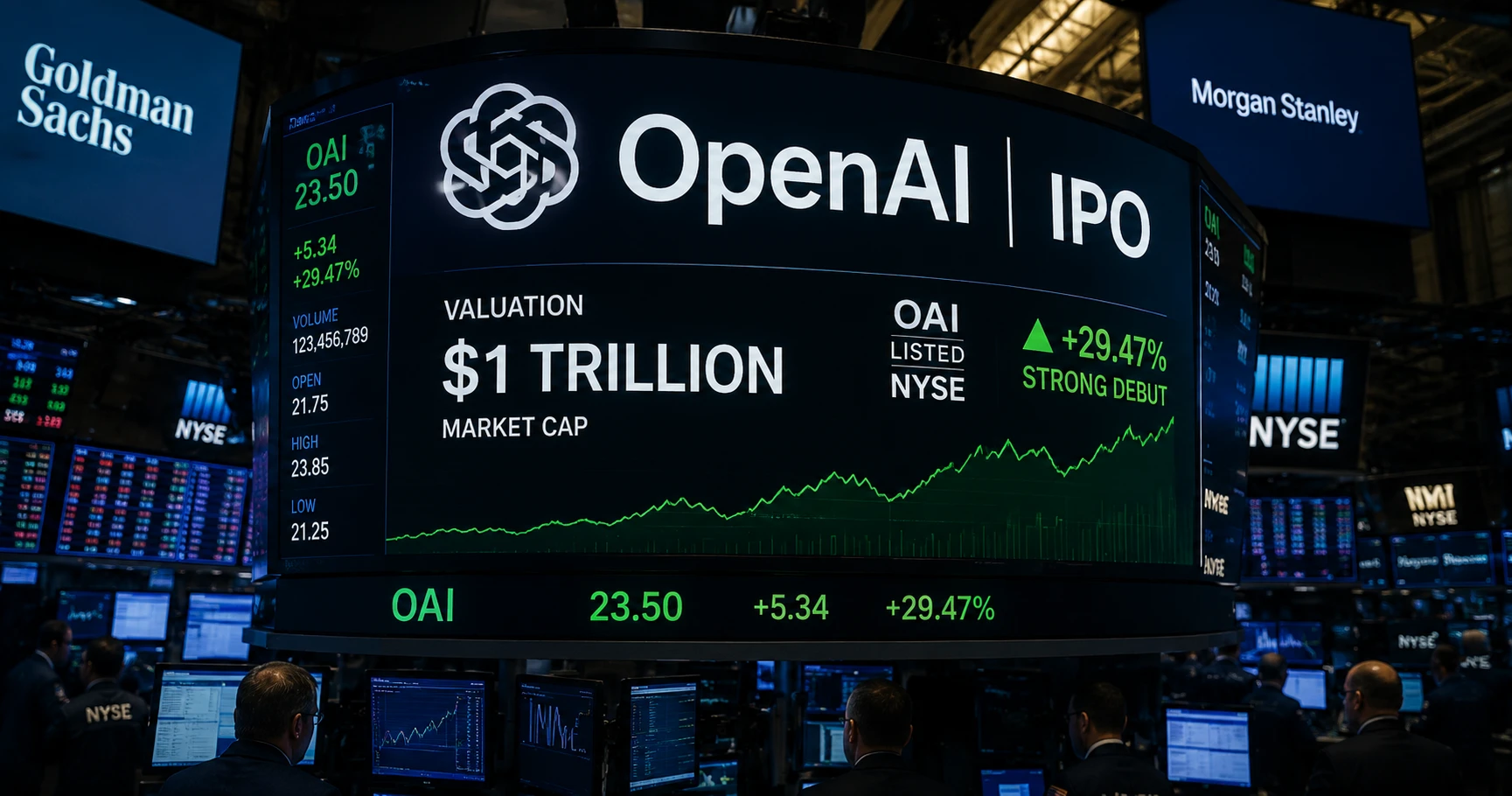
OpenAI filed a confidential S-1 with the SEC on May 22, 2026, targeting a September listing that could value the company at over $1 trillion — making it the most expensive U.S. IPO in history. Goldman Sachs and Morgan Stanley are leading the offering. The company posted $25 billion in annualized revenue as of February 2026, but warned investors it does not expect to turn profitable until around 2030. (Source: Enterprise DNA)
The Key Numbers — What OpenAI’s S-1 Reveals
The filing puts OpenAI’s last private valuation at $852 billion, set during a record-breaking $122 billion funding round in March 2026 — the largest private fundraise in history. The IPO target pushes that to $1 trillion or above. If it lands there, OpenAI would surpass Saudi Aramco’s 2019 debut as the biggest IPO ever.
Revenue growth is undeniable: $20 billion at year-end 2025, $25 billion annualized by February 2026, with enterprise now representing roughly 40% of total revenue. But the company still expects a $14 billion operating loss in 2026, and profitability isn’t projected until around 2030.
Anthropic, OpenAI’s closest rival, is reportedly preparing an October listing of its own, targeting a valuation near $900 billion. We covered Anthropic’s $65 billion funding round earlier this year — the competitive pressure between the two companies is now playing out on Wall Street.
Who Gets Affected — Developers, Enterprise, and Retail Investors
For developers and enterprise customers, an IPO changes almost nothing in the short term. OpenAI’s API pricing, model availability, and governance framework are locked in ahead of the roadshow. What changes is accountability: public companies must file quarterly financials, disclose material model risks, and answer to shareholders on safety and compute spend.
For retail investors, the more critical question is price. At $1 trillion, OpenAI would trade at roughly 40× annualized revenue — a premium that only makes sense if you believe 2026 is year one of a decade of compounding growth. The bears will point to the $14 billion projected operating loss. The bulls will point to the revenue trajectory: from $2 billion in 2023 to $25 billion in 2026 is a 12× run in three years.
Elon Musk’s lawsuit against OpenAI — a legal cloud that hung over any IPO plan — was dismissed by a jury two days before the confidential S-1 was filed, clearing the biggest obstacle to going public.
Why This Matters Now — The Race to $1 Trillion
SpaceX filed its own S-1 the same week, targeting a $1.75–$2 trillion valuation. Two of the most closely watched private companies in the world are heading to public markets simultaneously. That’s a once-in-a-generation event for tech investors — and a signal that the AI investment cycle has matured enough to demand public accountability.
For users choosing between ChatGPT, Claude, and Gemini subscriptions, an OpenAI IPO is a reminder that this is now a multi-trillion-dollar competitive race — not an experiment.
FAQ — OpenAI IPO 2026
When is the OpenAI IPO date?
OpenAI filed a confidential S-1 on May 22, 2026 and is targeting a September 2026 listing. The public S-1 will become available approximately 15 days before the investor roadshow, likely putting the earliest listing in mid-to-late September or October 2026.
What is OpenAI’s IPO valuation?
OpenAI is targeting a valuation above $1 trillion at IPO. Its last private valuation was $852 billion following a $122 billion funding round in March 2026 — the largest private fundraise in history.
Is OpenAI profitable?
No. OpenAI has $25 billion in annualized revenue as of early 2026 but projects a $14 billion operating loss for the full year. The company does not expect to reach profitability until around 2030.
Who are the underwriters for the OpenAI IPO?
Goldman Sachs and Morgan Stanley are the lead underwriters for OpenAI’s IPO, according to reports from multiple financial publications following the confidential S-1 filing.
Can retail investors buy OpenAI stock at IPO?
Potentially yes, but access will depend on your broker. Institutional investors typically get priority in IPO allocations. Retail investors can buy shares on the open market from the first day of trading, though prices on day one are often elevated above the IPO offering price.


