


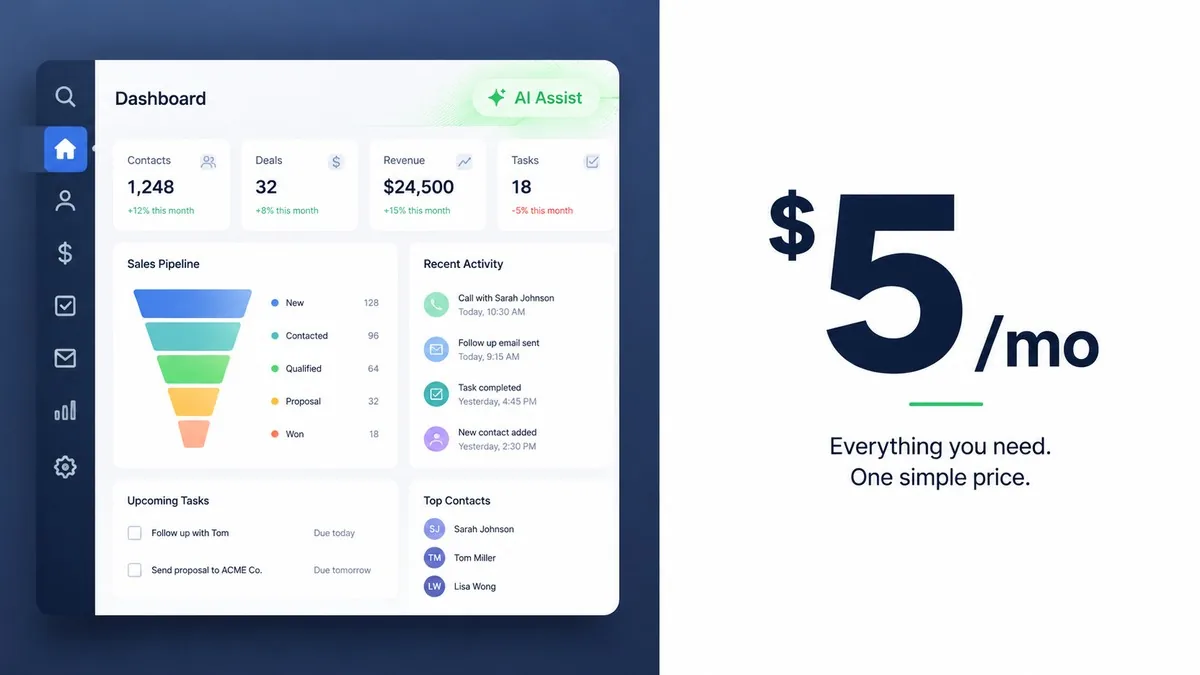
Saleoid launched an AI-powered CRM for small businesses on July 21, 2026, starting at $5 per month — billed every two years — with no per-seat fee. The platform combines lead management, AI-driven follow-up automation, appointment scheduling, contact management, and a sales pipeline, with 20+ optional add-on modules available at $1 per month each, according to MarTech Series and Saleoid’s product page. A 15-day free trial is included, with no minimum seat requirement.
What Saleoid Includes
Saleoid’s $5/month base plan covers 5 core functions: lead management, AI-powered follow-up automation, appointment booking, contact management, and a sales pipeline. The AI follow-up automation generates and sends follow-up messages after meetings or lead capture events without manual input from the sales team — the feature that comparable tools from HubSpot and Zoho reserve for paid plans.
Beyond the base plan, Saleoid offers 20+ modular add-ons at $1 per month each. Confirmed add-ons include email marketing, billing, landing pages, and client portals, per Saleoid’s product page. This means a business can start at $5 and add only the modules it uses, rather than paying for a fixed feature bundle.
How Saleoid’s Pricing Compares
The small-business CRM market has a clear structure at the entry tier. HubSpot’s Starter CRM starts at approximately $20 per user per month. Salesforce Essentials starts at $25 per user per month. Zoho CRM starts at $14 per user per month. HubSpot and Zoho both offer free tiers, but free plans cap the number of contacts and automations and exclude AI features.
Saleoid’s flat $5 rate — not per user, not per contact — is cheaper than any comparable offering with AI automation included. For a 10-person sales team, the difference between Saleoid and HubSpot Starter is $195 per month. For context on how the broader CRM market stacks up, see the guide to best CRM software for business use cases.
Who Saleoid Targets
Saleoid targets 4 buyer types explicitly: startups, agencies, consultants, and growing businesses, according to OpenPR’s coverage of the launch. The positioning aligns with the platform’s modular design — a solo consultant needs lead management and follow-up automation but not billing or client portals; the $1/add-on model lets them pay for only what applies. For small businesses evaluating the full landscape of AI tools for business, Saleoid adds a genuinely affordable CRM option to the shortlist.
What to Watch
Saleoid is a new entrant without the brand history of HubSpot, Zoho, or Pipedrive. The $5 price point raises 2 questions any buyer should investigate during the 15-day trial: whether the AI follow-up automation performs well enough to replace manual outreach in real deal cycles, and whether the company is funded to support the platform long-term. Low-price SaaS startups carry longevity risk that established vendors do not. Businesses building sales workflows on the platform should test the trial aggressively on their actual use case — lead type, message volume, pipeline complexity — before committing to annual billing. For broader guidance on how ChatGPT for small business programs compare as an AI-first sales alternative, see that coverage.
Our Take: Saleoid is the most affordable AI CRM we’ve tracked — but the price is both the selling point and the caution flag. At $5/month flat, the platform could be transformative for the solo consultant or 5-person startup that needs real CRM automation but can’t budget $200/month for HubSpot. The 15-day trial is genuinely risk-free. The risk is whether Saleoid is still around in 2 years — a question the trial period can’t answer. Use it if the cost is the blocker; keep the data portable.
For Context
Saleoid’s launch on July 21, 2026 came the same day as Fireflies AI Sales Suite — signalling a broader market push to bring AI-native CRM features to small businesses at sub-$10 price points. The launch maps to the C8 and C9 nodes on our topical map (best CRM software and best CRM for small business) — hubs currently being built out. Coverage here feeds freshness into those evergreen comparison pages once published.


