


Published: July 30, 2026
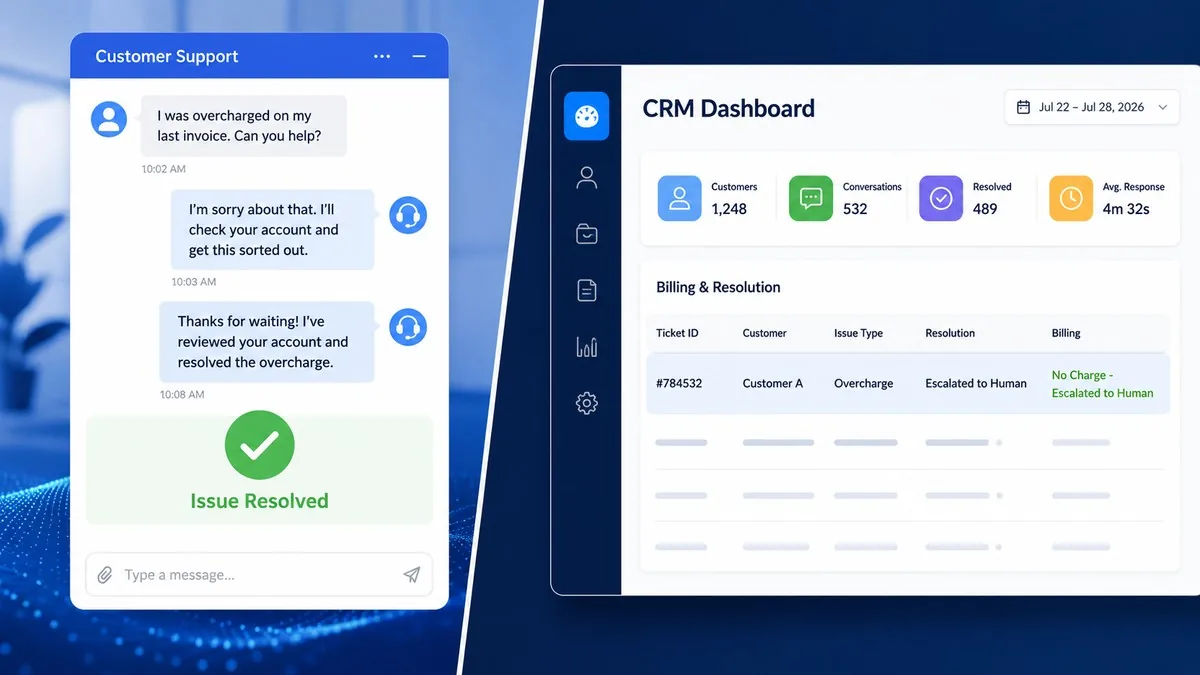
Salesforce made Agentforce Help Agent generally available in July 2026 with pay-per-resolution pricing, charging customers only when the AI agent resolves a support issue autonomously from start to finish. Salesforce announced the release on June 25, 2026, and disclosed that it ran the same agent on its own support site, help.salesforce.com, where Agentforce handled 4.3 million inquiries and resolved 70% of them without a human. Agentforce Help Agent deploys across voice, web, portal, and messaging from a single setup screen, grounded on a company’s existing Salesforce Knowledge articles. Salesforce charges nothing when a customer escalates to a human agent or leaves unsatisfied.
How Pay-Per-Resolution Pricing Changes the AI Agent Purchase
Pay-per-resolution pricing bills the buyer per completed outcome instead of per seat or per API call, so an AI agent that fails to resolve a ticket generates no charge. Salesforce made this model available in July 2026 alongside the general availability of Agentforce Help Agent and Agentforce Customer Service Portal.
The pricing structure removes the procurement risk that stalls AI agent evaluations. A support organisation running 100,000 tickets per year can now model the cost of an AI agent directly against its current cost per human-handled ticket, because the AI cost only exists where a resolution occurred. Salesforce has not published the dollar amount charged per resolution.
According to Kishan Chetan, EVP and GM of Agentforce Service at Salesforce: “The promise of AI agents in customer service isn’t just about answering questions faster; it’s about resolving issues completely, across any channel, the first time and every time. Agentforce Help Agent leverages nearly two years of real-world learnings. Built on our deeply unified, secure-by-design platform, it delivers a personalized, proactive omni-channel experience that is even easier to set up. And with our pay-per-resolution pricing, our success is directly tied to our customers’ success.”
What Salesforce Proved on 4.3 Million of Its Own Tickets
Salesforce deployed Agentforce on help.salesforce.com, where the agent handled 4.3 million customer inquiries and resolved 70% of them autonomously. Salesforce states it built the learnings from that deployment into the generally available product — the “nearly two years of real-world learnings” Chetan referenced.
The 70% figure on 4.3 million tickets is the largest published autonomous-resolution benchmark from a major CRM vendor. Competing customer service AI agents, such as HubSpot Breeze, Zendesk AI agents, and Freshdesk Freddy AI, have not published equivalent resolution rates against a disclosed ticket volume.
Named customers report similar direction. According to Rudi Khoury, Chief Digital Officer at Fisher & Paykel: “Agentic AI has already doubled self-service resolution rates, and we expect further uplift in both efficiency and experience as we continue to empower customers to resolve their own needs inside their current workflows.” Nicole LaCamp, SVP of Platform Strategy and Engineering at PenFed Credit Union, endorsed the pricing model directly: “This kind of model means we only win when our members win.”
Setup: Knowledge Articles, File Uploads, and URL Crawling
Agentforce Help Agent grounds its answers on a company’s existing Salesforce Knowledge base, and accepts two additional context sources: drag-and-drop file upload and URL crawling. A single setup screen configures all four channels — voice, web, customer portal, and messaging — which is the step Salesforce describes as taking minutes rather than an implementation project.
The grounding requirement determines buyer readiness. An organisation with thin or outdated knowledge articles gives the agent less to resolve from, which under pay-per-resolution pricing produces fewer billed resolutions and more human escalations.
The Fin Acquisition: Salesforce’s Second Bet, Aimed at SMBs
Salesforce signed a definitive agreement on June 15, 2026 to acquire Fin, formerly Intercom, for approximately $3.6 billion — ten days before the Agentforce Help Agent announcement. Fin serves more than 30,000 customers globally and resolves 76% of support queries without a human, a rate 6 percentage points above Agentforce’s 70% on help.salesforce.com. Fin customers include Asana, Shutterstock, and Riot Games.
Fin is not part of Salesforce yet. Salesforce expects the transaction to close in Q4 of its fiscal year 2027, subject to regulatory clearances.
The two moves together define a two-tier strategy in CRM AI. Agentforce Help Agent targets existing Salesforce customers with a configured CRM and a populated knowledge base. Fin targets small and mid-sized businesses that need a support agent running quickly without a Salesforce implementation behind it. A buyer comparing CRM platforms after the deal closes would find both options under one vendor.
Frequently Asked Questions
What is Salesforce Agentforce Help Agent?
Salesforce Agentforce Help Agent is an autonomous customer service AI agent that resolves support issues across voice, web, customer portal, and messaging channels. It became generally available in July 2026. The agent grounds its answers on a company’s existing Salesforce Knowledge articles, and also accepts uploaded files and crawled URLs as context. Salesforce configures all four channels from a single setup screen.
How does Salesforce pay-per-resolution pricing work?
Pay-per-resolution pricing charges a customer only when Agentforce Help Agent resolves a support issue autonomously from start to finish. Salesforce applies no charge when the customer escalates to a human agent or leaves without a resolution. The model became available in July 2026. Salesforce has not published the specific dollar amount charged per resolution.
Is Fin part of Salesforce?
No, Fin is not part of Salesforce yet. Salesforce signed a definitive agreement to acquire Fin, formerly Intercom, on June 15, 2026 for approximately $3.6 billion, and expects the transaction to close in Q4 of its fiscal year 2027, subject to regulatory clearances. Fin serves more than 30,000 customers and resolves 76% of support queries without a human.
Agentforce Help Agent is one entry in a customer service agent market where every major CRM vendor now ships an autonomous agent, and resolution rate is becoming the metric buyers compare. Our comparison of the best AI agents for business tasks covers how these agents differ across support, sales, and operations workflows. For teams building an AI stack around a CRM rather than replacing it, our guide to AI tools for business maps which tools handle which function.
For Context: Salesforce’s pay-per-resolution move follows HubSpot’s push into multi-agent CRM workflows earlier this year — see our coverage of HubSpot Agent Hub letting CRM teams run AI agents together for how the closest competitor structures the same capability without outcome-based pricing.
Last Updated: July 2026


