


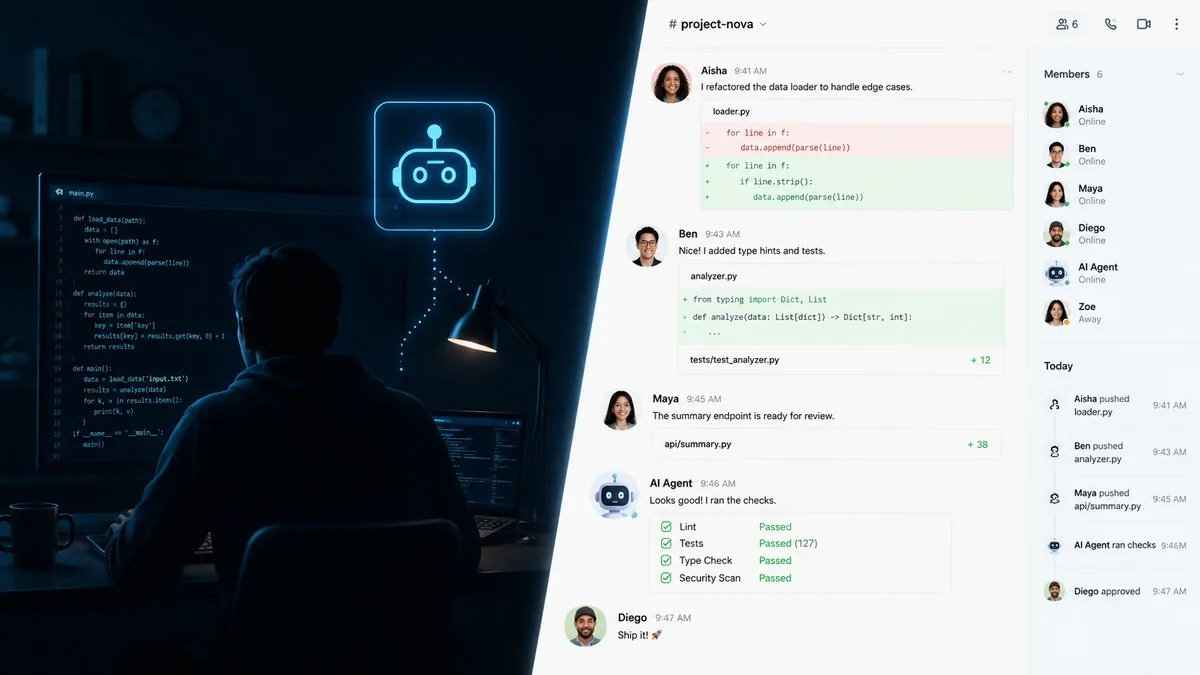
Salesforce launched Slack Code on August 20, 2026, embedding AI coding agents — Anthropic’s Claude Code, Cognition’s Devin, GitHub Copilot, and Vercel’s agent — directly inside shared Slack channels where a whole team watches, steers, and ships the agent’s work together. Slack Code is available on all Slack plans at launch, and each user supplies their own access to the partner agent they invoke.
Every agent task opens a dedicated code channel containing code diffs, live previews, a running plan tab, and an archived audit trail of the session. Agents inherit the invoking user’s access control lists, so no bot-level service identity or elevated permission set is created. Salesforce also shipped agent DMs, an Agents tab showing live agent status with a stop button, and an “Add to Slack” flow for agents built on Lovable, n8n, OpenAI, LangChain, and Airtable.
What Slack Code Changes About AI Coding Agents
Slack Code moves AI coding agents out of the individual terminal and into a shared channel, converting agent-assisted development from a solo activity into a team one. Until this launch, Claude Code, Devin, GitHub Copilot, and OpenAI Codex all operated inside a single developer’s terminal or IDE, where teammates saw the merged result but never the agent’s working process. A code channel instead shows the plan, the diffs, and a deployable preview while the work happens, which lets a non-engineer file a request and follow the fix to a shippable state.
“One of the things I love about this is that code is no longer the bottleneck. Ideas, taste, judgment, craft — those are the things that are the bottleneck, and you’ve effectively extended the population that can contribute ideas, taste, judgment, and craft to anybody that exists in your Slack.” — Rob Seaman, interim CEO at Slack
Katie Steigman, VP of Product at Slack, framed the shared channel as a quality control: “The multiplayer part is a guard against that [AI slop], actually, because people can see your work, people can comment on your work.”
Why the ACL Inheritance Matters for Enterprise Buyers
Slack Code agents run with the permissions of the person who invoked them, which means IT provisions no new identities and existing GitHub pull-request review gates still apply unchanged. Standalone agent platforms typically require a separate service account with its own permission scope — a review burden security teams carry every time a new agent vendor enters the stack. Cognition adds a second containment layer: Devin executes inside isolated sandboxes with minimum viable access and offers an optional no-internet mode for sensitive repositories.
Businesses evaluating this category can compare the underlying tools in our guide to the best AI agents for business tasks, which covers Devin and Claude Code as standalone products outside the Slack context.
What the Adoption Data Says
Cognition’s internal merged pull-request count rose 10× over the last few months while headcount grew approximately 40%, according to Jeff Wang, President of New Enterprise at Cognition. Wang described the non-engineer pattern Slack Code is built around: “Believe it or not, a lot of our bugs are reported by our sales team. They report it in Slack, and then someone who’s technical applies them to fix the bug.”
Broader agent adoption data is less decisive. McKinsey’s State of AI research finds 62% of organizations experimenting with AI agents, roughly one third scaling AI at all, and 39% reporting bottom-line impact. Gartner predicted in June 2025 that over 40% of agentic AI projects will be cancelled by the end of 2027 because of escalating costs and unclear business value — a market-wide forecast, not an assessment of Slack Code.
How Slack Code Fits Salesforce’s Strategy
Slack Code reverses Salesforce’s 2025 posture of blocking rival AI firms from accessing Slack data, repositioning Slack as an open platform any AI agent can operate inside. Salesforce shares fell approximately 18% through January 2026 as Wall Street questioned whether AI would erode enterprise software demand; making Slack the surface where agents work, rather than a data source they consume, is the company’s answer.
The rebuilt Slackbot shipped in January 2026, powered by Anthropic’s Claude, became the fastest-adopted feature in Salesforce’s 27-year history. That product answered questions; Slack Code produces artifacts. Microsoft Teams pairs Copilot for Teams with GitHub Copilot but ships no equivalent multiplayer agent-coding channel, and Jack Dorsey’s Buzz puts AI agents inside team chat at a far smaller scale.
Our Take
Slack Code is Salesforce’s most credible answer yet to the Microsoft Copilot threat, because it turns transparency into a moat rather than competing on model quality. The businesses that gain most are those already standardized on Slack: they get multiplayer AI coding without a new dashboard, a new identity provider, or a new review process. Slack Code supplies the channel, not the agent subscription, so the per-seat cost of Claude Code or Devin still sits outside the Slack plan. Two caveats belong in any evaluation: four agents are confirmed at launch with an API for others still planned, and Rob Seaman states terminal-based solo agent work will coexist with the channel model rather than be replaced by it.
For Context
Salesforce has been layering AI agents across its product line through 2026. The company brought CRM data into Slack directly in our coverage of Slackbot pulling CRM data without app switching, and extended agents into storefront workflows in Salesforce Agentforce for commerce.
Related Reading
- HubSpot built a comparable shared-agent workspace for revenue teams — see HubSpot’s Agent Hub for CRM teams.
- On the automation side of the same stack, n8n builds workflows from plain language without code.


