


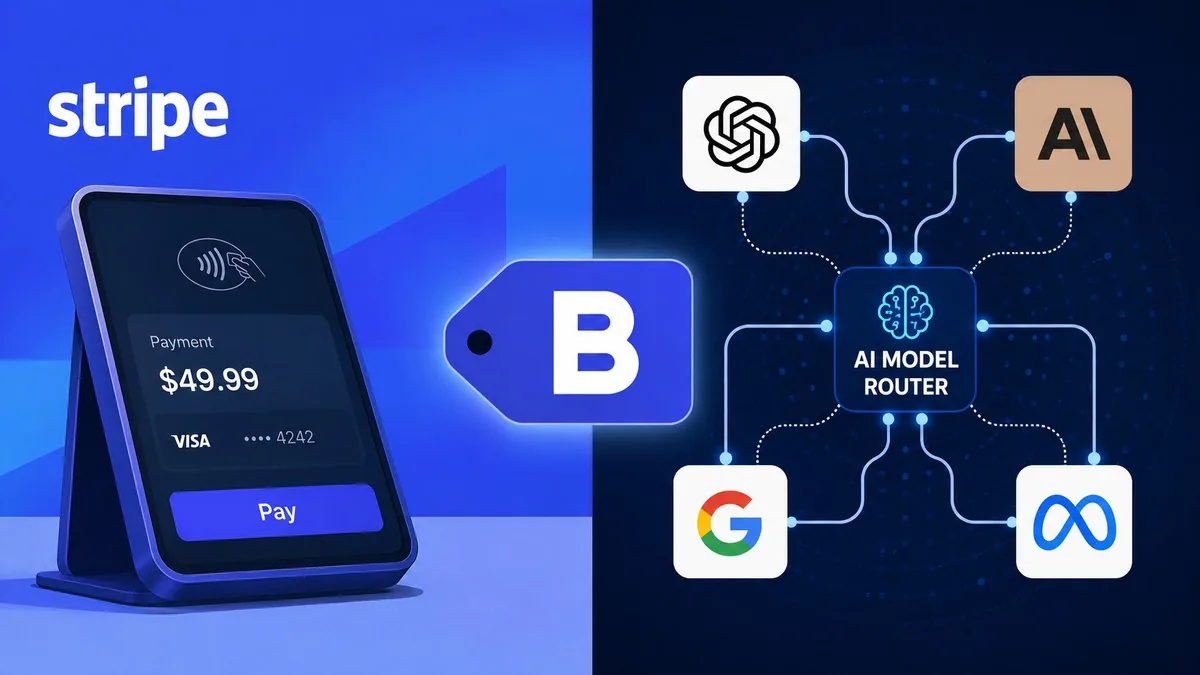
Stripe has finalized an agreement to acquire OpenRouter — the AI model gateway used by 8 million users to access 400+ AI models through a single API — for more than $7 billion, per Bloomberg (reported August 16, 2026). The deal values OpenRouter at more than 5× its $1.3 billion Series B valuation from May 2026, when Sequoia, Andreessen Horowitz, Menlo Ventures, and Alphabet’s Capital G invested $113 million. Stripe intends to integrate OpenRouter’s model routing platform into its AI economic infrastructure.
What Is OpenRouter and Why Do Businesses Use It?
OpenRouter is an AI model gateway that provides access to 400+ AI models — including those from OpenAI, Anthropic, Google, Meta, and Mistral — through a single OpenAI-compatible API endpoint and one unified billing account. Businesses and developers adopted OpenRouter specifically to avoid vendor lock-in: switching from one AI model to another requires changing one parameter, not rewriting integration code.
OpenRouter’s value proposition was model neutrality — it had no commercial stake in which AI model a user chose. That neutrality is now the central question following the Stripe acquisition.
Why Stripe Paid $7 Billion for a Model Router
Stripe’s strategic interest in OpenRouter is payment infrastructure, not AI development. As AI model usage becomes a recurring corporate expense, whoever controls model routing controls the payment relationship. According to Fortune, Stripe intends to embed payment settlement into AI model consumption directly through OpenRouter’s platform.
By owning OpenRouter, Stripe gains visibility into which AI models businesses are actually selecting and at what volume — data that is commercially valuable for its payments and financial services business. Stripe is already valued at approximately $91 billion and has been building AI infrastructure through products such as Frontier, its AI model API for payments automation.
What the Neutrality Risk Means for Your AI Stack
OpenRouter’s 8 million users — a mix of individual developers and businesses — relied on the platform’s model-neutral stance to make unbiased routing decisions. An OpenRouter owned by Stripe introduces a structural conflict: Stripe has commercial interests that could favor certain AI model providers, pricing structures, or settlement arrangements over others.
The Hacker News discussion on August 16, 2026 (270 points) reflected immediate user concern about this exact conflict. Businesses that built their AI stack on OpenRouter’s neutrality guarantee should now evaluate whether that guarantee is still operative under Stripe’s ownership.
Three alternatives that businesses are likely to evaluate as a result include Portkey (an AI gateway with routing, caching, and fallback features), Eden AI (a multi-model API aggregator), and Vercel AI Gateway (built into the Vercel infrastructure layer). None of these alternatives reached OpenRouter’s scale of 400+ models before this announcement, but each preserves the neutral-routing model that OpenRouter’s acquisition now puts in question.
OpenRouter is not shutting down. Stripe confirmed it is integrating OpenRouter’s platform, not decommissioning it. The practical risk for businesses is not service loss — it is that future pricing, model availability, and routing logic may reflect Stripe’s commercial priorities rather than neutral market access. No official statements from Stripe CEO Patrick Collison or OpenRouter’s founders were available at publication time; check Stripe’s newsroom and OpenRouter’s blog for post-announcement positions.
How This Fits the Shift Toward AI-Native Payments
The Stripe–OpenRouter deal is distinct from the Cerebras–OpenAI $10 billion partnership announced in the same news cycle. The Cerebras deal is about AI compute; the Stripe deal is about AI distribution and payment settlement. These are separate markets with separate strategic logics.
For businesses choosing AI tools, the acquisition illustrates a structural change in the AI tools market: the infrastructure layer — routing, billing, and model access — is consolidating into large financial and cloud platforms. Businesses that rely on independent AI tool vendors for model-neutral access are facing fewer independent options as consolidation continues.
For background on evaluating AI tools as payment and routing infrastructure converge, see our guide to the 15 best AI tools for business in 2026, which covers model-specific tools and their commercial dependencies across the major providers. For related news on AI agents that handle spending autonomously, see our coverage of Cloudflare Wallets and how it lets AI agents spend money within set limits.
For Context: OpenRouter and AI Model Access
OpenRouter launched as a model-neutral API gateway — described by its community as the “Switzerland of AI models” — precisely because it held no stake in which provider a user chose. The May 2026 Series B at $1.3 billion reflected investor confidence in that neutral position. The Stripe acquisition at $7 billion represents a 5×+ premium paid in three months, signaling that the strategic value of controlling AI model distribution has overtaken the value of neutrality as a product differentiator.
Our Take: Stripe bought the AI equivalent of a universal remote — and now the companies making the televisions (OpenAI, Anthropic, Google) have to ask whether their distribution partner will quietly favor certain channels. Businesses that relied on OpenRouter’s neutrality should evaluate alternatives now, before Stripe’s commercial priorities are embedded in the routing logic.
Sources: Bloomberg, Fortune, Yahoo Finance, TechCrunch


