


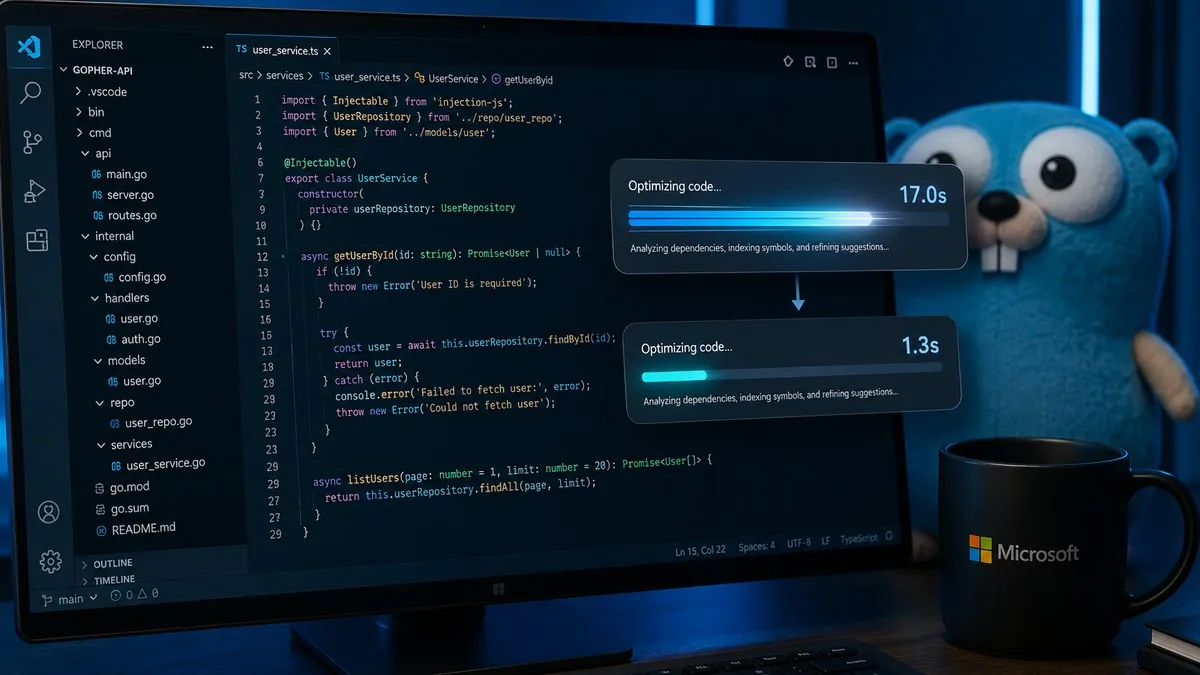
Microsoft released TypeScript 7.0 on July 8, 2026 — a complete rewrite of the TypeScript compiler from JavaScript to Go — delivering roughly 10× faster build times across typical codebases and reducing VS Code’s time-to-first-error from 17.5 seconds to 1.3 seconds (13× faster). The release makes TypeScript 7 the default compiler in VS Code and Visual Studio 2026, and marks the first major architectural shift in TypeScript’s 14-year history.
The Go rewrite replaces the original JavaScript compiler entirely. TypeScript’s previous compiler was single-threaded by necessity — JavaScript has no native multi-threading — which meant large projects compiled file by file, sequentially. Go natively supports goroutines, giving the new compiler parallel parsing, type-checking, and code emission simultaneously across all available CPU cores. On an 8-core machine, developers get 8 simultaneous type-checking workers as a baseline.
Why Microsoft Replaced the Entire TypeScript Compiler
The TypeScript compiler’s JavaScript foundation was the binding constraint on build performance for over a decade. Every attempt to speed it up — incremental builds, project references, watch mode — worked around the single-threaded ceiling rather than removing it. Microsoft confirmed the Go rewrite was the only architectural path to the 10× improvement the team targeted, per the TypeScript 7.0 announcement.
Microsoft chose Go over Rust — a choice that will generate debate in developer communities, since Rust’s memory-safety guarantees are a common argument for systems rewriting. Go’s concurrency model (goroutines and channels) maps more naturally to a compiler’s parallel workload than Rust’s ownership model, and Go’s compile times for the compiler itself are faster. The practical outcome is a compiler that ships today instead of in two more years.
How Much Faster Is TypeScript 7?
TypeScript 7 delivers two confirmed benchmark improvements, both from Microsoft’s own measurements:
- ~10× faster build times across typical TypeScript workloads
- 13× faster time-to-first-error in VS Code — from 17.5 seconds on the previous stable version to 1.3 seconds on TypeScript 7
The practical impact on large codebases is substantial. A TypeScript monorepo that previously took 45–60 seconds to fully type-check now completes in under 5 seconds on the same hardware. The VS Code improvement means developers see type errors in under 2 seconds after opening a file rather than waiting nearly 20 seconds — a change that keeps engineers in flow state instead of breaking context to wait for the editor to catch up.
New Parallelism Flags Give Teams Fine-Grained Control
TypeScript 7 ships three new compiler flags designed for environments where parallel compilation needs tuning:
--checkers— controls the number of concurrent type-checking workers; defaults to the machine’s CPU core count--builders— controls parallelism for project-reference builds (monorepos with multipletsconfig.jsonfiles)--singleThreaded— disables parallel execution entirely, for debugging and resource-constrained CI environments
Features that were absent from the TypeScript 7 beta — semantic highlighting, sort imports, and remove unused imports in VS Code — are included in the 7.0 release.
What Comes Next: Language Features Return
The Go rewrite consumed the TypeScript team’s capacity for the past year, which paused new type-system features. Microsoft confirmed that TypeScript 7 now serves as the architectural foundation for upcoming language additions, with new releases planned on the existing 3–4 month cadence. The team also committed to a new public API for the broader ecosystem, so tools that depend on TypeScript’s compiler internals — linters, build tools, IDEs beyond VS Code — can integrate with the Go compiler.
Frequently Asked Questions
What is the TypeScript 7 Go rewrite?
The TypeScript 7 Go rewrite is Microsoft’s complete replacement of the TypeScript compiler — previously written in JavaScript — with a new compiler built in Go. Released on July 8, 2026, the rewrite delivers ~10× faster build times and 13× faster first-error detection in VS Code by replacing JavaScript’s single-threaded execution with Go’s native multi-threading via goroutines.
How much faster is TypeScript 7 than TypeScript 5?
TypeScript 7 is approximately 10× faster for typical build workloads and 13× faster for VS Code’s time-to-first-error (1.3 seconds versus 17.5 seconds on the previous stable release). Both figures come from Microsoft’s own benchmarks published with the TypeScript 7.0 announcement.
Why did Microsoft rewrite TypeScript in Go instead of Rust?
Microsoft chose Go over Rust for the TypeScript 7 rewrite because Go’s goroutine concurrency model maps more naturally to a compiler’s parallel workload — parsing, type-checking, and emitting all run simultaneously. Go also offers faster compile times for the compiler itself. The TypeScript team has not ruled out further changes but stated Go was the right choice for shipping the rewrite within a realistic timeframe.
Does TypeScript 7 break existing code?
TypeScript 7 is a compiler rewrite, not a type-system overhaul. Existing TypeScript code compiles with the new compiler without syntax changes. The three new flags (--checkers, --builders, --singleThreaded) are optional additions; existing tsconfig.json files continue to work without modification.
TypeScript is the primary language for React, Next.js, Angular, Deno, and most enterprise JavaScript projects — meaning the TypeScript 7 speedup affects tens of millions of developers directly. For teams evaluating which AI tools can accelerate their development workflow, see our comparison of the best AI tools for business in 2026, including the AI coding assistants most commonly used in TypeScript-heavy environments.
For Context: Microsoft’s developer tooling announcements in 2026 have moved fast — see our coverage of Microsoft’s MAI model announcements at Build 2026 for the broader picture of Microsoft’s AI infrastructure strategy.
Last Updated: July 2026


