


Last Updated: June 2026
This Shopify vs WooCommerce comparison — and how BigCommerce stacks up against both — is the one decision that will shape your ecommerce business for years. Choose wrong and you pay in migration costs, developer bills, and missed sales.
Choosing the wrong ecommerce platform is one of the most expensive mistakes you can make. The wrong choice means months of migration work, lost revenue, and a site that fights your growth instead of enabling it. This guide compares Shopify, WooCommerce, and BigCommerce on every dimension that matters — pricing, features, scalability, and real total cost — so you can pick the right platform the first time.
Quick Answer: Which Platform Is Best in 2026?
Shopify is the best ecommerce platform for most businesses in 2026. It offers the easiest setup, the most polished checkout experience, and a proven track record at every scale from solo sellers to billion-dollar brands. WooCommerce wins if you already run WordPress and need maximum flexibility at low cost. BigCommerce is the strongest choice for high-volume stores that want enterprise-grade features without per-transaction fees.
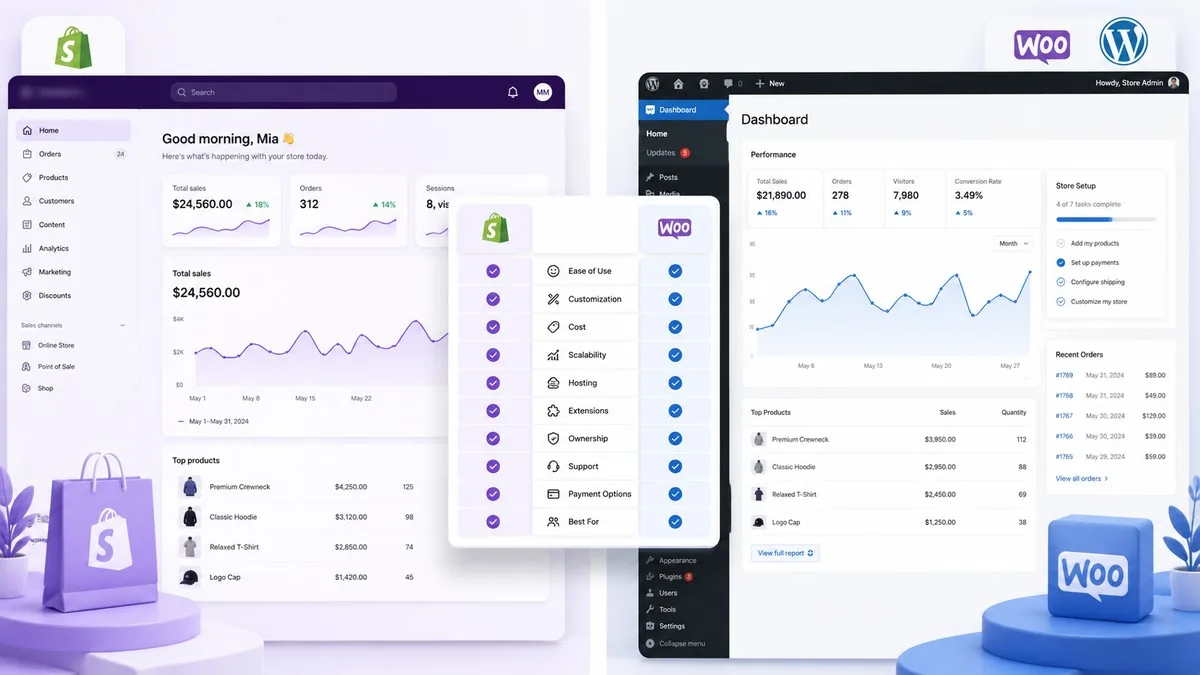
Quick Comparison: Shopify vs WooCommerce vs BigCommerce (2026)
| Platform | Starting Price | Transaction Fees | Hosting | Best For | Our Rating |
|---|---|---|---|---|---|
| Shopify | $39/mo ($29 annual) | 0% with Shopify Payments; up to 2% with 3rd party | Included | Beginners + scaling fast | ⭐⭐⭐⭐⭐ 4.8/5 |
| WooCommerce | Free plugin (~$20–40/mo total with hosting) | 0% (gateway fees apply) | Self-managed | WordPress users + full control | ⭐⭐⭐⭐ 4.3/5 |
| BigCommerce | $39/mo (Core) | 0% on all plans | Included | High-volume + multi-storefront | ⭐⭐⭐⭐ 4.5/5 |
Shopify — Best for Beginners and Scaling Fast

Shopify is the dominant force in ecommerce, powering 28.8% of the top 1 million online stores globally as of 2026. It is a fully hosted, all-in-one platform — you pay a monthly fee and Shopify handles servers, security, updates, and PCI compliance. There is nothing to install, patch, or maintain.
Setup is genuinely fast. A basic store with products, payment, and shipping can be live in a weekend. Shopify’s checkout is widely regarded as the best-converting in the industry, and its 8,000+ app marketplace covers virtually every use case from subscriptions to loyalty programs to print-on-demand.
Shopify Pricing (Verified June 2026)
| Plan | Monthly | Annual (save 25%) | Transaction Fee (3rd party gateway) |
|---|---|---|---|
| Starter | $5/mo | — | — |
| Basic | $39/mo | $29/mo | 2.0% |
| Grow | $105/mo | $79/mo | 1.0% |
| Advanced | $399/mo | $299/mo | 0.6% |
| Plus | $2,300/mo (3-yr) / $2,500/mo (1-yr) | — | 0.2% |
Important: The Starter plan ($5/mo) only provides a buy button and checkout link — not a full storefront. The Basic plan at $29/month (annual) is the true entry point. If you use a third-party payment gateway instead of Shopify Payments, add a 2.0% surcharge on Basic, dropping to 0.6% on Advanced. Switching to Shopify Payments eliminates this fee entirely.
Credit card rates through Shopify Payments run 2.9% + $0.30 on Basic, improving to 2.5% + $0.30 on Grow and 2.4% + $0.30 on Advanced. Most stores adding apps and premium themes should budget $150–300/month total on the Basic plan.
Shopify Pros
- Fastest setup of any platform — full store live in hours
- Best-in-class checkout conversion rates
- 8,000+ apps for virtually any feature
- Hosting, SSL, and PCI compliance handled automatically
- Shopify POS for seamless online-to-offline selling
- 24/7 support via chat and email on all paid plans
Shopify Cons
- Transaction fee of up to 2% if you don’t use Shopify Payments (unavailable in some countries including India)
- Monthly app costs add up quickly — advanced stores can spend $500–1,400/month on apps alone
- Limited content management for blogs and editorial sites
- Switching platforms later is painful — data migration is complex
Who Shopify Is For
Shopify is ideal for entrepreneurs launching their first store, D2C brands that want to move fast, and businesses scaling from $0 to $10M+ in GMV without wanting to manage servers or developers. It is also the default choice for Indian businesses selling internationally, since Shopify Payments is not yet available in India but Razorpay and PayU integrations work cleanly.
Our Verdict on Shopify: The polish, speed, and ecosystem are unmatched. For 80% of businesses starting out or growing, Shopify is the correct choice — provided you use Shopify Payments (or an integrated gateway) to avoid transaction fees. If you are in India or a market without Shopify Payments, calculate your gateway costs carefully before committing.
WooCommerce — Best for Flexibility and Total Ownership


WooCommerce is a free, open-source plugin for WordPress that turns any WordPress site into a full ecommerce store. It powers 33.4% of all ecommerce websites globally by store count — more than any other platform — with 4.5 million live stores as of Q1 2026. That scale reflects one reality: the internet runs on WordPress, and WooCommerce is how WordPress stores sell.
The plugin itself costs nothing. What you pay for is hosting, a domain, premium extensions, and whatever themes or developers you need. For technically capable users or those on tight budgets, this can be dramatically cheaper than Shopify. For users who want a hands-off experience, it can become expensive in both time and money.
WooCommerce Real Cost Breakdown (2026)
| Store Size | Hosting | Extensions | Estimated Annual Total |
|---|---|---|---|
| Small (1–50 products) | $3.99–$15/mo | $100–$200/yr | $148–$380/yr |
| Growing (50–500 products) | $15–$40/mo | $300–$600/yr | $480–$1,080/yr |
| Mid-market (500+ products) | $40–$100/mo | $600–$1,500/yr | $1,080–$2,700/yr |
Common paid extensions include WooCommerce Subscriptions ($279/year), WooCommerce Bookings ($249/year), and advanced shipping plugins ($119/year). Payment processing fees depend entirely on your gateway — WooPayments (powered by Stripe) charges 2.9% + $0.30 for US cards with no additional platform fee.
WooCommerce has no transaction fee at the platform level. You pay your payment gateway and nothing else on top.
WooCommerce Pros
- Free plugin — lowest barrier to entry of any full-featured platform
- No transaction fees — keep more revenue as you scale
- Total ownership of data, code, and infrastructure
- Unlimited customization — if WordPress can do it, WooCommerce can do it
- 60,000+ WordPress plugins extend functionality in every direction
- Strong for content-heavy businesses — blogs, media, editorial alongside ecommerce
- Best for India: works with every Indian payment gateway (Razorpay, PayU, CCAvenue, Paytm)
WooCommerce Cons
- You manage hosting, security, backups, and updates — this is real ongoing work
- A slow host or misconfigured plugin stack can tank conversion rates
- No native 24/7 support — help comes from community forums, documentation, or paid developers
- Security is your responsibility — WooCommerce sites are common targets for attacks if not maintained
- Hidden costs accumulate: premium themes, plugin renewals, developer time
Who WooCommerce Is For
WooCommerce is the right choice if you already have a WordPress site, if you want full ownership of your data and code, if you sell in India or markets with complex local payment requirements, or if your store requires deep customisation that SaaS platforms cannot accommodate. It is not the right choice if you want to launch fast and manage nothing technical.
For a deep dive on hosting options for your WooCommerce store, see our guide to the best web hosting in 2026.
Our Verdict on WooCommerce: WooCommerce is genuinely powerful and genuinely free — but “free” hides real costs in hosting, extensions, and developer time. If you are technically comfortable and value ownership over convenience, it is an excellent choice. If the idea of managing WordPress updates fills you with dread, choose Shopify.
BigCommerce — Best for High-Volume and Multi-Storefront Operations
BigCommerce is a fully hosted SaaS platform that targets mid-market and enterprise merchants who have outgrown Shopify’s limitations — particularly around native features, multi-storefront management, and B2B selling. Unlike Shopify, BigCommerce charges zero transaction fees on all plans, regardless of which payment gateway you use.
BigCommerce updated its plan names on June 1, 2026. What was Standard, Plus, and Pro is now Core, Growth, and Scale. The pricing remains similar, but the new plans come with revised GMV caps and a new Open Payment Provider Fee for stores not using an embedded payment provider.
BigCommerce Pricing (Updated June 2026)
| Plan | Monthly | Annual (save ~20%) | GMV Cap | Platform Transaction Fee |
|---|---|---|---|---|
| Core | $39/mo | $29/mo | $30K/yr | 0% (embedded gateway) / 2% (open gateway) |
| Growth | $105/mo | $79/mo | $100K/yr | 0% (embedded gateway) / 1% (open gateway) |
| Scale | $399/mo | $299/mo | $400K/yr | 0% (embedded gateway) / 0.6% (open gateway) |
| Performance | From $1,499/mo | Custom | Custom | Custom |
GMV caps matter: If your store exceeds the GMV limit on your plan, BigCommerce automatically upgrades you to the next tier. A Core store doing $35K in GMV will be bumped to Growth mid-year, raising your monthly cost from $29 to $79 (annual). Plan ahead.
The new Open Payment Provider Fee is a meaningful change: if you use a third-party gateway not on BigCommerce’s “embedded” list, you now pay 2.0% (Core), 1.0% (Growth), or 0.6% (Scale) on GMV from those orders. This narrows the “no transaction fee” advantage for merchants using uncommon gateways.
BigCommerce Pros
- Zero native transaction fees — the best deal among hosted platforms for high-volume stores
- Native multi-storefront: run multiple brands from one admin (Shopify needs a separate plan per store)
- Best-in-class native B2B features — customer groups, price lists, quote management built-in
- Headless commerce support out of the box — connect to any frontend framework
- More built-in features than Shopify at base price (no app required for product reviews, gift cards, faceted search)
BigCommerce Cons
- GMV caps force plan upgrades as you grow — can spike costs unexpectedly
- New Open Payment Provider Fee (June 2026) partially erodes the no-transaction-fee advantage
- Smaller app ecosystem than Shopify — fewer niche integrations available
- Steeper learning curve than Shopify — the admin is more complex
- Less brand recognition means fewer freelancers and agencies specialise in it
Who BigCommerce Is For
BigCommerce is the best fit for mid-market retailers doing $100K–$5M/year in GMV who need multi-storefront management, strong B2B features, or deep headless commerce capability. It is also compelling for stores using multiple payment gateways who want to avoid Shopify’s 3rd-party transaction surcharge.
Our Verdict on BigCommerce: BigCommerce punches above its weight on native features and B2B capability. The GMV caps and the new 2026 Open Payment Provider Fee are real drawbacks that require careful cost modelling. If you are doing serious volume and managing multiple storefronts, BigCommerce frequently beats Shopify on total cost.
Detailed Pricing Comparison: True Cost at Every Stage
| Scenario | Shopify | WooCommerce | BigCommerce |
|---|---|---|---|
| Just starting out ($0/mo budget) | $29/mo (Basic annual) | ~$5–10/mo hosting + free plugin | $29/mo (Core annual) |
| Growing store ($50K GMV/yr) | ~$79/mo + apps | ~$20–40/mo + extensions | $79/mo (Growth annual) |
| Scaling store ($500K GMV/yr) | $299/mo + 0.6% 3rd-party fee + apps | $40–100/mo + extensions + dev | $299/mo + 0% (or 0.6% open gateway) |
| India-specific gateway (Razorpay) | No Shopify Payments → 2% extra fee on Basic | Zero extra — native Razorpay plugin | Likely 2% (Core) open gateway fee |
For Indian merchants: Shopify Payments is not available in India as of June 2026. This means all transactions incur the third-party gateway surcharge (2.0% on Basic, 1.0% on Grow). On a store doing ₹50 lakh/year in GMV, that is ₹1 lakh/year extra just in Shopify transaction fees. WooCommerce or BigCommerce (with an embedded gateway) avoid this entirely. For an overview of all the platforms available for Indian online sellers, see our guide to what an ecommerce platform is and how to choose one.
Feature Comparison: Where Each Platform Wins
| Feature | Shopify | WooCommerce | BigCommerce |
|---|---|---|---|
| Ease of setup | ⭐⭐⭐⭐⭐ Easiest | ⭐⭐⭐ Moderate (need WordPress) | ⭐⭐⭐⭐ Easy |
| Transaction fees | 0% (own payments) / up to 2% (3rd party) | 0% platform fee | 0% (embedded) / up to 2% (open) |
| App/plugin ecosystem | ⭐⭐⭐⭐⭐ 8,000+ apps | ⭐⭐⭐⭐⭐ 60,000+ WP plugins | ⭐⭐⭐ ~1,000 apps |
| Customisation | ⭐⭐⭐⭐ Good with Liquid | ⭐⭐⭐⭐⭐ Unlimited | ⭐⭐⭐⭐ Good |
| B2B / wholesale | ⭐⭐⭐ Plus plan only | ⭐⭐⭐⭐ Via plugins | ⭐⭐⭐⭐⭐ Best native B2B |
| Multi-storefront | ❌ Separate plan per store | ✅ Via multisite | ✅ Native on Scale+ |
| Blogging / SEO | ⭐⭐⭐ Basic blog | ⭐⭐⭐⭐⭐ Full WordPress CMS | ⭐⭐⭐ Basic blog |
| Headless / API | ⭐⭐⭐⭐ Hydrogen framework | ⭐⭐⭐⭐ REST + GraphQL | ⭐⭐⭐⭐⭐ Best native headless |
| 24/7 support | ✅ All paid plans | ❌ Community only | ✅ All plans |
| POS (in-person selling) | ✅ Shopify POS (best) | ⭐⭐⭐ Via plugins | ⭐⭐⭐ Limited |
Which Should You Choose?
Here is a decision guide based on your situation. Skip the comparison and just answer these questions:
- You want to launch quickly with zero technical headaches → Choose Shopify. Pay for the Basic annual plan, use Shopify Payments or an integrated gateway, and your store will be live and conversion-optimised within days.
- You already run WordPress or need deep content integration → Choose WooCommerce. The plugin is free and the ecosystem is vast. Invest in good managed WordPress hosting (Kinsta, WP Engine) and a caching layer.
- You are in India and can’t use Shopify Payments → Choose WooCommerce (for cost control) or BigCommerce (for a hosted experience without the Shopify gateway surcharge).
- You manage multiple brands or need enterprise B2B features → Choose BigCommerce. Multi-storefront is native, B2B price lists are built-in, and the headless capabilities are industry-leading.
- You are doing $500K+ GMV and want to minimise platform fees → Model both Shopify Advanced and BigCommerce Scale — the outcome depends on your gateway setup and GMV trajectory.
- You want maximum SEO and blogging capability alongside ecommerce → Choose WooCommerce. WordPress remains the world’s most powerful content management system, and WooCommerce inherits all of that SEO muscle.
💡 Our Take
We have tested all three platforms extensively. Shopify wins on polish, speed, and peace of mind — it is the Netflix of ecommerce platforms and worth the subscription for most businesses. WooCommerce wins on ownership, flexibility, and cost at scale if you have the technical chops to manage it. BigCommerce is the underrated option for serious merchants who want Shopify-level hosting without Shopify’s transaction fee model.
One thing that rarely gets said: the platform matters far less than your product, your marketing, and the quality of your customer experience. Pick a platform, commit to it for 18 months, and focus your energy on what actually drives sales.
If you need help choosing the right tools to grow your online store, our Best AI SEO Tools 2026 guide covers the analytics and content tools that drive traffic to whatever platform you choose.
How to Migrate Between Platforms
Switching platforms is disruptive but manageable. For Shopify to WooCommerce (or vice versa), tools like LitExtension or Cart2Cart migrate products, customers, and orders automatically — expect a weekend of work and some manual cleanup. Set up 301 redirects for every URL that changes to preserve your SEO rankings. BigCommerce to Shopify migrations follow the same process. Whatever you do, never migrate during peak sales periods (Diwali, Black Friday, etc.).
Frequently Asked Questions
Is Shopify available in India and does it support Indian payment gateways?
Yes, Shopify is fully available in India. However, Shopify Payments — Shopify’s own payment processor — is not available in India as of June 2026. This means Indian merchants must use third-party gateways like Razorpay, PayU, or CCAvenue, which incur an additional transaction surcharge of 2.0% (Basic), 1.0% (Grow), or 0.6% (Advanced). For high-volume Indian sellers, this makes WooCommerce or BigCommerce more cost-effective.
Is WooCommerce really free? What are the hidden costs?
The WooCommerce plugin is genuinely free and open source. But a production-ready store is not free. You need: web hosting ($10–40/month), a domain (~$10/year), an SSL certificate (usually free via Let’s Encrypt), a premium theme ($50–200 one-time), and likely several paid extensions ($100–900/year for subscriptions, bookings, shipping tools, etc.). A small WooCommerce store realistically costs $150–500/year in total; a mid-size store $1,000–3,000/year. The “free” label refers to the software license, not the total cost of operation.
What are BigCommerce’s GMV caps and what happens when I exceed them?
BigCommerce’s 2026 plans have annual GMV caps: Core at $30K, Growth at $100K, and Scale at $400K. If your store’s GMV exceeds the cap mid-year, BigCommerce automatically upgrades you to the next plan tier. There is no surcharge for exceeding the cap — you simply pay the higher plan rate from that point forward. This is worth planning for: a store growing rapidly from Core to Growth mid-year will pay the difference unexpectedly.
Can I switch from WooCommerce to Shopify without losing my SEO rankings?
Yes, if you do it correctly. The key step is implementing 301 redirects from every old URL to the corresponding new URL on Shopify. If your WooCommerce site used permalink structures like /product/[slug]/ and Shopify uses /products/[slug]/, every old URL needs a redirect to the new one. Submit the new sitemap to Google Search Console immediately after migration and monitor for crawl errors in the weeks that follow. Most sites recover rankings within 30–60 days of a well-executed migration.
Which platform is better for dropshipping in 2026?
Shopify is the dominant platform for dropshipping. It has the deepest integrations with DSers (AliExpress), Spocket, Zendrop, and AutoDS — all of which automate product imports, order routing, and tracking updates. WooCommerce also supports dropshipping via AliDropship and WooDropship, but the setup is more complex and requires hosting management. BigCommerce has fewer dropshipping-specific apps. For a hands-off dropshipping operation, Shopify wins clearly.
Is BigCommerce better than Shopify for large stores?
It depends on the specific large store. BigCommerce has meaningful advantages for stores with complex B2B requirements (customer-specific pricing, quote management, purchase orders), multiple storefronts, or headless architecture needs. Shopify Plus is more established at the highest enterprise tier and has a larger ecosystem of Plus-certified partners. If your store does $1M–$10M in GMV and is purely DTC with standard B2C requirements, Shopify Advanced or Plus is typically the stronger choice. If you run B2B alongside B2C, or manage 3+ storefronts, BigCommerce often wins on total cost and native feature coverage.
Prices verified June 2026 from official sources: Shopify pricing, WooCommerce pricing, and BigCommerce pricing. Always check official pages before making a final decision as rates change.


