


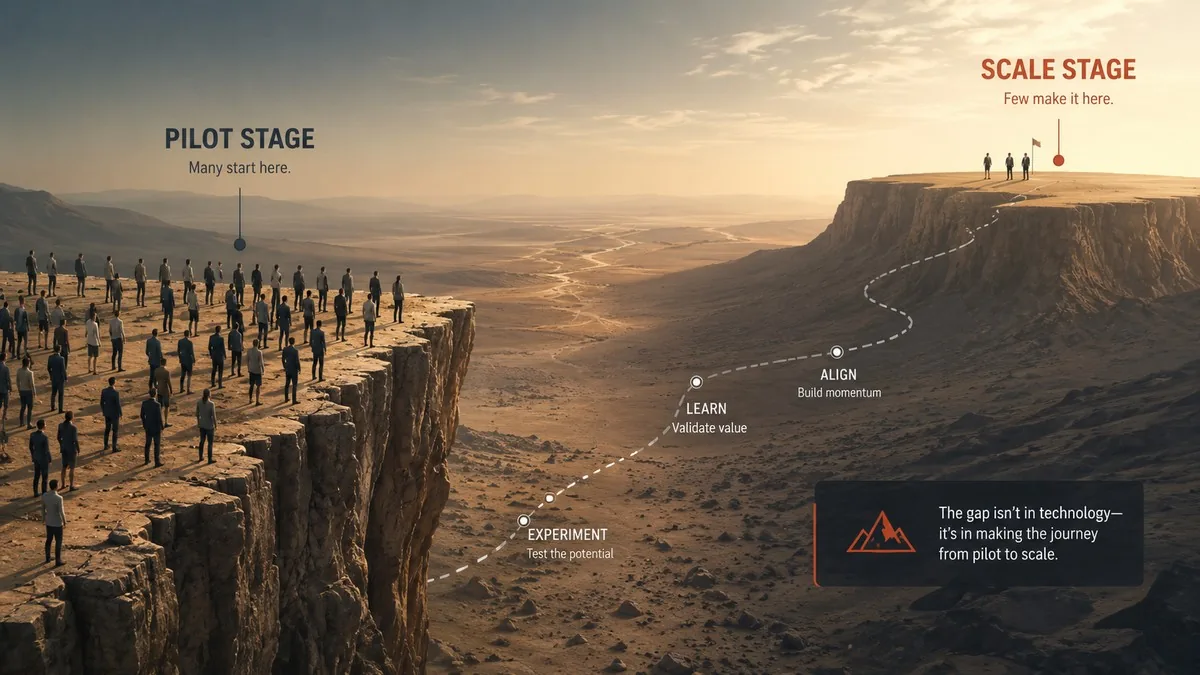
Ness Digital Engineering reported in August 2026 that approximately 99% of companies plan to put AI agents into production while only 9–14% have fully done so, a gap the firm names the “Death Valley” between proof of concept and production. The report, carried by ANI on August 19, 2026, attributes the failure to two non-technical causes: lost trust in probabilistic generative AI output, and no visible difference in employees’ daily user experience.
What the Death Valley Gap Measures
Death Valley describes the distance between an AI agent pilot that works in a demo and an AI agent that runs in live business operations, and Ness Digital Engineering puts 85 to 90 percentage points of company intent inside that gap. The metaphor borrows from startup financing, where companies fail between an early funding round and profitability rather than at launch.
Ness Digital Engineering names two reasons in the report:
- Loss of trust in probabilistic solutions — teams stop relying on generative AI output whose answers vary between identical runs.
- No visible change in daily user experience — employees cannot feel the agent working, so adoption never reaches the threshold that justifies production spend.
Neither cause is a model capability failure. Both are deployment design failures, which places the fix inside the buyer’s control rather than the vendor’s roadmap.
What the Report Says Survivors Do Differently
Ness Digital Engineering recommends routing every agent through the messaging window employees already use, with the agent gathering data from multiple back-end systems via APIs, instead of shipping a separate dashboard. A second interface competes with the workflow; the existing one absorbs the agent into it.
The report makes two further recommendations. Judge an agent project by the improvement in user experience, not by task automation counts alone. Track LLM token consumption, AI subscriptions, and cloud costs at the individual application level, then compare that figure against the expected return for that application.
Businesses selecting a platform before running that comparison can start with our guide to the best AI agents for business tasks, which maps each tool to the workflow it handles.
How the Numbers Compare to Other Research
Independent research points the same direction from different angles. McKinsey’s State of AI finds roughly one third of organizations are scaling AI at all and 39% report bottom-line impact. Gartner predicted in June 2025 that over 40% of agentic AI projects will be cancelled by the end of 2027 because of escalating costs and unclear business value — a forecast about project cancellation broadly, not about the POC-to-production gap Ness Digital Engineering measures.
Sector spending keeps climbing regardless. The agentic AI market in financial services is projected to reach USD 33.26 billion by 2030, according to the figure cited in the Ness Digital Engineering report. Traditional financial institutions concentrate agent deployments in back-office efficiency and IT, while digital-native fintechs build agents into customer-facing experiences.
Our Take
Companies stall in Death Valley because they measure inputs — demos delivered, tokens consumed, tasks automated — and never measure the output that decides renewal, which is the change an employee or customer can perceive. Traditional enterprises carry the higher stall risk here: back-office agents produce efficiency that no user sees, which is precisely the invisible-change failure the report names. Digital-native firms putting agents in front of customers get a visible delta by default. The practical test before funding a production rollout: name the person whose day changes and describe how they would notice. A project that cannot answer that will not cross.
For Context
Vendors are attacking the production gap with pricing and packaging. Pega moved to outcome-based pricing with enterprise AI agents at a flat fee per case, and OpenAI reported enterprise AI agents resolving 75% of customer calls on its Presence platform.
Related Reading
- Alibaba’s infrastructure answer to the same problem: running AI agent teams in the cloud.
- For deployments that already crossed, see real-world AI agent examples.


