


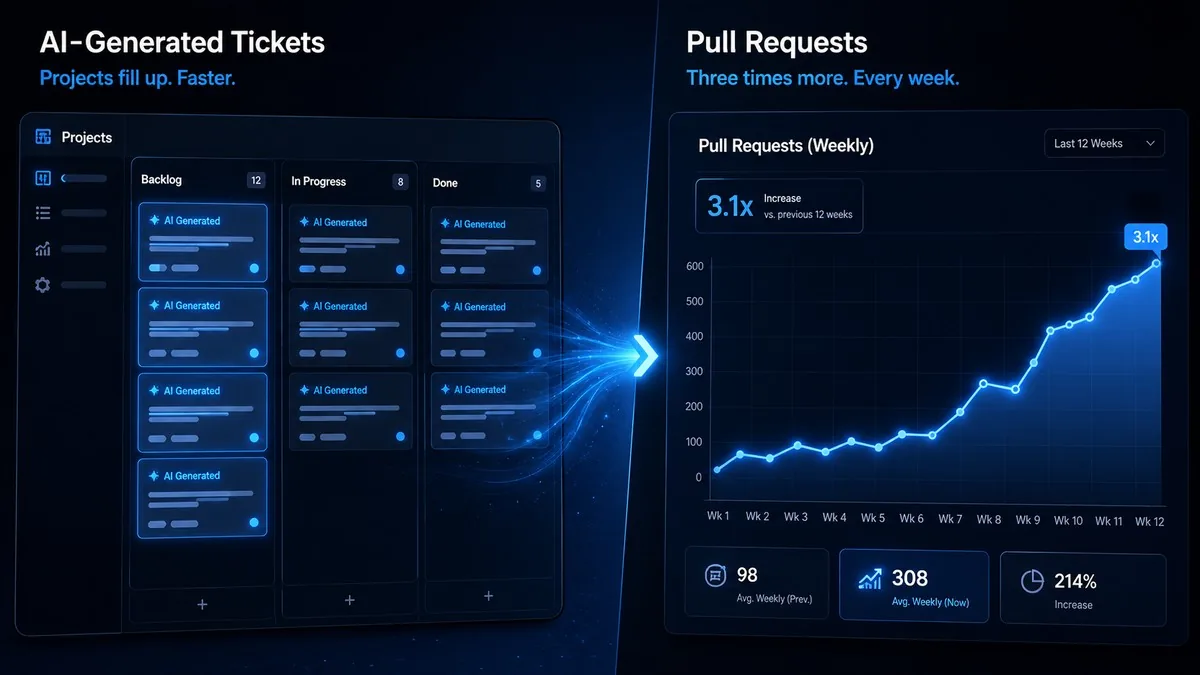
Linear published its “How teams build” data report on August 19, 2026, revealing that AI now authors just under half of everything created inside the project management platform. Linear drew the report from millions of issues and pull requests across its user base, making it usage data rather than a survey. At the current pace, AI will soon author more content in Linear than humans and integrations combined.
The report quantifies three shifts. Teams that connected a coding agent tripled their weekly pull requests over 2 years, from 21 to 65, while teams without one moved from 8 to 10. Between January and June 2026, the share of users active on AI features more than doubled in every function. CEOs at companies with 201 or more people posted the largest adoption jump of any cohort, from 9% to 36% in 6 months.
Coding Agents Tripled Weekly Pull Requests
Teams with a coding agent connected to Linear grew from 21 to 65 weekly pull requests over 2 years — a 3x increase — while teams without an agent grew from 8 to 10. The gap separates an operating-model decision from an experiment: the agent-connected cohort compounds output, and the unconnected cohort stays flat.
The pull-request gap is the report’s most commercially significant number for buyers comparing platforms, because it ties an AI feature directly to shipped-work volume. Teams evaluating where AI-native tooling fits their stack should weigh it alongside our benchmark-led guide to the best project management software, which compares Linear against Jira, ClickUp, and 9 other tools.
CEOs Are Adopting AI Features Faster Than Developers
CEO adoption of Linear’s AI features rose from 9% to 36% in 6 months at companies with 201 or more people — the steepest climb of any role in the report. Product managers rose from 12% to 34%, and go-to-market teams rose from 5% to 18% over the same January-to-June window. Developers already sit near saturation: 88.3% use AI regularly, up from roughly 72% in early 2024.
The role reversal matters because executives are learning AI by using it, not by delegating it. Linear Agent, launched in March 2026, packages the features driving that adoption: it creates issues from Slack messages, auto-triages bugs, flags duplicate issues, and drafts issue descriptions.
What the Data Means for Software Buyers
Linear’s data shows AI raising throughput at the input end of software work — more tickets, more pull requests, more drafted content. Earlier 2026 data from LinearB, which analyzed 8 million pull requests, identified the matching constraint: code review bottlenecks block teams from converting AI-produced code into shipped features. Decision-makers should therefore evaluate whether a platform helps manage review load, not only whether it produces more work items — the same absorption question that runs through our guide to the best AI tools for business.
One caveat bounds the findings: the report reflects Linear’s own user base, which skews toward startup and scale-up engineering teams, not a representative sample of the software industry.
For Context: AI Output Data in Software Teams on WithO2
- Databricks tested AI coding agents on real code — head-to-head agent performance data that complements Linear’s throughput numbers.
- AI coding bills are exploding — the cost side of the same adoption curve Linear measures.
- Best AI coding assistant 2026 — the tool choices behind the coding-agent cohort in Linear’s data.
Linear’s report is the clearest evidence yet that AI tools have crossed from experiment to operating model — real usage data, not a vendor survey, showing a 3x output gap between teams that adopted agents and teams that did not. The CEO cohort leading adoption signals that board-level pressure to adopt AI has arrived. The loser is any project management vendor still selling AI as a premium add-on; the risk for buyers is mistaking more tickets for more shipped product while review capacity stays flat.


