


Published: July 27, 2026
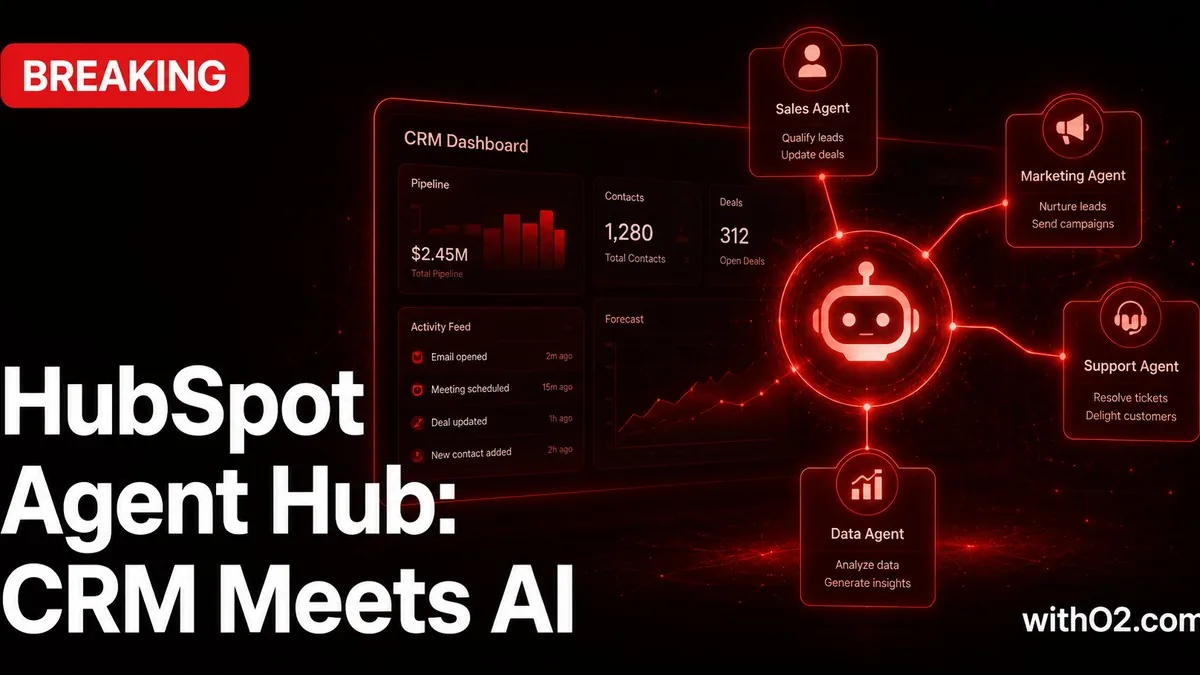
HubSpot launched Agent Hub and Agent Builder in public beta on July 23, 2026, giving all Pro and Enterprise customers a single console to build, monitor, and coordinate AI agents that share live customer context across sales, marketing, and service. The launch targets a specific enterprise failure mode: fragmented agents, such as a prospecting agent and a service agent, contacting the same customer simultaneously without knowing about each other. It is HubSpot’s clearest move yet in its repositioning as an “Agentic Customer Platform.”
What Agent Hub and Agent Builder do
Agent Hub is a centralized dashboard showing live status and performance for every active agent in a HubSpot account. Agent Builder lets teams create custom agents in natural language through Breeze Assistant, drawing on existing HubSpot data such as deal history, contact records, and buying signals. A unified canvas connects workflows, custom agents, and triggers in one place, and agents fire from multiple trigger sources: schedules, webhooks, or third-party integrations. Both tools shipped in public beta — not general availability — to all Pro and Enterprise customers, with no pricing disclosed.
“Agent Hub fixes that one place to see agent performance, all working together and using shared context. That’s what will drive outcomes for go-to-market teams,” said Duncan Lennox, Chief Product and Technology Officer at HubSpot, according to CMSWire.
One early customer, tutoring company Ignite Reading, built an agent that finds and parses school district calendars — a task that previously took 15–20 minutes per district and now takes seconds, saving the company more than 350 hours per year.
Why shared context is the differentiator
Agent sprawl is the problem Agent Hub is built against. Enterprises deploying AI agents for business tasks across departments face agents that duplicate outreach, contradict each other, and act on stale data. HubSpot’s architectural answer is shared CRM context: every agent reads the same live deal history and buying signals, so a service agent knows what the prospecting agent did an hour earlier. The approach mirrors a market-wide shift toward multi-agent orchestration — SAP announced its own AI Agent Hub at Sapphire 2026 with general availability due in Q3 2026, and Gartner estimates $234 billion in enterprise software spending is at risk from agentic AI.
What this means for CRM buyers
Teams comparing the best CRM software should now weigh agent orchestration as a selection criterion alongside pipeline and reporting features. HubSpot enters the fight from a mixed position: Q1 2026 revenue reached $881 million, up 23% year over year, and enterprise deals above $120,000 ARR grew 64% — yet HubSpot shares are down roughly 48% year to date. Agent Hub is both a product answer to Salesforce Agentforce and a strategic argument for HubSpot’s valuation.
Our Take
HubSpot’s Agent Hub is the right product at the right moment — the agent-collision problem it targets is real and gets worse with every agent an enterprise adds. The open question is whether shared context actually prevents those collisions in production, or just gives managers a prettier dashboard to watch the same chaos in one place. Public beta results from go-to-market teams will answer that before general availability does.
For Context
Enterprise vendors are racing to ship agent-orchestration consoles this summer. Our recent coverage tracks the pattern: Pega Infinity ’26 priced enterprise AI agents at a flat fee per case, and Alibaba’s agent-native cloud lets businesses run AI agent teams.


