


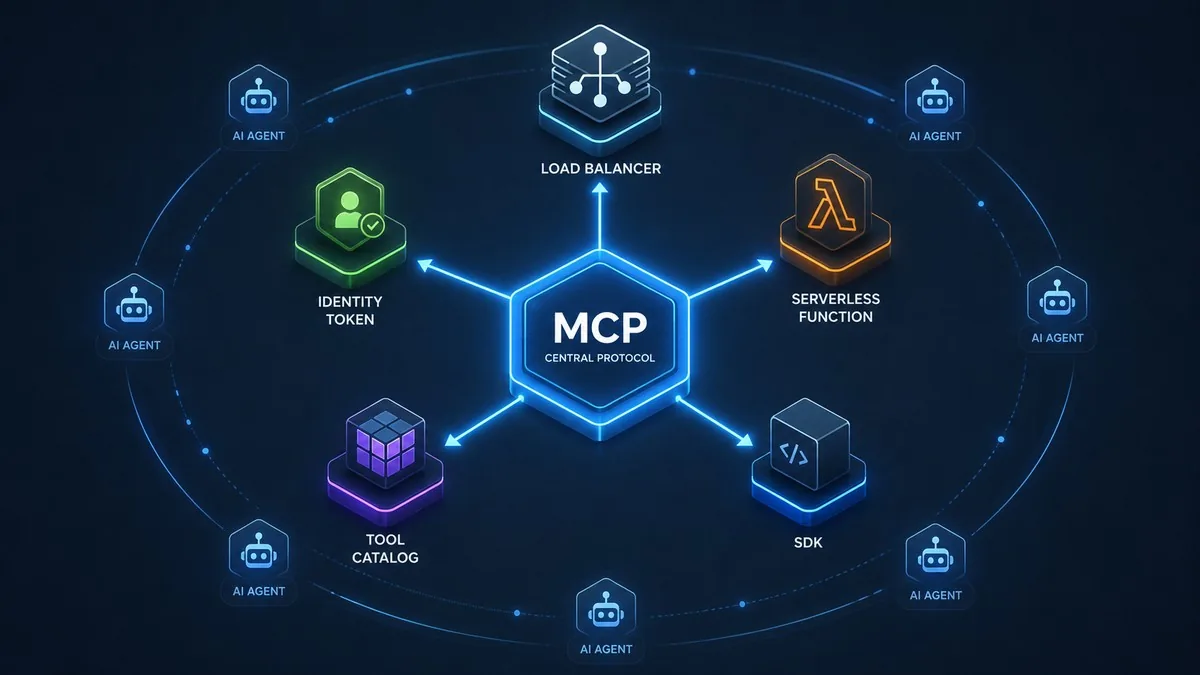
The Model Context Protocol (MCP) published an updated roadmap on August 22, 2026, naming five priority areas for the next specification release: agentic messaging primitives, HTTP-native transport unification, agent identity and enterprise-ready security, improved primitives, and improved SDK developer experience. Lead Maintainers David Soria Parra and Den Delimarsky wrote the roadmap with the Core Maintainers and MCP Working Groups. The roadmap follows the 2026-07-28 specification release, which the maintainers call the largest revision of the protocol since launch.
What the New MCP Roadmap Prioritizes
The new roadmap organizes MCP’s next specification cycle into five priority areas, each owned by named Core Maintainers and at least one Working Group. The March 2026 roadmap listed four areas — transport evolution and scalability, agent communication, governance maturation, and enterprise readiness — so the August version expands the scope by one and re-cuts the boundaries.
- Agentic messaging primitives — server-initiated events via webhooks and channels, so clients stop polling for results, plus maturing the Tasks extension (SEP-2663) into the specification proper.
- HTTP-native transport unification and hardening — extending the stateless HTTP model to more deployment modes, including local servers speaking Streamable HTTP over stdio.
- Agent identity and enterprise-ready security — a standard way for servers to recognize agent callers, built on DPoP, Workload Identity Federation, and token exchange.
- Improved primitives — one contract for
tools/callresult handling, plus progressive discovery for servers that expose large tool catalogs. - Improved SDK developer experience — ergonomics, documentation, and specification conformance across every supported language.
SEPs that fall inside these five areas get expedited maintainer review. Proposals outside them are not rejected automatically, but review time goes to the priority areas first. Business buyers evaluating agent platforms can read the list as a shipping forecast: identity, long-running tasks, and tool-catalog scale are the vendor capabilities arriving next, and they map directly to the automation gaps in the 12 Best AI Agents for Business Tasks comparison, where per-tool permissions and long-job handling separate the platforms.
Why Agent Identity Is the Roadmap’s Biggest Business Change
MCP authorization today assumes a person approves access in a browser, and the roadmap targets that assumption directly. The maintainers state that a growing share of callers are agents running as cloud workloads with their own identity, acting for a user who is not present, or delegating narrower authority to sub-agents. MCP’s answer is a standardized identity path built on existing standards — Demonstrating Proof of Possession (RFC 9449), Workload Identity Federation, and the ID-JAG grant behind Enterprise-Managed Authorization — instead of pasted API keys and long-lived tokens.
The maintainers also committed to continued engagement with the IETF OAuth and WIMSE working groups. For regulated buyers, such as banks, insurers, and healthcare providers, agent identity is the control that makes an audit trail attributable to a specific agent rather than to a shared service account.
How Progressive Discovery Fixes Tool-Heavy Servers
Progressive discovery lets an MCP server expose a small entry point and reveal more of its tool catalog as a conversation narrows. The maintainers name the problem exactly: connecting to a server with a hundred tools means the model pays for that entire surface before the user asks a single question, and tool selection degrades as the list grows. Vendors shipping wide MCP servers, such as CRM, ERP, and helpdesk suites, carry that cost today on every request.
What Already Shipped in the 2026-07-28 Release
The July 28 specification removed protocol-level sessions and the initialization handshake, letting a server scale horizontally without holding state (SEP-2575, SEP-2567). Clients can now call server/discover to read a server’s supported versions and capabilities before connecting, and list results are cacheable (SEP-2549). Multi Round-Trip Requests (SEP-2322) replaced server-initiated requests so elicitation works on stateless servers. Governance shifted too: MCP adopted a Contributor Ladder, Working Groups now triage SEPs in their own areas, and the specification gained a formal feature lifecycle and deprecation policy.
Our take: The stateless rewrite made MCP servers cheap to run; this roadmap makes them safe to delegate to. A remote MCP server is now, in the maintainers’ words, “no different from any other HTTP workload” — so the remaining barrier to production agents is not infrastructure, it is knowing which agent did what. Ask any AI automation vendor two questions before signing: does your agent authenticate with its own identity, and does it hold sessions? A vendor answering “shared API key” and “yes” is one specification cycle behind.
For Context
- MCP 2026 Spec Is Live: What the Stateless Rewrite Means for AI Tools — our coverage of the July 28 release this roadmap builds on, including the three deprecated features.
- Vint Cerf Retires and Warns AI Agents Need Formal Protocols — the standards argument MCP’s governance changes now answer.
Related Reading
- Humans Miss 1 in 3 AI Agent Threats — 40,000-Run Study — why agent identity and audit trails matter operationally.
- Cloudflare Wallets Lets AI Agents Spend Money — With Limits You Set — a parallel attempt to bound what an autonomous agent may do.
- 15 AI Agent Examples Across Industries — the workloads these protocol changes are built to carry.
Source: The New MCP Roadmap, Model Context Protocol Blog, August 22, 2026.


