


Published: July 25, 2026, 6:40 PM IST
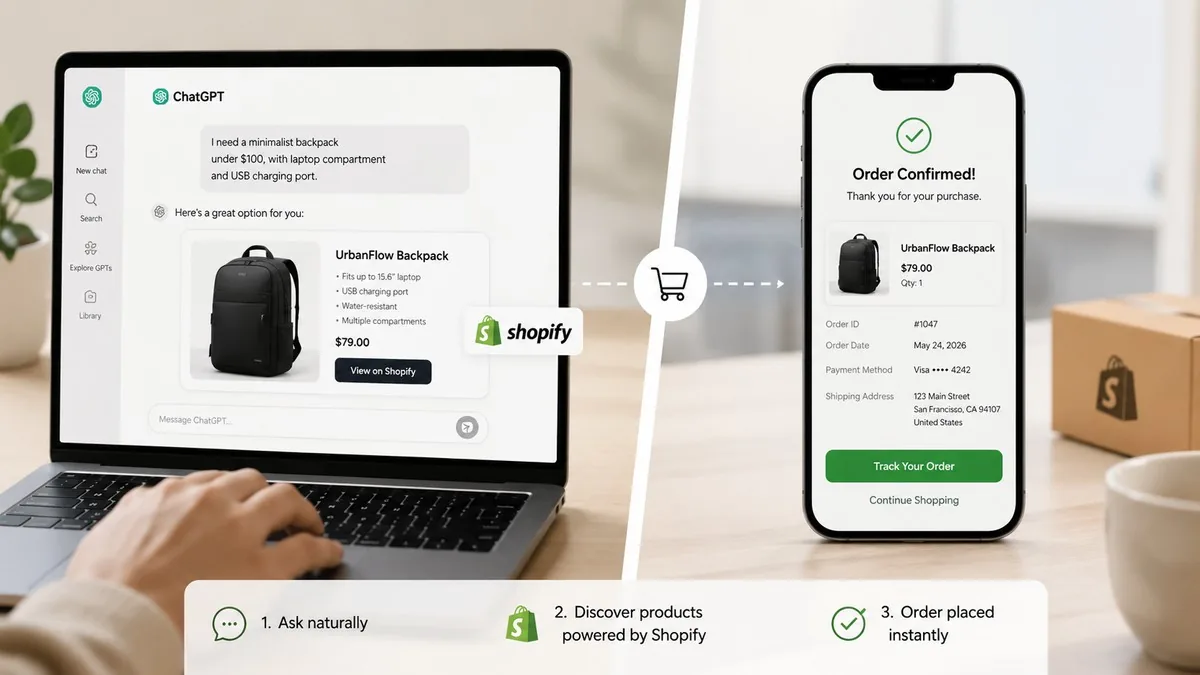
Shopify released its Summer 2026 Edition on June 17, 2026, shipping more than 150 updates in a single drop and enabling the Universal Commerce Protocol (UCP) by default on every store. UCP automatically syndicates eligible products to ChatGPT, Microsoft Copilot, Google AI Mode, Gemini, and the Shop app without any merchant setup, making every Shopify catalog readable and purchasable by AI shopping agents. CEO Tobi Lütke framed the release around “commerce showing up everywhere a customer already is.”
The Edition is Shopify’s largest ever by update volume, and its central claim is that a merchant’s store must now sell to AI agents, not only to people. Alongside UCP, Shopify moved AI merchandising — collection sorting, cross-sell, and search — natively into the admin, removing several tasks merchants currently pay third-party apps to handle.
What is the Universal Commerce Protocol?
The Universal Commerce Protocol is an open standard, co-developed by Shopify and Google, that lets AI agents read a merchant’s catalog and complete purchases through a single standardized interface. Shopify enabled UCP by default on every store in the Summer 2026 Edition, so any Shopify merchant becomes agentic-commerce-ready without developer work. Before UCP, an AI agent shopping on a customer’s behalf required a custom integration built separately for each merchant.
Every Shopify admin now includes an Agentic section that shows which AI channels a product surfaces in and reports agent-driven activity metrics. Salesforce independently adopted the same UCP standard and moved its Agentforce Commerce with ChatGPT integration to general availability on July 6, 2026, signaling that the industry is converging on UCP as the shared standard for AI commerce.
What AI merchandising features did Shopify add?
Shopify added 4 native AI merchandising capabilities that previously required paid apps: AI Collection Sort, predictive cross-sell blocks, a merchandising insights panel, and AI-powered on-site search. AI Collection Sort orders products by real-time conversion probability. Predictive cross-sell blocks are cart-aware and need no separate upsell app. The merchandising insights panel explains why each product ranks where it does. On-site search now returns predictive results with typo tolerance.
The Edition also moved Checkout Components to general availability for Shopify Plus, where early adopters reported conversion lifts of 8–22%, and added native A/B testing for themes and checkout configurations. Sidekick, Shopify’s assistant, can now execute store tasks from plain-language commands, and a Retail AI Sales Associate extends Sidekick to point of sale. This mirrors the broader shift toward AI acting as a shopping agent inside consumer assistants.
What does agentic commerce mean for platform choice?
Agentic commerce by default is a direct differentiator for merchants choosing an ecommerce platform, because a WooCommerce, BigCommerce, or Magento store does not receive AI syndication automatically and would need custom integrations to match it. Shopify enabling UCP for its merchant base commoditizes a capability that Salesforce is selling to enterprise clients as an individually configured service. Merchants weighing this trade-off can compare storefront options on our guide to the best ecommerce platform for a growing store.
Salesforce reported that AI influenced 20% of global online sales during the 2025 holiday season, worth 262 billion dollars, and that retailers running shopper agents grew sales 59% faster than those without them. Those figures frame why platform vendors are racing to make catalogs agent-readable.
For Context
WithO2 has tracked AI moving from assistant to autonomous actor across business software, including OpenAI’s ChatGPT for Work. Shopify’s Summer 2026 Edition applies the same pattern to retail: the store stops waiting for shoppers and starts feeding AI agents that buy on their behalf.
Our Take
Shopify flipped the channel model. Instead of merchants chasing customers through social ads and SEO, AI agents now come to the merchant’s catalog — and the platform that makes that easiest wins the next decade of ecommerce. Enabling UCP by default for its entire merchant base is a deliberate land-grab: Shopify commoditized agentic commerce the same season Salesforce began charging enterprise clients to configure it. The risk for merchants is app-ecosystem lock-in, as Shopify absorbs the merchandising, upsell, and testing functions that independent apps used to sell.
Frequently asked questions
Is Universal Commerce Protocol turned on automatically?
Yes. Shopify enabled the Universal Commerce Protocol by default on every store in the Summer 2026 Edition, syndicating eligible products to AI channels without merchant setup.
Which AI channels do Shopify products syndicate to?
Shopify products auto-syndicate to 5 channels: ChatGPT, Microsoft Copilot, Google AI Mode, Gemini, and the Shop app.
How much do Checkout Components lift conversion?
Early adopters of Shopify Checkout Components reported conversion lifts of 8–22%, according to Shopify’s Summer 2026 Edition recap.
Sources: Shopify Editions Summer 26 recap; Salesforce Agentforce Commerce announcement.


