


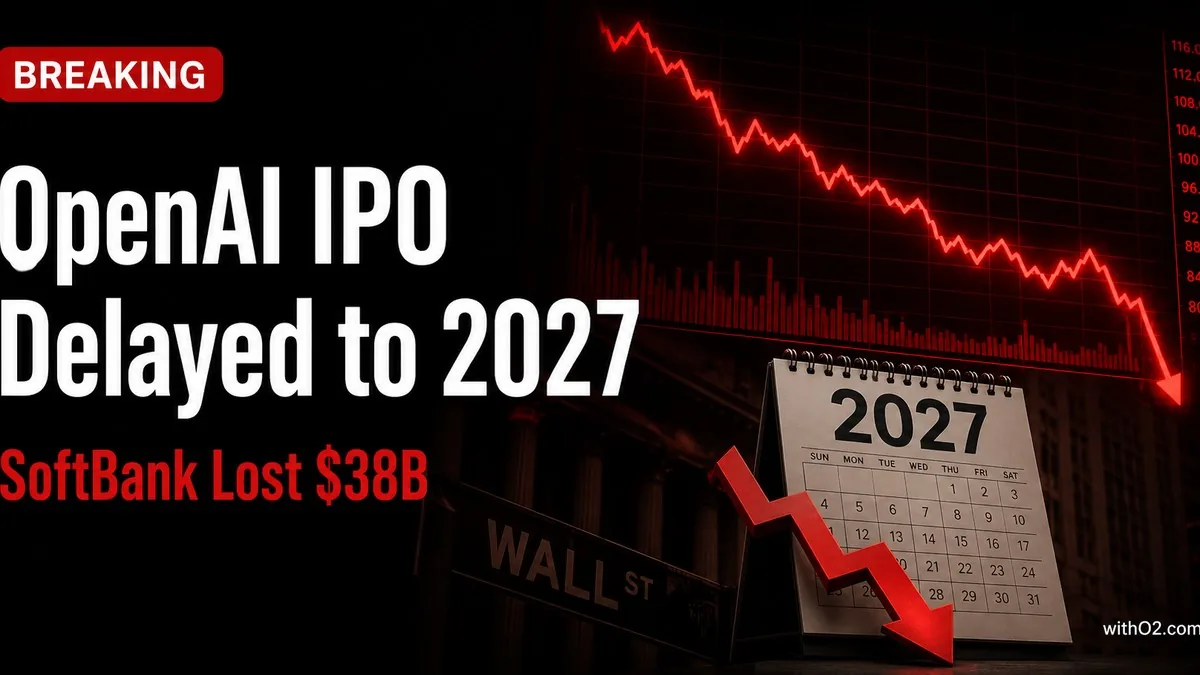
OpenAI is leaning toward delaying its public listing to 2027 — and the news has already cost its biggest backer $38 billion. On June 26, shares of SoftBank fell more than 12% in a single Tokyo session after the New York Times reported that CEO Sam Altman refused to list the company at any valuation below $1 trillion, even if that means waiting another year. For investors who had priced in a landmark 2026 tech IPO, the market’s message was immediate and unambiguous.
The story, confirmed by TechTimes, describes Altman’s advisers presenting him with a stark binary: accept a lower valuation and list in late 2026, or hold out for $1 trillion and wait until 2027. He chose to wait. OpenAI filed a confidential S-1 with the SEC in May 2026, but has stated publicly that a listing date has not been decided.
OpenAI IPO Status — July 2026
- Confidential S-1 filed: May 22, 2026
- Altman’s valuation floor: $1 trillion (last private mark: $852B)
- SoftBank stake: ~13%; $40B bridge loan due March 2027
- CFO’s concern: $600B in future infrastructure commitments
- Prediction market odds: 59% chance of IPO announcement by March 2027
Why Altman Won’t Accept a Lower Number
OpenAI’s last private valuation was $852 billion, set in March when the company closed a $122 billion funding round led by SoftBank, Amazon, and Nvidia. Reaching $1 trillion would put OpenAI alongside Nvidia, Microsoft, and Apple — the only companies that have sustained that threshold in public markets. The gap is roughly 17%, and Altman’s advisers have warned that volatile 2026 conditions make it unlikely public investors will close it this year.
CFO Sarah Friar separately flagged two structural concerns: OpenAI has accumulated roughly $600 billion in future infrastructure spending commitments, and the company may not yet meet the reporting standards required of a public company on Altman’s compressed timeline. OpenAI’s audited 2025 net loss came in at $38.53 billion, and analysts at HSBC estimate the company could need more than $207 billion in additional capital through 2030 even under optimistic scenarios.
Recent market history added weight to the caution. SpaceX’s own IPO in June opened at $150 per share, hit $225, then fell 32% within two weeks. Altman’s team cited that volatility directly when advising him to hold out.
SoftBank’s Clock Is Running
For SoftBank, this is not merely a delayed payday — it is a collision with a debt deadline. The Japanese investment giant took on a $40 billion bridge loan to fund its OpenAI position, with repayment due in March 2027. A public OpenAI was the planned exit valve. Without it, SoftBank must navigate its largest debt maturity with no confirmed liquidity event. A separate $6 billion margin loan — collateralized by SoftBank’s OpenAI stake — has already stalled, because lenders cannot set a loan-to-value ratio without a public market reference price. S&P Global downgraded SoftBank’s credit outlook to negative in March; that pressure is now likely to persist.
The Rival Quietly Closing the Gap
Altman’s $1 trillion argument also has to contend with what Anthropic has done in parallel. The rival AI lab closed a funding round in late May at a valuation of $965 billion — $113 billion above OpenAI’s own last private mark. Anthropic projected $10.9 billion in Q2 2026 revenue alone, a figure that would exceed its entire 2025 annual revenue in a single quarter. The gap between the two companies has closed faster than most analysts expected.
Prediction markets on Kalshi currently place 59% odds on an official OpenAI IPO announcement by March 2027, and roughly 73% probability by June 2027.
Our Take
Altman is making a bet the market cannot make for him: that by 2027, revenue growth and narrowing losses will justify what looks today like an inflated floor. That is a reasonable bet — if Anthropic doesn’t get there first. Every month OpenAI waits for the right public market window, Anthropic closes the valuation gap and strengthens the argument that there is real competition at the frontier. SoftBank’s $40 billion clock, meanwhile, does not wait for anyone’s revenue trajectory.


