


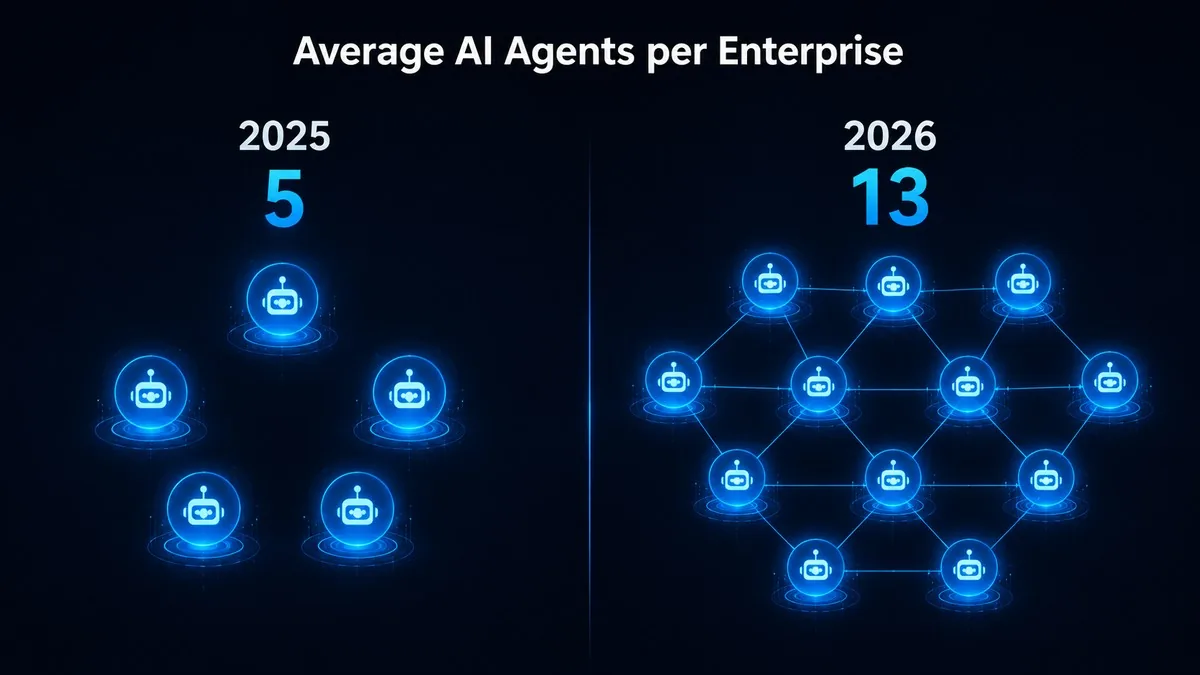
Salesforce’s second Agentic Enterprise Index, covering February 2025 through April 2026, shows the average enterprise now runs 13 active AI agents — nearly three times the 5 agents recorded at the start of the tracking period. The report, published August 10, 2026, introduces a new productivity metric called the Agentic Work Unit (AWU) and finds that retailers who deployed AI agents during the 2025 holiday season grew sales 4 times faster than non-deployers.
What the Salesforce Agentic Enterprise Index Found
The Agentic Enterprise Index tracks aggregated output data from Salesforce Agentforce platform customers. The second edition covers 15 months — from February 2025 to April 2026 — making it the first edition built on a full year of deployment data rather than early adoption signals.
Key figures from the index:
- Average agents per organization rose from approximately 5 in February 2025 to approximately 13 in April 2026, a 2.6× increase.
- AWU output — where one Agentic Work Unit equals one discrete task completed by an AI agent — is growing at a 15% compound monthly rate as of April 2026.
- Time to first agent deployment fell 53% across the analysis period; organizations now activate their first agent within an average of 2 days.
- 7 in 10 customer-service sessions in the Agentforce dataset are handled fully autonomously, with escalation rates holding steady despite the volume shift.
- Retailers that deployed AI agents during the 2025 holiday season saw 4× higher sales growth compared to retailers that did not deploy agents.
Why the 70% Autonomous Customer-Service Rate Is the Most Significant Data Point
Seven in ten customer-service sessions resolving without a human handoff — while escalation rates stay flat — is the first large-scale quantified answer to the primary objection against AI agent deployment in customer-facing roles: that customers will reject autonomous handling and drive up escalation costs. This data, drawn from Salesforce’s own Agentforce platform customers, shows that autonomous resolution volume and escalation rate are not correlated in this dataset.
Businesses comparing the best AI agents for business tasks should treat the 70% figure as platform-specific — it reflects Agentforce deployments only, not AI agents running on other platforms or deployed in-house.
What the Agent Growth Pattern Means for Different Sectors
Salesforce’s index data reflects two distinct deployment profiles. Consumer-facing sectors — retail and e-commerce — deploy high volumes of task-specific agents that handle returns, cart abandonment, and order status lookups. Complex sectors — manufacturing and financial services — deploy fewer agents per organization but configure them for multi-step workflows spanning multiple internal systems. A business evaluating an agent platform should identify which profile matches its operations before comparing vendor benchmarks.
The AWU metric Salesforce introduces is an attempt to give enterprises a standard unit for measuring agent productivity, analogous to a completed-task count. No equivalent cross-platform metric currently exists, which limits direct comparison of AWU figures against agent output data from other platforms.
Our Take
Salesforce is measuring its own platform’s customers, so every figure in the index represents Agentforce deployments — not enterprise AI agent adoption broadly. The AWU metric is useful for tracking internal Agentforce productivity trends, but Salesforce does not commit to dollar-per-agent ROI figures, which limits its usefulness for cross-vendor business cases. The finding worth acting on: if escalation rates stayed flat while 7 in 10 customer-service sessions turned fully autonomous, the argument that customers reject AI-handled service does not hold in Salesforce’s dataset. That is the most credible third-party objection to AI CRM deployment, and this index provides its first large-scale quantified counter-evidence.
For Context
Salesforce has been expanding its Agentforce capabilities throughout 2025 and 2026. The company integrated Agentforce into commerce workflows earlier this year — see our earlier coverage of Agentforce for commerce. Salesforce also updated its CRM data integration for Slack users: Salesforce AI CRM updates.


