

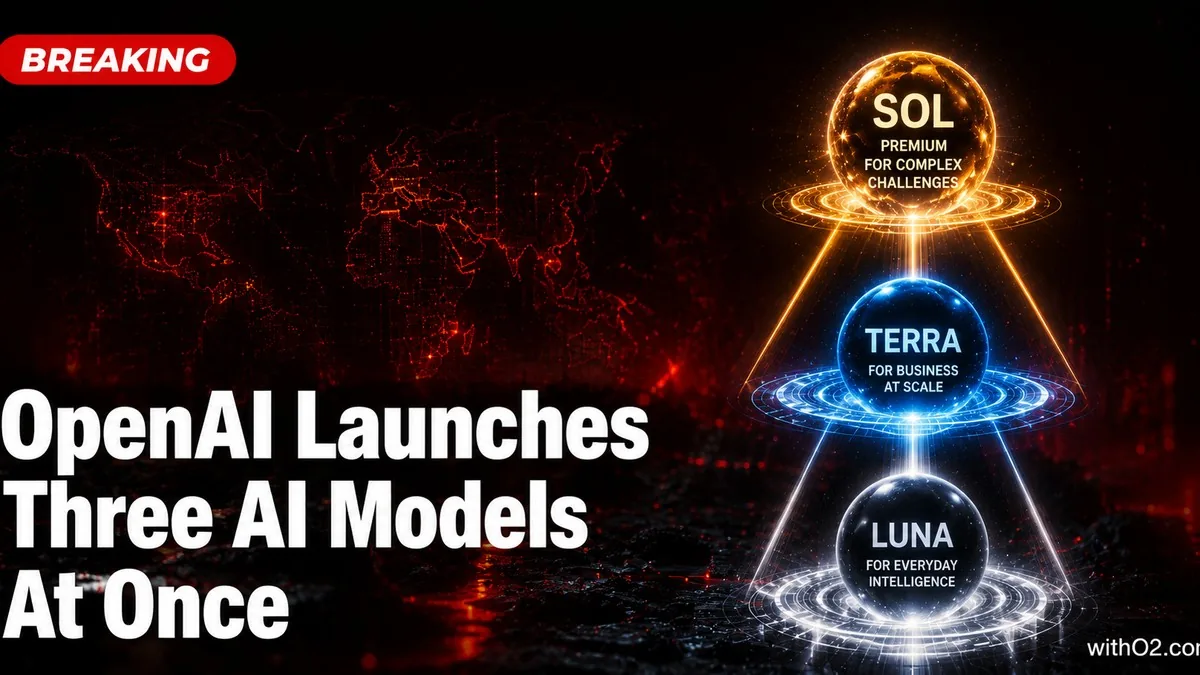
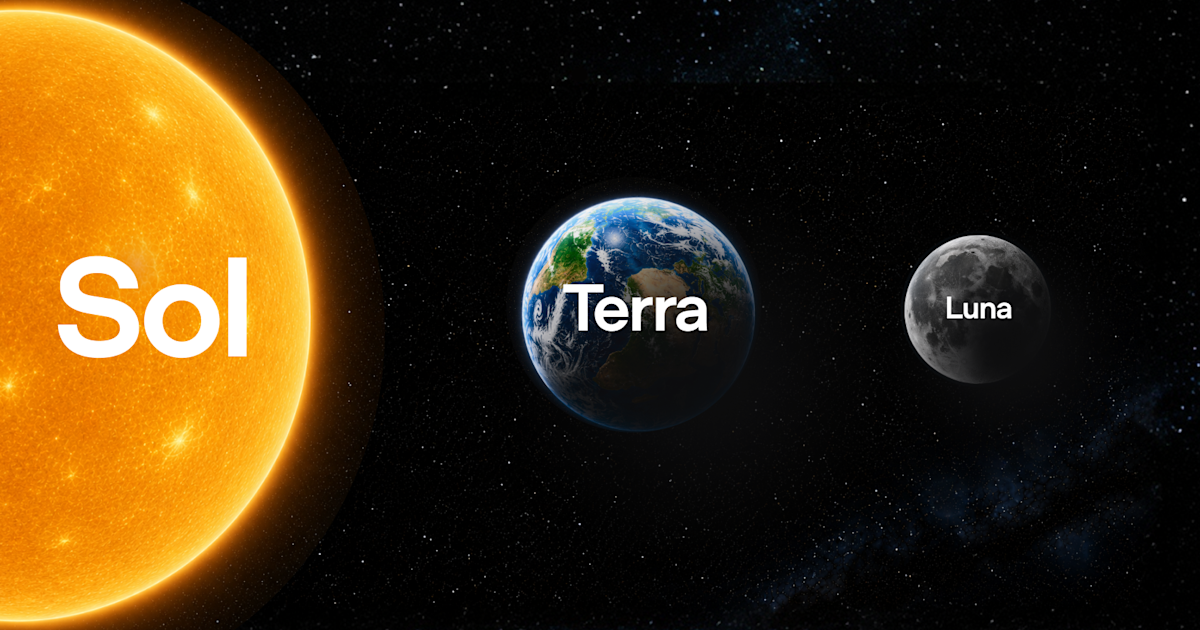
OpenAI shipped GPT-5.6 on June 26 — GPT-5.6 Sol pricing starts at $5 per million tokens input, with a three-tier family called Sol, Terra, and Luna — and handed the U.S. government first access before any developer could touch it. Sol is the flagship at $5/$30 per million tokens (input/output) — among the most competitive frontier rates OpenAI has offered; Terra matches GPT-5.5 quality at exactly half that cost; Luna is the fastest affordable frontier model OpenAI has ever shipped. Prices, benchmarks, and which tier to use are below.
Updated: July 2026 — prices confirmed at general availability (July 9, 2026); benchmarks unchanged.
GPT-5.6 Sol, Terra, and Luna launched June 26, 2026. Sol ($5/$30 per million tokens input/output) scores 88.8% on Terminal-Bench 2.1, beating Claude Mythos 5 (88.0%). Terra ($2.50/$15) matches GPT-5.5 at half the cost. Luna ($1/$6) is the fastest affordable frontier option. The U.S. government received priority access before public availability.
GPT-5.6 Sol Pricing, Benchmarks, and Tier Comparison
The three-tier system replaces ad-hoc naming with a permanent structure: Sol is always flagship, Terra is always balanced, Luna is always fast and cheap. Future versions advance each tier independently.
Pricing per one million tokens: Sol runs $5 input and $30 output per million tokens. Terra is $2.50 input and $15 output — GPT-5.5 quality at 2× lower cost. Luna comes in at $1 input and $6 output per million tokens — OpenAI’s lowest API price for a frontier-class model.
| Model | Tier | Input (per 1M tokens) | Output (per 1M tokens) | Best For |
|---|---|---|---|---|
| GPT-5.6 Sol | Flagship | $5.00 | $30.00 | Max capability, agentic tasks |
| GPT-5.6 Terra | Balanced | $2.50 | $15.00 | GPT-5.5 quality at half cost |
| GPT-5.6 Luna | Fast/Affordable | $1.00 | $6.00 | High-volume production |
OpenAI is also launching GPT-5.6 Sol on Cerebras in July, targeting speeds up to 750 tokens per second — fast enough for real-time agentic loops that current infrastructure makes impractical. Prompt caching gets an upgrade too: explicit cache breakpoints, a 30-minute minimum cache life, and cache writes billed at 1.25× the uncached input rate (reads stay at the 90% discount).
How GPT-5.6 Benchmarks Stack Up Against Claude Fable 5 and Mythos 5
Sol Ultra — extended reasoning plus multi-agent “ultra” mode — scores 91.9% on Terminal-Bench 2.1, the command-line workflow benchmark for long-horizon planning and tool coordination. Plain Sol sits at 88.8%, narrowly edging Claude Mythos 5 at 88.0%. Luna still reaches 82.5%, well above where previous mid-tier OpenAI models landed.
Terra posts 84.3%, matching Claude Fable 5 and beating GPT-5.5’s 83.4% — at half the price. For teams running high-volume inference, that cost differential compounds fast.
On biology workflows, Sol shows meaningful gains on GenBench v1 (long-horizon genomics tasks) using fewer tokens than GPT-5.5. The cybersecurity picture is more complicated: Sol is competitive with Anthropic’s Mythos Preview on ExploitBench using roughly one-third the output tokens — making it cheaper for both offense and defense.
Why the U.S. Government Got Priority Access to GPT-5.6
OpenAI’s decision to let the Trump administration coordinate the launch is unusual even by frontier-AI standards. The company frames it as a short-term measure while working with the Administration on a “cyber Executive Order framework” and a “repeatable process for future model releases.”
Sol’s cyber capabilities are strong enough that OpenAI spent over 700,000 A100-equivalent GPU hours on automated red-teaming before launch, using its own models to find jailbreaks at scale rather than relying solely on human testers. The company concludes that Sol does not cross the “Cyber Critical” threshold under its Preparedness Framework — but notes the benchmark can’t capture every real-world use case.
The phased rollout is less about safety failure and more about optics. OpenAI can argue it cooperated with national security reviewers before releasing a model that can find Chromium and Firefox vulnerabilities.
The Safeguard Stack Under GPT-5.6
GPT-5.6 runs layered defenses: model-level training to refuse prohibited cyber assistance, real-time output classifiers that can pause generation for secondary review by a larger reasoning model, and account-level monitoring that looks across conversations to distinguish persistent malicious patterns from legitimate dual-use security work.
OpenAI is also testing “privacy-preserving detection” and “customer-operated safety controls” for enterprise customers — a nod to the fact that enterprises have legitimate reasons not to want OpenAI reading their security research queries.
Users in the preview may see occasional refusals or slower responses when the real-time classifiers kick in. OpenAI says that friction is intentional — it’s testing whether the safeguards block misuse without meaningfully disrupting legitimate work.
Frequently Asked Questions
What is GPT-5.6 Sol?
GPT-5.6 Sol is OpenAI’s current flagship model, launched in limited preview on June 26, 2026. It is the most capable model in the GPT-5.6 family, which also includes Terra (balanced) and Luna (fast and affordable). Sol sets new records on coding and biology benchmarks and introduces “ultra” mode, which uses multiple subagents to accelerate complex tasks.
What is the difference between GPT-5.6 Sol, Terra, and Luna?
GPT-5.6 Sol pricing starts at $5 per million tokens input and $30 output — Sol is the flagship, most capable tier. Terra is the balanced option: performance close to GPT-5.5 at half the price ($2.50/$15). Luna is the fast, affordable tier at $1/$6 per million tokens — best for high-volume production workloads where cost matters more than top-end reasoning.
When will GPT-5.6 be available to everyone?
GPT-5.6 Sol launched publicly in July 2026 following the limited government-first preview that began June 26. All three tiers are now available via the OpenAI API and Codex.
How does GPT-5.6 Sol compare to Claude Fable 5?
GPT-5.6 Sol scores 88.8% on Terminal-Bench 2.1 versus Claude Fable 5’s 84.3% — Sol leads on agentic coding tasks. GPT-5.6 Terra ties Claude Fable 5 at 84.3% at half the cost of GPT-5.5. If your workload is primarily coding agents, Sol has a measurable edge; for cost-sensitive production inference, Terra and Fable 5 are comparable, but Terra is cheaper.
What is GPT-5.6 “ultra” mode?
Ultra mode is a new reasoning configuration that coordinates multiple subagents in parallel to tackle complex, multi-step tasks. Combined with the “max” reasoning effort setting, ultra mode is designed for deep research, long-horizon code tasks, and multi-tool automation chains. Sol Ultra scores 91.9% on Terminal-Bench 2.1 — 3.1 points above plain Sol.
For context on how GPT-5.6 Sol reached public availability, see the public launch announcement. For a direct model comparison, see our guide to the best AI coding assistants in 2026 and the OpenAI government stake story for the broader political context.
