

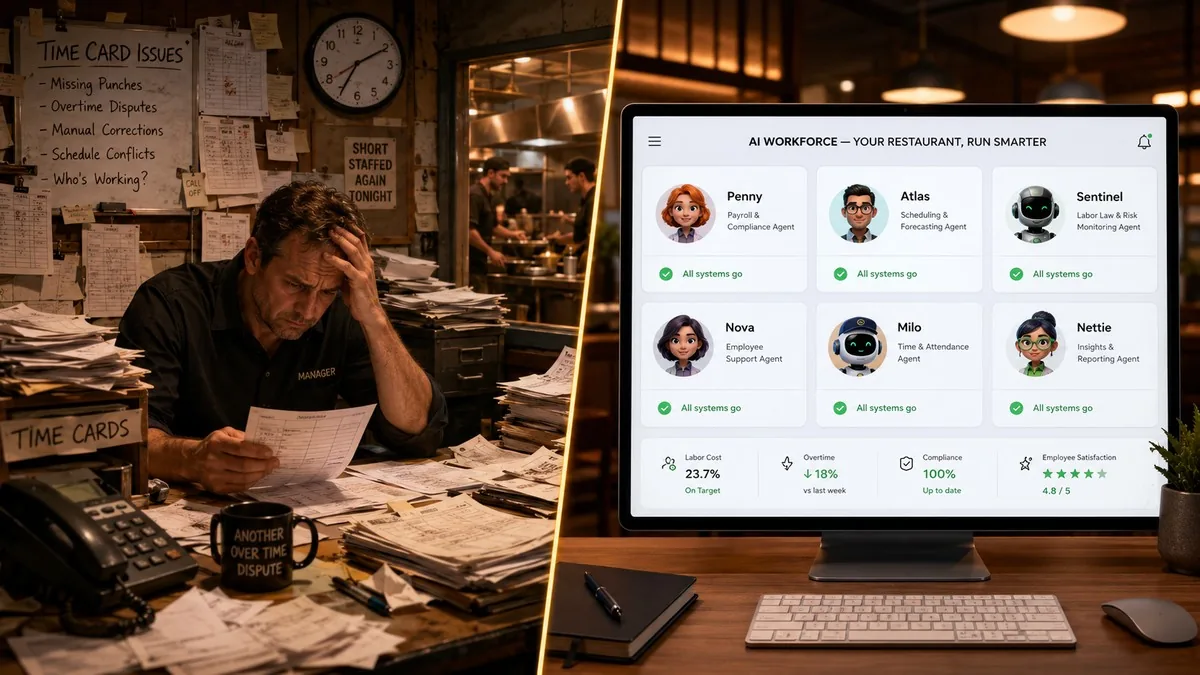
Netchex launched Mesh on July 20, 2026 — a team of six named AI HR agents that autonomously handle payroll, compliance, scheduling, analytics, employee support, and service delivery for restaurants, hotels, dealerships, and other deskless businesses. Employees interact with Mesh through ChatGPT or Claude without logging into a separate HR portal. The product is built on Netchex’s acquisition of Mesh.ai, a Y Combinator-backed AI performance platform, and is available to Netchex’s 7,500-plus US business customers in early access.
What Each Mesh Agent Does
Netchex designed Mesh as six specialist agents rather than a single generalist chatbot. Each agent owns a defined domain: Penny handles payroll processing and error prevention; Atlas manages people operations and onboarding; Sentinel monitors compliance and risk; Nova runs workforce analytics; Milo serves as an employee concierge for shift swaps, PTO requests, and pay-stub questions; and Nettie manages service-partner coordination. Giving each domain its own named agent with persistent responsibility is a deliberate departure from the HR-copilot model, where accountability for errors is diffuse. Early access customers reported roughly a 50% reduction in Monday administrative time and a double-digit drop in payroll corrections, according to Netchex — results described as directional and not audited benchmarks.
Abhinav Agrawal, CEO of Netchex, stated at launch: “AI teammates are how we keep delivering on that, giving every operator the bench strength that used to be reserved for companies ten times their size.”
How Deskless Workers Interact With Mesh
Mesh integrates with ChatGPT and Claude, so employees in restaurants, hotels, and dealerships can file PTO, swap shifts, or check pay information inside the AI tools they already use. No HRMS portal login is required for routine requests. All consequential actions — approvals, payroll submissions, compliance filings — require human confirmation before execution. Saurabh Nangia, Chief Product Officer of Netchex and founder of Mesh.ai, described the design goal: “Mesh gets ahead of the work, handles what people hate doing, and lets them focus on what matters.” Tabitha Lehman of multi-property hotel group Northwest X Southern said the continuous error-checking and prep-work automation “could be a total game changer” for small teams that handle many operational roles simultaneously.
Why This Launch Targets Deskless Industries Specifically
Roughly 80% of US workers are deskless, performing work on the floor, in the field, or on the frontline. Most HR software — including the leading alternatives compared in the Rippling vs Gusto vs BambooHR analysis — was built for desk-based employees with reliable portal access. Netchex operates specifically in restaurants, hotels, and dealerships where shift volatility, multi-state compliance, and high turnover make manual HR processes expensive. Mesh positions Netchex against the broader trend of AI that works like a persistent employee rather than a reactive assistant. Gartner projects that 40% of enterprise applications will feature task-specific AI agents by 2026, up from fewer than 5% in 2025, a benchmark Netchex cited directly in the launch announcement.
Rippling and Gusto, the main HRMS alternatives for SMBs, have not launched named autonomous agents at this depth. BambooHR, acquired by Vista Equity Partners, has focused on desk-based organizations. Netchex’s stated niche is deskless workforces plus agentic automation in a single platform. Pricing for Mesh was not disclosed at launch; demos are available at netchex.com/mesh.
For Context
Netchex was founded in 2003 and is headquartered in Covington, Louisiana. The company acquired Mesh.ai — a Y Combinator-backed startup building AI-first performance and engagement tooling — and repurposed its technology to run across every workflow an HR team manages. Netchex holds a #1 service ranking on G2 across its customer base of 7,500-plus US businesses.
Our Take
Netchex is doing something most HR vendors have avoided: naming each AI agent and giving it a defined job scope. That distinction matters — when accountability is vague, AI tools become toys rather than infrastructure. Whether Mesh delivers on its claims depends on how the agents handle deskless edge cases: last-minute shift swaps, late timecards, and multi-state compliance exceptions. Watch early-access adoption metrics for the answer.
