

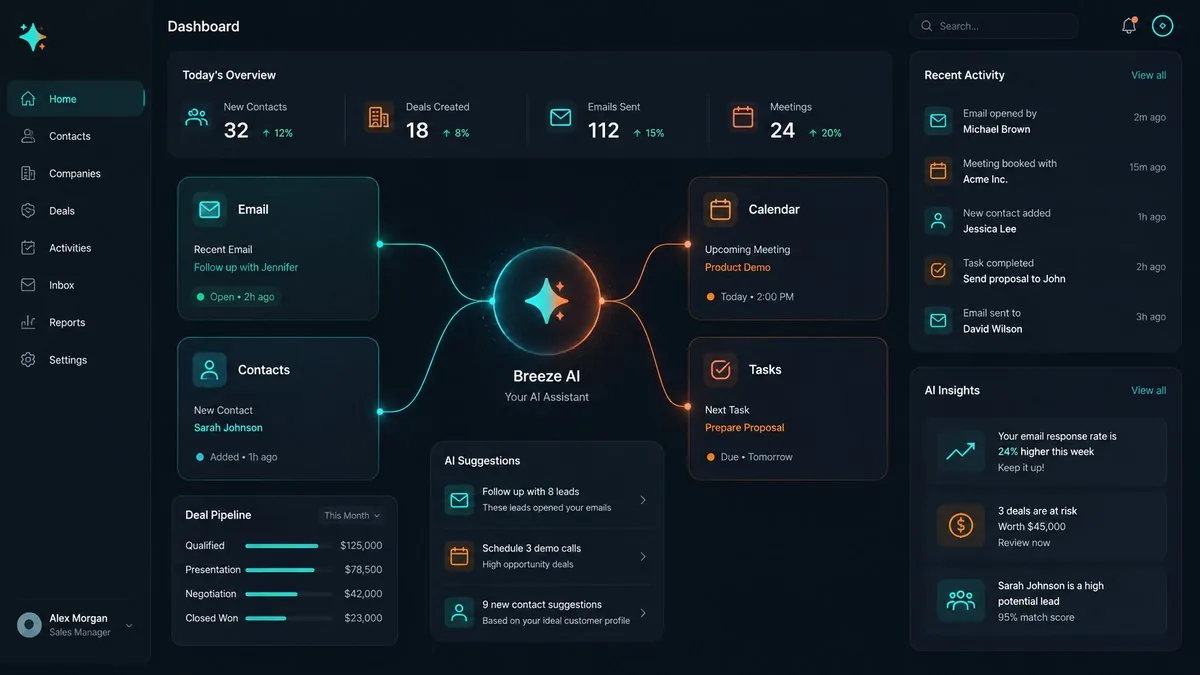
HubSpot shipped its largest product update of 2026 in early July, opening the Breeze AI Prospecting Agent to all paid customers, renaming Commerce Hub to Revenue Hub with added tax automation and buy-now-pay-later support, and launching a Microsoft 365 Copilot integration that surfaces live HubSpot deal data inside Outlook.
The Prospecting Agent is priced on an outcome basis: $1 per lead recommended for outreach, with a 28-day free trial. HubSpot announced outcome-based pricing for the agent on April 2, 2026; the July wave removes the early-access gate and makes the agent available on every paid HubSpot plan.
Commerce Hub Is Now Revenue Hub
HubSpot renamed Commerce Hub to Revenue Hub in the June–July 2026 release cycle. All existing Commerce Hub capabilities — quoting, invoicing, subscription billing, and payments — carry forward unchanged. Revenue Hub adds two new functions: automated tax calculation and buy-now-pay-later for customer checkouts.
The rename signals HubSpot’s intention to compete with billing-focused CRM tools such as Chargebee and Recurly, and more broadly with Salesforce Revenue Cloud, on revenue operations functionality — not just pipeline management and marketing automation. For businesses using HubSpot as their end-to-end sales and billing platform, the additions remove the need for a separate tax tool.
Prospecting Agent Now Available on All Paid Plans
The Breeze AI Prospecting Agent, previously limited to early-access customers, is now live across all paid HubSpot plans. The agent sources net-new contacts through a Seamless.ai integration launched July 1, 2026, so sales teams can identify and add prospects without leaving HubSpot. Contact sourcing, outreach sequencing, and lead scoring stay inside a single interface.
The outcome-based pricing model sets the cost at $1 per lead recommended for outreach. Small business CRM buyers who previously avoided HubSpot’s AI features as optional premium add-ons now receive Prospecting Agent access as a standard line item on any paid plan. The 28-day free trial allows teams to test lead quality before committing to the per-lead cost.
Breeze AI Expands Across the Platform
The July release extends Breeze AI to four additional surfaces. First, global search now surfaces AI-generated summaries alongside standard CRM search results. Second, email composition in HubSpot uses Breeze to draft outbound messages based on contact context and deal stage. Third, mobile meeting prep generates pre-call briefings from CRM activity on the HubSpot mobile app. Fourth, assignment notifications now include an AI-generated summary of the relevant record’s recent activity.
HubSpot also redesigned Breeze Projects — its collaborative workspace — to support direct file uploads, @mentions of CRM records (contacts, companies, deals), team permission levels, and pre-configured templates for prospecting campaigns and meeting prep workflows.
Microsoft 365 Copilot Integration
HubSpot released a Microsoft 365 Copilot integration that makes live HubSpot deal, ticket, and contact data accessible from within Microsoft 365 Copilot — including Outlook, Teams, and Word. Sales reps working in Outlook can surface deal stages, recent CRM notes, and contact history without switching to the HubSpot interface.
The integration addresses a common friction point for enterprise sales teams whose CRM and communication tools are split between HubSpot and the Microsoft stack. For businesses already standardized on Microsoft 365, this reduces the switching cost of adopting HubSpot as their primary best CRM software choice — Breeze data flows into the tools reps already use rather than requiring them to add another tab.
Our Take
HubSpot’s July wave is a consolidation play: AI features that were experiments or early-access pilots in Q1 are now standard-issue across paid plans. At $1 per qualified lead, the Prospecting Agent is cheap enough that a team generating 50 leads per month pays $50 for its AI SDR layer — well below the cost of Clay, Apollo, or a human SDR. The real question for CRM buyers is whether HubSpot’s lead quality and data coverage from Seamless.ai justify staying inside the HubSpot ecosystem rather than assembling a separate prospecting stack. That answer will depend on industry and ICP, but the switching cost just went down.
For Context — HubSpot Coverage on WithO2.com
- HubSpot Agent Hub Lets CRM Teams Run AI Agents Together — HubSpot’s earlier 2026 release that first introduced multi-agent orchestration inside the CRM platform.
- HubSpot Lost 12.7% After OpenAI Presence — Should You Still Buy It? — analysis of how OpenAI’s CRM ambitions affected HubSpot’s valuation and competitive positioning earlier in 2026.
