

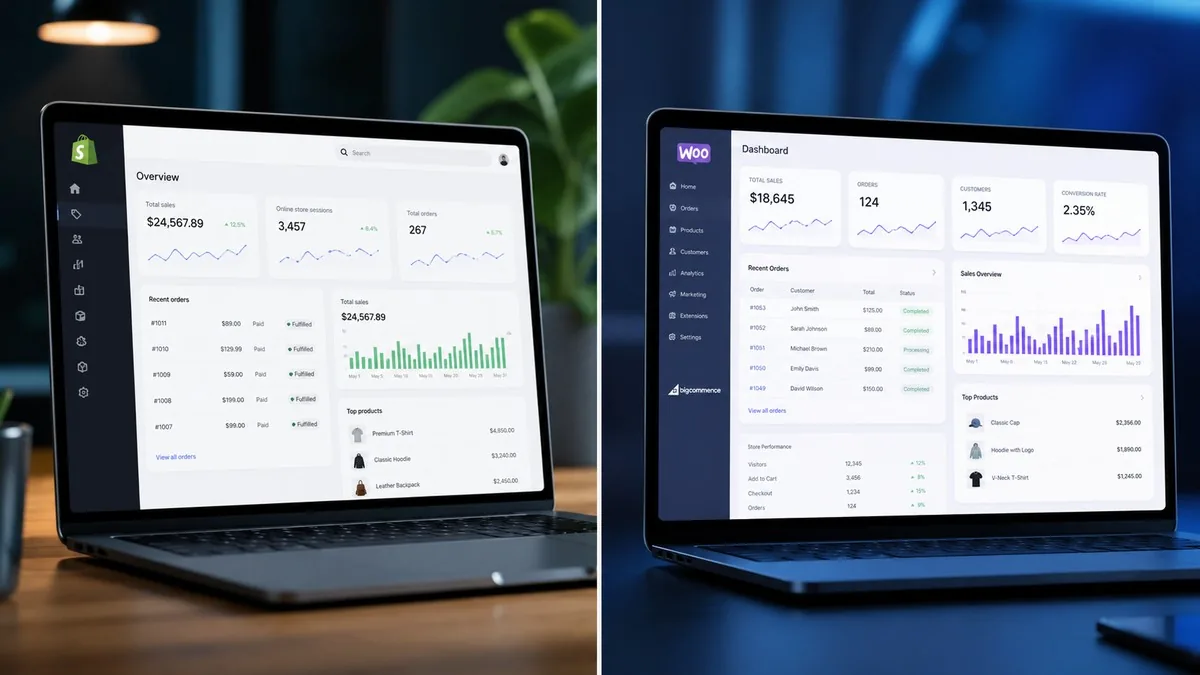
Choosing the best ecommerce platform 2026 comes down to three variables: your budget, how fast you plan to grow, and whether you want to manage hosting yourself. An ecommerce platform is software that lets you build, manage, and grow an online store — handling product listings, shopping carts, payments, inventory, and shipping in one place.
The best ecommerce platform for most businesses in 2026 is Shopify: it balances ease of use, a vast app ecosystem, and serious scaling power. But the right pick depends heavily on your situation. We tested and compared 10 leading platforms on pricing, ease of setup, transaction fees, built-in features, and scalability.
Quick Comparison: Best Ecommerce Platforms 2026
| Platform | Starting Price | Transaction Fee | Best For | Rating |
|---|---|---|---|---|
| Shopify | $39/mo | 0% (Shopify Payments) | Best overall / scaling brands | ⭐ 9.4/10 |
| WooCommerce | Free + hosting (~$10–25/mo) | 0% | WordPress users, flexibility | ⭐ 8.9/10 |
| BigCommerce | $39/mo | 0% | Growing stores, B2B | ⭐ 8.7/10 |
| Wix eCommerce | $17/mo | 0% | Beginners, simple stores | ⭐ 8.1/10 |
| Squarespace Commerce | $28/mo | 0% | Design-forward brands | ⭐ 8.0/10 |
| Adobe Commerce (Magento) | Free (self-hosted) / $22K+/yr | 0% | Enterprise, complex catalogs | ⭐ 8.4/10 |
| Ecwid by Lightspeed | Free / $25/mo paid | 0% | Adding store to existing site | ⭐ 7.9/10 |
| PrestaShop | Free (self-hosted) | 0% | Open-source flexibility | ⭐ 7.6/10 |
| Volusion | $35/mo | 0% | Budget-conscious SMBs | ⭐ 7.2/10 |
| Shift4Shop | Free (US, using Shift4 Payments) | 0% | US stores wanting free hosted option | ⭐ 7.5/10 |
1. Shopify — Best Overall Ecommerce Platform

Shopify powers over 4.5 million stores worldwide and remains the gold standard for a reason: it handles everything from your first sale to $100M+ in revenue without requiring a developer. The dashboard is clean, onboarding takes under an hour, and the app store has 8,000+ integrations covering every conceivable use case — from print-on-demand to wholesale portals.
Pricing (billed monthly, July 2026):
- Starter: $5/mo (social selling only, no full store)
- Basic: $39/mo ($29/mo annually)
- Shopify (Grow): $105/mo ($79/mo annually)
- Advanced: $399/mo ($299/mo annually)
- Shopify Plus: $2,300–$2,500/mo
Credit card rates start at 2.9% + 30¢ (Basic) and drop to 2.4% + 30¢ (Advanced) when using Shopify Payments. Use a third-party payment gateway and you pay an additional 0.5%–2% platform fee.
Standout features: One-click selling across TikTok, Instagram, and Amazon; built-in abandoned cart recovery from the Basic plan; Shopify Markets for multi-currency and multi-language stores; Shopify POS for unified online/offline selling.
Cons: Apps add up fast — most Shopify stores spend $350–$1,400/mo on apps to replicate features that BigCommerce includes natively. The Blog is basic. Heavy customization still needs a Liquid developer.
Best for: Most businesses launching their first store, DTC brands scaling past $500K/year, and anyone who wants a platform that just works.
2. WooCommerce — Best for WordPress Sites

WooCommerce is a free WordPress plugin that turns any WordPress site into a full ecommerce store. It’s the most installed ecommerce solution globally, with 36%+ market share — largely because the plugin itself costs nothing.
Pricing:
- Plugin: Free
- WooCommerce Starter hosting (via Automattic): ~$25/mo for up to $10K GMV
- Self-hosted: Add quality WordPress hosting (~$10–30/mo at SiteGround or Kinsta) + SSL + domain
- Premium extensions: $49–$299/yr each (subscriptions, memberships, product bundles)
Standout features: Total ownership of your store data and code. Unlimited customization. Massive extension library (700+ official, thousands via third parties). Perfect integration with the WordPress content ecosystem — crucial for SEO-driven stores.
Cons: You are responsible for hosting, security, updates, and backups. Total cost of ownership is higher than advertised once you factor in developer time and premium extensions. Performance degrades without proper hosting and caching.
Best for: WordPress-first businesses, content-heavy stores (blogs + shop), developers, and anyone who wants maximum flexibility and doesn’t mind managing infrastructure.
3. BigCommerce — Best for Growing Stores
BigCommerce got a significant pricing overhaul on June 1, 2026, renaming its plans (Standard → Core, Plus → Growth, Pro → Scale) and adjusting GMV caps. It remains the strongest hosted alternative to Shopify for stores that need enterprise-grade features at mid-market prices.
Pricing (July 2026, billed annually):
- Core (was Standard): $39/mo ($29/mo annually) — up to $30K GMV/yr
- Growth (was Plus): $105/mo ($79/mo annually) — up to $100K GMV/yr
- Scale (was Pro): $399/mo ($299/mo annually) — up to $400K GMV/yr
- Performance (was Enterprise): from $1,499/mo
⚠️ New 2026 fee: An Open Payment Provider Fee now applies if you don’t use an “Embedded” processor: 2.0% on Core, 1.0% on Growth, 0.6% on Scale. Plan accordingly.
Standout features: No platform transaction fees (with embedded payments). More built-in features than Shopify with fewer required apps — multi-currency, faceted search, product filtering, and B2B/wholesale tools all included. Headless commerce architecture for enterprise setups.
Cons: The GMV caps force plan upgrades as revenue grows — a $31K/year store immediately bumps from Core to Growth. The UI feels less polished than Shopify. Fewer third-party app integrations.
Best for: Established stores earning $30K–$500K/year, B2B merchants, and brands that want more native features without an app tax.
4. Wix eCommerce — Best for Beginners
Wix is primarily a website builder that added solid ecommerce features, making it the easiest on-ramp for first-time sellers. Its drag-and-drop editor is genuinely intuitive, and setup can be complete in an afternoon.
Pricing (eCommerce plans, billed annually):
- Light: $17/mo
- Core: $29/mo
- Business: $36/mo
- Business Elite: $159/mo
No transaction fees on any plan. Accepts payments via Wix Payments, PayPal, Stripe, and Square.
Standout features: AI-powered site builder (Wix ADI) for instant setup. Wix App Market for extending functionality. Built-in email marketing, bookings, and events. Good for hybrid sites (portfolio + shop, restaurant + merch).
Cons: Hits limits quickly at scale — no native B2B features, limited product variant options, weaker SEO control than Shopify or WooCommerce. Can’t migrate away from Wix cleanly (vendor lock-in is real). Inventory management is basic.
Best for: Local businesses, solopreneurs, and creative professionals selling fewer than 100 products who want the simplest possible setup.
5. Squarespace Commerce — Best for Design-Forward Brands
Squarespace consistently produces the most visually polished websites of any ecommerce platform. Its templates are designed by professional designers, and the editing experience maintains visual consistency that other builders sacrifice for flexibility.
Pricing (billed annually):
- Basic Commerce: $28/mo
- Advanced Commerce: $52/mo
No transaction fees on Commerce plans (3% fee on Personal/Business plans if used for selling).
Standout features: Stunning template library; built-in subscription selling; digital downloads; strong Instagram and Pinterest integrations; appointment scheduling built in.
Cons: No multichannel selling (no Amazon, eBay integrations). App ecosystem is very limited compared to Shopify. No native B2B features. SEO customization lags behind WooCommerce and Shopify.
Best for: Photographers, artists, designers, and lifestyle brands where aesthetics are the #1 priority and catalog complexity is low.
6. Adobe Commerce (Magento) — Best for Enterprise
Magento Open Source is free to download and self-host. Adobe Commerce (the enterprise product) starts around $22,000/year and scales based on GMV. It is not for beginners — plan for a 3–6 month implementation with a dedicated developer team.
Pricing:
- Magento Open Source: Free (self-hosted; you pay hosting, dev, and extensions)
- Adobe Commerce: ~$22,000–$125,000+/yr depending on GMV and cloud/on-prem
Standout features: Unlimited customization at every layer. Native multi-store, multi-language, multi-currency management from a single admin. Powerful B2B suite (company accounts, custom catalogs, quote management). Industry-grade scalability for complex catalogs.
Cons: High total cost of ownership. Average Adobe Commerce implementation costs $50,000–$200,000+ in developer fees. Security patches require constant vigilance on self-hosted setups. Overkill for stores under $5M revenue.
Best for: Enterprise retailers, multi-brand companies, and B2B distributors with complex catalog requirements and an in-house or agency dev team.
7. Ecwid by Lightspeed — Best for Adding Commerce to Existing Sites
Ecwid is unique: instead of replacing your website, it embeds a full store into it. Works with WordPress, Wix, Squarespace, Joomla, or any custom site via a JavaScript snippet.
Pricing:
- Free: Up to 5 products
- Venture: $25/mo (100 products)
- Business: $45/mo (2,500 products)
- Unlimited: $105/mo (unlimited products + priority support)
No transaction fees on any plan.
Standout features: Sell on Facebook, Instagram, TikTok, Google Shopping, and Amazon from one admin. Instant setup without rebuilding your existing site. Automatic tax calculation. Inventory syncs across all channels in real time.
Cons: The free plan is very limited (5 products). You’re adding commerce to a website, not getting a purpose-built store — checkout experience is less seamless. Design customization is constrained by your host platform.
Best for: Businesses with an existing website that want to start selling without rebuilding. Ideal for local services, freelancers, and bloggers adding a product line.
8. PrestaShop — Best Free Open-Source Platform
PrestaShop is the leading open-source ecommerce platform in Europe, with 300,000+ active stores. Like WooCommerce, it’s free to download and self-host — but it’s a standalone ecommerce system, not a CMS plugin.
Pricing: Free open-source download. Budget $10–$30/mo for quality hosting (Hostinger or SiteGround), plus domain and SSL. Premium modules range $50–$300 each.
Standout features: 600+ built-in features out of the box. Multi-store management from one admin. 4,000+ modules on the marketplace. Strong multi-language and multi-currency support — particularly suited to EU merchants. Active community support.
Cons: Steeper learning curve than hosted platforms. Premium modules add up quickly. Performance optimization requires developer knowledge. Less North American merchant support infrastructure than Shopify.
Best for: European merchants, technically confident store owners, and businesses that want open-source flexibility without WordPress dependencies.
9. Volusion — Best for Budget SMBs
Volusion is a veteran hosted ecommerce platform that has simplified its offering to compete on value. It lacks Shopify’s ecosystem depth but covers the basics cleanly for small businesses on a budget.
Pricing (billed annually):
- Personal: $35/mo (up to $50K GMV/yr)
- Professional: $79/mo (up to $100K GMV/yr)
- Business: $299/mo (up to $400K GMV/yr)
No transaction fees. Built-in payment processing via Volusion Payments (powered by Stripe).
Standout features: Clean, simple dashboard. Built-in inventory management and CRM. ROI calculator included. 24/7 support on all plans.
Cons: App ecosystem is much smaller than Shopify or BigCommerce. Limited multichannel selling. Design templates look dated vs. competitors. GMV caps mirror BigCommerce’s new structure, forcing plan upgrades.
Best for: Small retailers that want a simple, no-surprise hosted platform without the Shopify price tag.
10. Shift4Shop — Best Free Option for US Stores
Shift4Shop (formerly 3dcart) offers a genuinely free End-to-End Commerce plan — no monthly fee, ever — as long as you process at least $500/month through Shift4 Payments. For US businesses that qualify, this is unmatched value.
Pricing:
- End-to-End Plan: $0/mo (US only, requires Shift4 Payments, $500+/mo GMV)
- Basic: $29/mo
- Plus: $79/mo
- Pro: $229/mo
Standout features: Unlimited products, users, and bandwidth on the free tier. 200+ built-in features including SEO tools, dropshipping, subscriptions, and B2B. No transaction fees.
Cons: Free plan requires Shift4 Payments — lock-in with a single processor. Design templates are functional but not beautiful. Limited brand awareness means less community support. Not available to non-US merchants.
Best for: US-based small businesses that process through Shift4 and want a fully-featured store with no monthly software fee.
How to Choose the Best Ecommerce Platform
Run through these four questions and the right pick becomes obvious:
1. Are you on WordPress? If yes, WooCommerce is the natural choice — no reason to introduce a second platform. If no, continue.
2. Do you need maximum ease of use? Shopify for stores with growth ambitions; Wix for simple stores where design ease beats scalability.
3. Is design the #1 priority? Squarespace Commerce wins on aesthetics for small catalogs; Shopify wins if you want beautiful AND scalable.
4. Are you building something large and complex? BigCommerce for mid-market B2B and catalog complexity; Adobe Commerce for enterprise with a developer team budget.
Our Take
After testing all 10 platforms, Shopify is the right call for 80% of businesses — the setup speed, app ecosystem, and scaling path are unmatched. The only scenarios where we’d choose something else: you’re already on WordPress (WooCommerce), you need enterprise customization (Magento), your design is your product (Squarespace), or you’re a US merchant comfortable with Shift4 processing (Shift4Shop for the free tier). BigCommerce’s 2026 GMV caps and new Open Payment Provider Fee make it less attractive for bootstrapped stores than it was last year — factor that in before signing up.
Pricing at a Glance: Monthly Cost by Revenue Stage
| Monthly Revenue | Best Pick | Monthly Platform Cost |
|---|---|---|
| < $500/mo | Ecwid Free or Wix Core | $0–$17/mo |
| $500–$5K/mo | Shopify Basic or WooCommerce | $29–$39/mo |
| $5K–$15K/mo | Shopify Grow or BigCommerce Core | $79–$105/mo |
| $15K–$50K/mo | Shopify Advanced or BigCommerce Growth | $299–$399/mo |
| $50K+/mo | Shopify Plus or Adobe Commerce | $2,300+/mo |
Internal Linking: Dig Deeper
Looking at specific platform comparisons? We’ve covered the most common head-to-heads in detail: see our Shopify vs WooCommerce vs BigCommerce deep dive for a line-by-line feature breakdown. For broader business software picks, check our Business Software hub. If you’re weighing AI tools to support your store (copywriting, customer service), our AI tools section covers the best options.
Sources & Further Reading
Pricing and feature data verified from official sources: Shopify’s official pricing page and BigCommerce’s 2026 pricing update. Platform market share data from Statista and BuiltWith ecommerce surveys.
Frequently Asked Questions
What is the best ecommerce platform for beginners in 2026?
Shopify is the best beginner platform if you plan to grow — its setup wizard, themed templates, and 24/7 support make first-store launch straightforward. If you only need a tiny store and want the absolute simplest experience, Wix eCommerce works well for under 50 products.
Which ecommerce platform has no transaction fees?
BigCommerce, WooCommerce, Wix, Squarespace Commerce, Ecwid, and Shift4Shop all charge zero platform transaction fees. Shopify charges 0% only when you use Shopify Payments — if you use a third-party processor, fees range from 0.5% (Advanced) to 2% (Basic).
Is WooCommerce really free?
The plugin is free, but running a WooCommerce store is not free. You’ll need WordPress hosting ($10–$30/mo), a domain (~$15/yr), SSL, and often several premium extensions ($49–$299/yr each). Budget at least $25–$50/mo all-in for a functional starter setup.
What happened to BigCommerce’s pricing in 2026?
On June 1, 2026, BigCommerce renamed its plans (Standard → Core, Plus → Growth, Pro → Scale) and lowered GMV thresholds — the Core plan now caps at $30K/year GMV instead of $50K. They also introduced an Open Payment Provider Fee (0.6%–2.0%) for merchants not using embedded processors. Existing customers on old plans may need to re-evaluate their tier.
Can I switch ecommerce platforms later?
Yes, but it’s painful — especially from Wix, which has no export tool. Shopify, WooCommerce, and BigCommerce all support product/customer/order CSV exports, making migration manageable. Magento and PrestaShop offer the most portable data structures. If you think you’ll scale significantly, choose a platform with open data exports from day one.
Which ecommerce platform is best for SEO?
WooCommerce (with Yoast or RankMath) gives the most granular SEO control of any platform. Shopify and BigCommerce both have solid built-in SEO but limit some URL structures and redirect management. Wix and Squarespace have improved but still lag behind for serious SEO-driven stores.
Last Updated: July 2026. Prices verified from official platform pricing pages.
