

Last Updated: June 2026
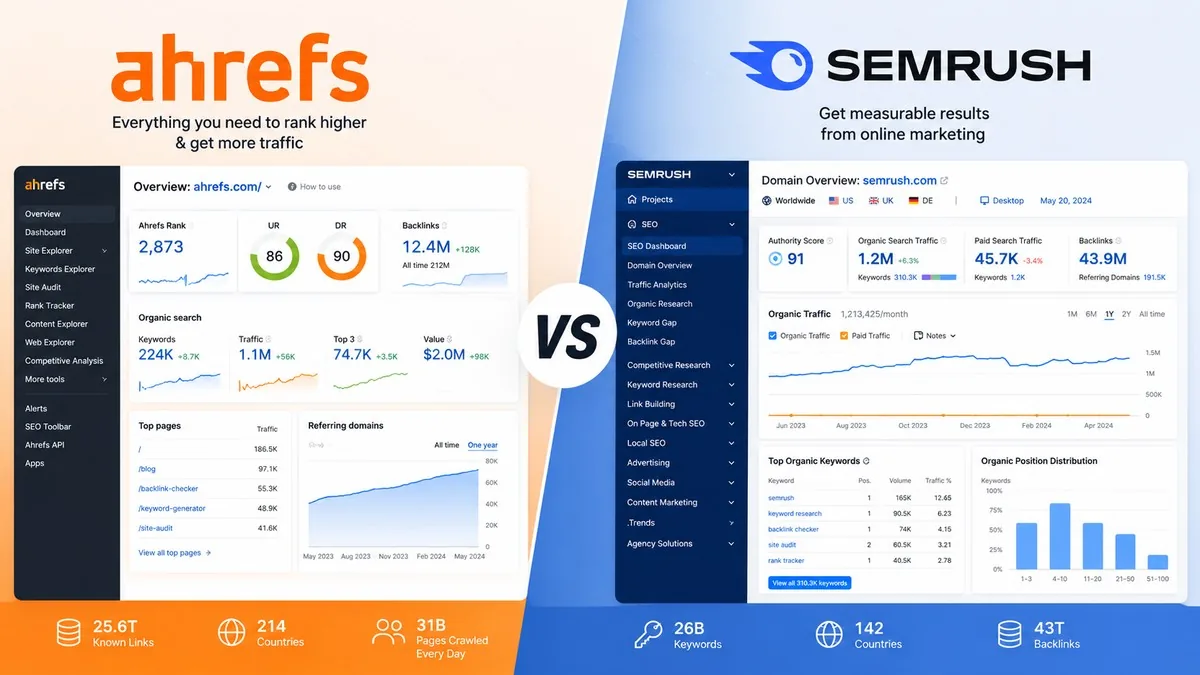
Ahrefs is a professional SEO tool built around backlink analysis, keyword research, and competitor intelligence. SEMrush is an all-in-one digital marketing platform covering SEO, content creation, PPC research, and AI visibility tracking. In the Ahrefs vs SEMrush comparison: Ahrefs leads on backlink data freshness (500M domains, 15-30 min refresh); SEMrush leads on breadth. Your best choice depends entirely on your daily workflow.
Quick Comparison: Ahrefs vs SEMrush (2026)
| Feature | Ahrefs | SEMrush |
|---|---|---|
| Starting price | $29/mo (Starter) | $139.95/mo (Pro) |
| Keyword database | 28.7 billion keywords | 26.7 billion keywords |
| Backlink index | 35T links, 500M referring domains | 43T links, 390M referring domains |
| Site audit | Fast, always-on crawling | 140+ issue checks, AI Search Health score |
| Content marketing tools | None built-in | ContentShake AI, SEO Writing Assistant, Topic Research |
| PPC / ad research | No | Yes |
| AI visibility tracking | No | Yes (Semrush One, 2026) |
| Free trial | Free tier for verified site owners | 7-day free trial |
| Best for | Link builders, SEO-focused teams | Agencies, content teams, all-in-one marketing |
| Our rating | 4.6 / 5 | 4.7 / 5 |
Ahrefs Review — Best for Backlink Analysis and Competitor Research
Ahrefs (ahrefs.com) started as a backlink checker and still leads the industry in that category. AhrefsBot crawls 8 billion pages per day — the second most active web crawler after Googlebot — and the backlink index refreshes every 15 to 30 minutes. When a competitor earns a new link, you see it the same day. The database covers 500 million unique referring domains and 35 trillion backlinks, providing the most comprehensive domain-level link view available.
Beyond backlinks, Ahrefs’ keyword data spans 28.7 billion keywords across 170+ countries. The “traffic potential” metric shows estimated monthly clicks for the top-ranking page rather than raw search volume — accounting for SERP features that absorb clicks before anyone reaches your result. The “parent topic” grouping shows which single page can rank for an entire family of related terms, reducing keyword-research sprawl.
The interface is deliberately narrow: Site Explorer, Keyword Explorer, Site Audit, Rank Tracker, and Content Explorer. If you are an SEO specialist who does not need PPC data, social media scheduling, or AI content tools, the focused scope is an advantage. Less noise, faster decisions.
Ahrefs Pros
- Largest unique referring domain index (500M domains) — deepest backlink intelligence
- Fastest link discovery: index refreshes every 15-30 minutes; AhrefsBot crawls 8B pages/day
- Clean, purposeful interface — no feature bloat
- 28.7B keyword database with traffic potential and parent-topic metrics
- $29/mo Starter plan gives bloggers an affordable entry point for self-site analysis
Ahrefs Cons
- No PPC research tools — paid search teams must add a separate platform
- No built-in content tools — no writing assistant, topic research, or content audit features
- No AI visibility tracking — cannot monitor brand appearances in ChatGPT or Gemini answers
- Starter plan is restricted — only analyses sites you have verified in Google Search Console; not usable for competitor research
- Historical keyword and ranking data limited to Standard plan and above
Ahrefs Pricing (Verified June 2026)
| Plan | Monthly billing | Annual (per month) | Best for |
|---|---|---|---|
| Starter | $29 | Monthly only | Bloggers auditing their own site |
| Lite | $129 | ~$108 | Freelancers, small businesses |
| Standard | $249 | ~$208 | In-house SEO teams |
| Advanced | $449 | ~$374 | Large teams, agencies |
| Enterprise | Custom | From $1,499/mo | Enterprise, API data access |
Source: ahrefs.com/pricing, verified June 2026. Annual billing saves approximately 17% (two months free).
SEMrush Review — Best All-in-One SEO and Marketing Platform
SEMrush (semrush.com) is the Swiss Army knife of digital marketing tools. Where Ahrefs focuses tightly on SEO, SEMrush covers keyword research, technical site audits, content marketing, PPC competitor intelligence, social media scheduling, and — as of 2026 — AI visibility tracking through its Semrush One platform. According to Semrush’s official stats page, the platform now has over 10 million users across 142 countries.
The SEO data is extensive: 26.7 billion keywords (3.6 billion US-specific terms), 43 trillion backlinks from 390 million referring domains, and a site audit engine that checks for over 140 distinct issues. The 2026 Semrush One update added brand monitoring across AI assistants — tracking how often ChatGPT, Perplexity, and Google Gemini recommend your brand versus competitors. For agencies managing AI search performance reporting, this feature has no equivalent elsewhere.
The content toolkit separates SEMrush from every pure-SEO alternative. ContentShake AI generates optimised draft articles from a target keyword. The SEO Writing Assistant grades content in real time inside Google Docs. Topic Research surfaces question-based and semantically related angles. Content Audit flags posts losing organic traffic. For teams publishing at scale, these tools collectively save multiple hours per week.
SEMrush Pros
- True all-in-one platform: SEO + content + PPC + social + AI visibility
- 43 trillion backlink index — largest raw link count in the industry
- ContentShake AI and SEO Writing Assistant save hours per article for content teams
- Site audit checks 140+ issues, including 2026’s AI Search Health score
- Semrush One is the only major SEO platform tracking brand visibility inside AI assistants
- 7-day free trial on all paid plans
SEMrush Cons
- Higher entry price — Pro at $139.95/mo vs Ahrefs Lite at $129/mo
- Interface complexity — 55+ tools in one dashboard creates a steep learning curve
- Fewer unique referring domains than Ahrefs (390M vs 500M) — backlink coverage can miss edge cases
- Slower backlink discovery — index refresh lags Ahrefs’ 15-30 minute cadence
- ContentShake AI requires Guru plan ($249.95/mo) or higher
SEMrush Pricing (Verified June 2026)
| Plan | Monthly billing | Annual (per month) | Best for |
|---|---|---|---|
| Pro | $139.95 | $117.33 | Freelancers, startups |
| Guru | $249.95 | $208.33 | SMBs, content teams |
| Business | $499.95 | $416.66 | Agencies, large teams |
| Semrush One Starter | $199 | N/A | AI visibility + SEO bundle |
| Semrush One Pro+ | $299 | N/A | Agencies with AI reporting needs |
| Enterprise | Custom | Custom | Large enterprises |
Source: semrush.com/pricing, verified June 2026. Annual billing saves 17%.
Keyword Research: Ahrefs Leads on Breadth, SEMrush on US Depth
Ahrefs has a slightly larger keyword database overall (28.7B vs SEMrush’s 26.7B) and the “traffic potential” metric is genuinely useful — it estimates monthly clicks for the top-ranking page rather than raw search volume, accounting for SERP features that absorb clicks. The parent-topic grouping reduces keyword-research sprawl by identifying which single page can rank for an entire cluster of terms.
SEMrush counters with a larger US-specific database (3.6B US terms vs Ahrefs’ 2.3B) and Keyword Magic Tool, which groups semantically related suggestions across 20+ billion phrases. For finding question-based and long-tail angles specifically for the US market, SEMrush’s depth is hard to beat.
Verdict: Roughly equal. Ahrefs wins on international breadth; SEMrush wins for US-focused long-tail campaigns.
Backlink Analysis: Ahrefs Wins Clearly
Ahrefs’ 500 million unique referring domains surpass SEMrush’s 390 million — a 28% advantage in domain-level coverage. The 15-30 minute index refresh is faster than SEMrush’s crawl cadence, which matters when monitoring active link-building campaigns or tracking newly published competitor content.
SEMrush’s raw backlink count is higher (43T vs 35T links), but a significant proportion comes from low-quality link networks that Ahrefs filters more aggressively. When comparing unique referring domains — the metric that actually signals link authority — Ahrefs is ahead. For link building research, prospecting, and disavow workflows, most professional SEOs trust Ahrefs’ data more.
Verdict: Ahrefs wins, and it is not particularly close on the metrics that matter for outreach work.
Site Audit: Different Strengths
SEMrush’s site audit checks for 140+ distinct issues including broken links, Core Web Vitals, duplicate content, hreflang errors, and missing schema markup. The 2026 update added an AI Search Health score that flags whether AI crawlers such as GPTBot are blocked or deprioritised in your robots.txt — a newly critical issue as AI search surfaces drive more traffic.
Ahrefs’ site audit is faster on large sites and offers always-on crawling that re-audits your site continuously rather than on a weekly or monthly schedule. The issue prioritisation is sharper, making it easier to identify what actually needs fixing first. For large e-commerce sites or technical SEO workflows requiring rapid iteration, Ahrefs’ speed is a meaningful advantage.
Verdict: SEMrush for completeness and AI-era issue detection; Ahrefs for speed and actionable prioritisation.
Content Marketing Tools: SEMrush Wins Decisively
Ahrefs has no built-in content creation or optimisation tools. SEMrush’s content toolkit includes ContentShake AI (keyword-guided draft generation), the SEO Writing Assistant (real-time grading inside Google Docs), a Topic Research tool, and a Content Audit feature that tracks which existing posts are declining in traffic and flags update opportunities.
For teams publishing blog posts, landing pages, and product content at scale, SEMrush can reduce the time from keyword to optimised draft by several hours per piece. Ahrefs users who need these capabilities must add Surfer SEO, Frase, or a similar tool separately. You can read more about the broader AI writing landscape in our guide to the best AI writing software in 2026.
Verdict: SEMrush wins decisively. Ahrefs is not in the same category here.
AI Visibility Tracking (New in 2026)
Semrush One’s AI Visibility Toolkit monitors how often your brand and competitors appear in answers from ChatGPT, Google Gemini, Perplexity, and other AI assistants. As AI-generated answers replace traditional search results for more query types, brand mentions in these responses are becoming a meaningful traffic and awareness metric. Ahrefs has no equivalent feature as of June 2026.
For agencies that report on AI search presence to clients, Semrush One ($199/mo Starter) is currently the only major SEO platform offering this natively — justifying the higher price for any team where AI visibility is a client deliverable.
Who Should Use Ahrefs?
- Link builders and outreach specialists — the freshest, deepest backlink data available at any price point
- SEO-only teams who do not need PPC, social media, or AI content tools
- Technical SEOs who value continuous crawling and a clean, fast audit interface
- Bloggers and solo operators — the $29/mo Starter plan provides affordable site health data
- International SEO teams needing wide geographic keyword coverage across 170+ countries
Who Should Use SEMrush?
- Agencies managing clients across SEO, PPC, and content — one platform, one invoice
- Content marketing teams writing and optimising posts at scale with AI assistance
- Businesses running paid search alongside organic — SEMrush’s ad intelligence has no match
- Brands monitoring AI search visibility — Semrush One is the only tool tracking this natively
- SMBs replacing multiple point solutions — Guru plan often covers five separate tools in one subscription
Whatever SEO tool you choose, your site’s technical foundation matters just as much. Our guide to the best web hosting in 2026 covers the infrastructure side of the equation.
For pure SEO work — backlink analysis, keyword research, technical audits — Ahrefs is the better-built tool. The interface is faster, the link data is fresher, and nothing gets in your way. But if we had to pick one platform for an agency or content-driven business, we would choose SEMrush at the Guru tier ($249.95/mo). At that price, you replace ContentShake AI, an SEO writing assistant, a content audit tool, and PPC research — tools that would cost far more if purchased separately. The new AI visibility reporting in Semrush One is genuinely differentiated. The one clear exception: if 80% of your work is link building and outreach, do not overpay for SEMrush’s extras. Ahrefs Standard at $249/mo is the right tool for that job.
For teams also evaluating AI writing tools to use alongside their SEO platform, see our round-up of the best AI writing software for 2026.
Frequently Asked Questions
Is Ahrefs or SEMrush better for beginners?
SEMrush has a 7-day free trial and a more guided onboarding experience. Ahrefs’ Starter plan at $29/mo is a lower financial commitment, but it only analyses sites you have verified ownership of — not competitors. Most beginners will find SEMrush Pro the more productive starting point, as it includes everything a new marketer needs in one dashboard without requiring additional tools.
Can I use Ahrefs and SEMrush together?
Yes, and some agencies do. A common setup is Ahrefs for backlink analysis and link prospecting, plus SEMrush for content marketing and PPC research. The combined cost starts at roughly $259-$389/mo across the lowest tiers, so this is usually only justified for teams with dedicated SEO and content functions where each tool is used daily.
Does SEMrush have a free plan?
SEMrush offers a free account that returns 10 results per report with no historical data. It is enough to preview the interface but not sufficient for real work. The 7-day free trial of a paid plan is the more useful option. Ahrefs’ free tier is restricted to analysing sites you have verified in Google Search Console — it cannot be used for competitor research.
Which tool has more accurate keyword difficulty scores?
Both tools use a 0-100 Keyword Difficulty scale but calculate it differently. Ahrefs’ KD is based primarily on the referring domain count of top-ranking pages. SEMrush’s KD incorporates additional on-page factors. In practice, Ahrefs’ KD scores tend to be more conservative and realistic for content sites; SEMrush occasionally underestimates competition on high-volume commercial terms.
What is Semrush One and is it worth it?
Semrush One is a bundled platform launched in 2026 that adds AI visibility tracking — monitoring brand appearances in ChatGPT, Gemini, and Perplexity — on top of the classic SEO toolkit. Starter tier is $199/mo. It is worth it specifically for agencies that need to report on AI search presence to clients, or brands that want to monitor how they are described by AI assistants versus competitors. For pure SEO work, the classic Guru plan ($249.95/mo) remains more cost-effective.
