

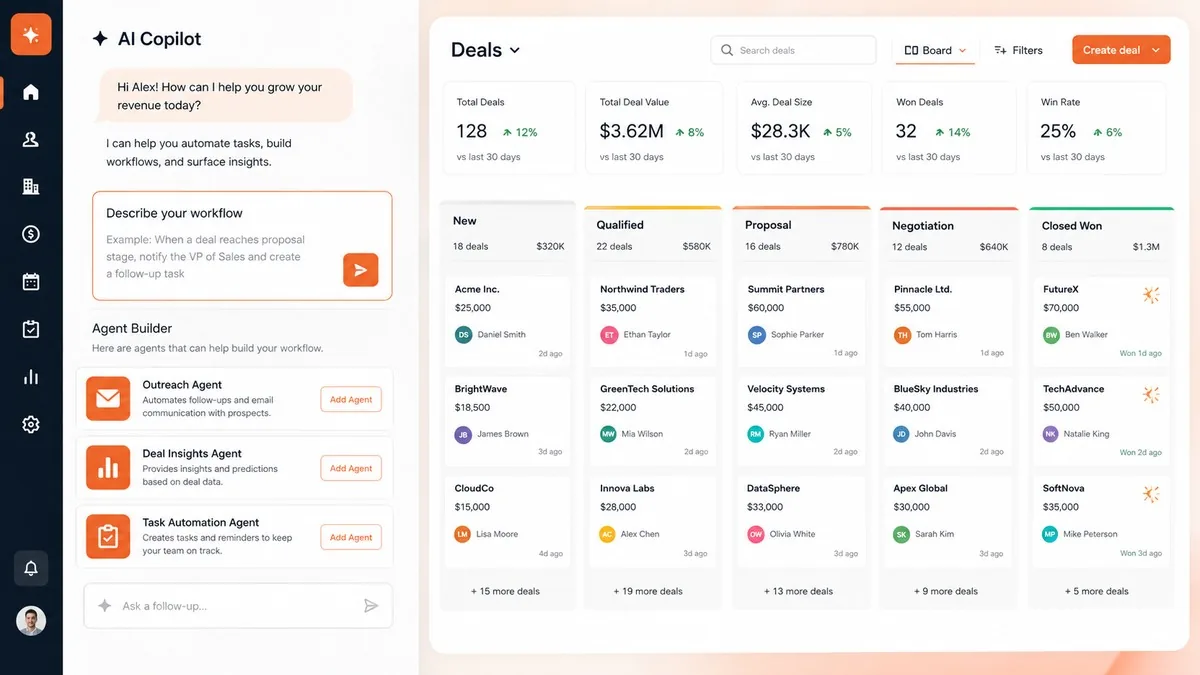
HubSpot’s AI-first CRM redesign became mandatory for all users on August 31, 2026, and the platform has since accelerated further: at its September 16 Unbound conference, HubSpot announced 8 new AI capabilities spanning Breeze, Smart CRM, Marketing Studio, ChatGPT Ads integration, and a Prospecting Agent that now monitors 40+ buying signals.
HubSpot launched the visual refresh phase of the redesign in June 2026 as an opt-in. From August 31, all accounts switched automatically. The deeper AI-first reimagining of core CRM workflows continues rolling out over approximately six months after that date, according to HubSpot’s published roadmap. August 31 was Phase 1 — a forced migration — not the platform’s final state.
What Changed on August 31
August 31 marked Phase 1 of a two-phase overhaul. The visual refresh — updated navigation, redesigned dashboards, and a cleaner interface layout — became compulsory for all users. Phase 2, HubSpot’s deeper AI-native rebuild of core CRM workflows, follows over the six months after the August deadline. HubSpot described the August date as the “mandatory default” rollout, not the completion of the redesign.
What Is HubSpot Agent Builder?
Agent Builder is HubSpot’s no-code tool for building custom CRM agents using Breeze Assistant. According to HubSpot product documentation cited by releasebot.io, Agent Builder lets teams describe a workflow in plain English and generate a custom agent trained on their existing deal data. The agents draw on contact records and pipeline history. HubSpot positions Agent Builder as the mid-market alternative to Salesforce Agentforce, which targets enterprise deployments and requires technical configuration.
What Works — and What Doesn’t — in HubSpot AI
HubSpot’s own ecosystem analysis establishes a clear performance boundary for its AI features. Simple Machines Marketing’s review found that AI features with clear inputs and a human review checkpoint work well, while features designed to run fully autonomously tend to underperform expectations. HubSpot AI capabilities are bundled into existing subscription tiers — no separate AI add-on fee has been announced. The platform surfaces next-best-action recommendations and lead conversion predictions suited to mid-market growth.
How HubSpot Compares to Salesforce and Zoho in 2026
Salesforce’s Agentforce platform — including Agentforce 3.0 and Einstein — is HubSpot’s primary competition for AI-first CRM positioning. Salesforce’s August 2026 Agentic Enterprise Index shows enterprise AI agent deployments doubling. Zoho CRM and Freshsales carry AI layers but have not pushed AI-first branding as aggressively as HubSpot in 2026. HubSpot’s differentiation argument is that Agent Builder delivers autonomous CRM workflows without a developer team — a gap Agentforce, designed for enterprise IT departments, does not close for smaller organizations.
For a comparison of CRM platforms competing in the mid-market, see our guide to the best CRM software for your business, which covers Salesforce, Zoho CRM, and Freshsales alongside HubSpot.
HubSpot Unbound September 16: 8 New AI Features
At its September 16, 2026 Unbound conference, HubSpot announced 8 new AI-powered capabilities across Breeze, CRM data capture, marketing, advertising, and sales. HubSpot CPO Duncan Lennox stated: “We reimagined HubSpot to be a platform that delivers those outcomes.” (Source: SiliconAngle, September 16, 2026.)
Breeze Assistant Redesigned for Agentic Work Assignment
Breeze Assistant now assigns and completes work via specialized sub-agents rather than responding to single prompts. Each sub-agent handles a defined domain — such as prospecting, follow-up sequencing, or deal-stage analysis — and operates within its scope without manual orchestration. This shifts Breeze from a chat interface to a task-delegation layer embedded in HubSpot’s workflow engine.
Smart CRM Auto-Captures Calls, Emails, and Meetings
Smart CRM automatically captures contact activity from calls, emails, and meetings, then syncs the data to the relevant contact and deal records in HubSpot. Teams no longer log activity manually after each interaction. The feature targets the data-completeness gap that causes CRM records to decay between sales cycles.
Context Home Scores Data Completeness and Flags Gaps
Context Home gives sales representatives a real-time data-completeness score for each account, surfacing missing fields, stale contact details, and incomplete deal attributes. Representatives see which gaps are highest-priority before outreach. HubSpot positions Context Home as a pre-call preparation tool that reduces time spent manually auditing records.
Marketing Studio: 81% More Campaigns, 2.2x More Leads in Early Access
Marketing Studio highlights underperforming segments and generates campaign recommendations, then automates campaign creation inside HubSpot’s existing marketing tools. Early-access users ran 81% more campaigns and generated 2.2 times more leads than baseline, according to HubSpot’s internal usage data cited at Unbound 2026. The feature draws on contact behavior, deal-stage signals, and historical campaign performance to prioritize which segments to target next.
HubSpot + OpenAI ChatGPT Ads: First CRM-to-AI-Search Ad Integration
HubSpot launched the first CRM integration with OpenAI’s ChatGPT Ads product, enabling sponsored placements below AI-generated responses in ChatGPT. Advertisers connect HubSpot contact and segment data to ChatGPT Ads targeting without exporting audiences to a separate platform. The integration marks HubSpot’s entry into AI-native advertising channels as ChatGPT becomes a primary discovery surface for B2B buyers.
Microsoft Advertising Integration
HubSpot added a native integration with Microsoft Advertising, connecting HubSpot contact lists, deal stages, and lead scores directly to Microsoft’s Bing and LinkedIn audience targeting. Marketers sync HubSpot segments to Microsoft Advertising campaigns without CSV exports or third-party connectors. This extends HubSpot’s native advertising reach beyond Google Ads and Meta.
Revenue Hub Auto-Generates Quotes from Deal Data
Revenue Hub reads open deal records and auto-generates draft quotes using the deal’s product line items, pricing tiers, and custom terms already stored in HubSpot. Sales representatives review and send the draft rather than building quotes manually. The feature reduces quote-creation time for deals with 5 or more line items, where manual quote assembly typically takes 20 to 45 minutes.
Updated Prospecting Agent Monitors 40+ Buying Signals
The HubSpot Prospecting Agent now tracks more than 40 distinct buying signals — including funding rounds, leadership changes, job postings for relevant roles, product review activity, and website behavior — and surfaces accounts showing multiple concurrent signals as high-priority targets. The agent updates signal monitoring in real time and pushes alerts to the assigned representative’s HubSpot feed. According to HubSpot’s Unbound release notes, the previous version tracked fewer than 20 signals.
Frequently Asked Questions
What did HubSpot announce at Unbound on September 16, 2026?
HubSpot announced 8 new AI features at its Unbound 2026 conference on September 16: a redesigned Breeze Assistant with specialized sub-agents, Smart CRM for automatic activity capture, Context Home for data-completeness scoring, Marketing Studio for automated campaign creation (81% more campaigns and 2.2x more leads in early access), the first CRM integration with OpenAI ChatGPT Ads, Microsoft Advertising integration, Revenue Hub for auto-generated quotes, and an updated Prospecting Agent that monitors 40+ buying signals.
What is HubSpot Context Home?
HubSpot Context Home is a dashboard that scores the data completeness of each account and flags missing or stale fields. Sales representatives use it before outreach calls to identify which contact details, deal attributes, or activity records need to be updated. HubSpot positions it as a pre-call preparation tool designed to reduce manual CRM auditing.
How does HubSpot Marketing Studio work?
HubSpot Marketing Studio is an AI feature that analyzes contact behavior, deal-stage signals, and historical campaign performance to identify underperforming segments and recommend new campaigns. It then automates campaign creation inside HubSpot’s existing marketing tools. Early-access users reported running 81% more campaigns and generating 2.2 times more leads compared to their baseline performance.
What is the HubSpot and ChatGPT Ads integration?
HubSpot’s ChatGPT Ads integration is the first CRM-native connection to OpenAI’s ChatGPT Ads product. It lets advertisers use HubSpot contact lists and audience segments to target sponsored placements that appear below AI-generated responses in ChatGPT — without exporting data to a separate ad platform. HubSpot announced this at Unbound on September 16, 2026.
Was the August 31 HubSpot redesign mandatory for all users?
Yes. The HubSpot CRM visual refresh became mandatory for all users on August 31, 2026, ending the opt-in period that began in June 2026. Phase 2 — HubSpot’s deeper AI-native rebuild of core CRM workflows — continues rolling out over the six months following the August deadline and is not yet complete.
