

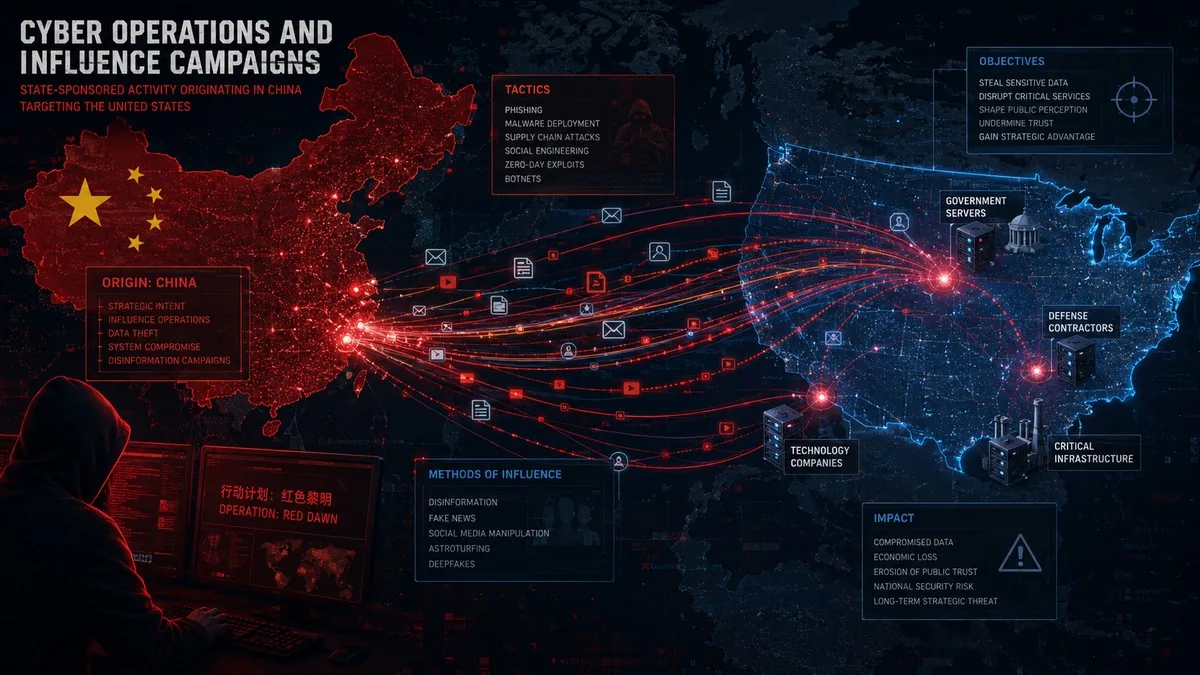
OpenAI’s June 2026 report on the China influence operation targeting US data centers reveals that accounts “likely originating from China” used ChatGPT to generate covert social media content designed to turn Americans against AI infrastructure by blaming data centers for rising electricity bills. OpenAI found no evidence of meaningful impact from either campaign — but the report is the first time the company has publicly named a domestic US influence campaign as China-linked, and the weapon was its own product.
An influence operation is a coordinated effort to covertly shape public opinion using inauthentic accounts, fabricated content, or deceptive amplification — in this case, AI-generated social media posts scripted via ChatGPT prompts. OpenAI published its threat intelligence findings on June 11, 2026. The banned accounts operated via VPNs and simplified Chinese prompts — a behavioral fingerprint, though not definitive state attribution. China’s embassy responded that it “opposes groundless attacks or smears against China.”
Inside the China Influence Operation OpenAI Disrupted
OpenAI identified two distinct campaigns, both targeting American public opinion from opposite angles. Campaign #1 — “Data Centre Bandwagon” — generated social media comments blaming data centers for US electricity price spikes. The content included a comic strip showing a businessman clutching bags of money as a family reacted in horror to their power bill — engineered to feel organic and locally sourced.
Campaign #2 — “Tech and Tariffs” — produced content criticizing US tariffs and portraying Washington as seeking to “dominate technological competition” with China. Operators explicitly told ChatGPT not to mention Xi Jinping, a telling detail about the scripting. China-linked actors also revived a botnet in parallel, according to The Register — a multi-vector approach combining AI-generated content with traditional bot infrastructure. Total audience reached: effectively zero.
How Effective Was China’s ChatGPT Data Center Campaign? Not Very.
OpenAI found “no authentic engagement” and “no evidence of meaningful breakout” from either campaign. That tracks with what independent researchers have been observing. Darren Linvill, a professor at Clemson University who specializes in foreign influence operations, is blunt: “My team is very familiar with the work of various Chinese influence actors, and the AI work China has done to date has been interesting but not effective.”
He punctured the narrative further with a sharper question: “If China were really serious about meaningfully influencing the discourse around data centres using AI chat bots, I question if they would use OpenAI to do it.” As OpenAI itself acknowledged in the report: “Foreign influence operations have long sought to latch onto existing local issues and sincerely held beliefs, using them to build credibility, amplify divisions or exacerbate public distrust.” That’s exactly what these campaigns attempted — the failure was in execution, not in strategy.
This Isn’t OpenAI’s First Disruption Report
OpenAI has been publishing influence operation disruption reports since 2024, making this part of a growing pattern. What distinguishes this case is the target: US domestic AI policy and data center development. Previous campaigns focused on foreign elections or international narratives. Turning the adversarial lens onto America’s own infrastructure debates — and using the adversary’s commercial AI product to do it — is a new escalation in the playbook.
The political backdrop matters too. Secretary of Interior Doug Burgum said in May 2026 that opposition to data centers could be tied to “foreign-sourced dark money.” The OpenAI report adds credible, specific evidence in that direction — two campaigns, 36+ data center projects blocked or delayed between May 2024 and June 2025 (per Data Center Watch), and a coordinated effort to exploit legitimate local grievances about power costs.
The Real Data Center Problem Behind the Operation
None of this means US concerns about AI data centers are manufactured. Data centers consumed 1.5% of global electricity in 2024, growing 12% annually per the IEA — and communities bearing the grid upgrade costs feel that acutely. Senators Bernie Sanders and Alexandria Ocasio-Cortez introduced a data center moratorium bill in March 2026. The AI industry’s fight over the Great American AI Act runs directly through communities with legitimate power cost grievances, not manufactured ones.
OpenAI publishing this report while simultaneously being one of the largest drivers of AI compute demand is a tension worth naming. The report doesn’t resolve the underlying energy debate — it simply establishes that an adversarial actor tried to exploit it, and failed to move the needle.
Frequently Asked Questions
What did OpenAI find about the China influence operation targeting data centers?
OpenAI identified two clusters of ChatGPT accounts “likely originating from China” that generated covert social media content targeting US data center opposition and tariff debates. The accounts used VPNs and simplified Chinese prompts. OpenAI found no evidence of meaningful impact from either campaign. The company has been publishing influence operation disruption reports since 2024, but this marks the first targeting domestic US AI infrastructure policy.
What were the two China-linked ChatGPT campaigns OpenAI disrupted?
“Data Centre Bandwagon” blamed US data centers for rising electricity prices, using AI-generated social media posts including comic strips. “Tech and Tariffs” criticized US tariffs and framed Washington as seeking technological dominance over China. Both campaigns’ operators explicitly instructed ChatGPT not to mention Xi Jinping. A parallel botnet was also revived alongside the AI-generated content.
Did China’s ChatGPT data center influence operation succeed?
No. OpenAI found “no authentic engagement” and no evidence of “meaningful breakout.” Clemson University’s Darren Linvill, who tracks Chinese influence operations, described the AI-assisted campaigns as “interesting but not effective” and questioned why China would use OpenAI’s own product if the goal were serious influence.
Are US concerns about AI data centers manufactured by China?
No. Legitimate local opposition is well-documented and predates any influence operation. At least 36 US data center projects were blocked or delayed between May 2024 and June 2025. Data centers consumed 1.5% of global electricity in 2024, growing 12% annually per the IEA. Senators Sanders and Ocasio-Cortez introduced a moratorium bill in March 2026. The concerns are real regardless of covert amplification attempts.
How did OpenAI detect the China-linked ChatGPT accounts?
OpenAI’s threat intelligence team flagged the accounts via behavioral signals: VPN usage and simplified Chinese prompts with specific political instructions. The company has published influence operation disruption reports since 2024 and monitors for coordinated inauthentic behavior across its platform. This is the first report to identify a campaign targeting domestic US AI infrastructure policy.
For more on how AI is reshaping geopolitics, see ChatGPT’s growing role in global information flows. Follow WithO2.com for breaking AI news as it happens.
Last Updated: June 2026
