

Last Updated: June 2026
In this SEMrush review 2026, we test the platform across keyword research, site audits, PPC, and the new AI Visibility Toolkit. Here’s our verdict: SEMrush is worth it for agencies and marketing teams managing multiple sites, but overkill for solo bloggers — especially now that Pro costs $139.95/month.
SEMrush is an all-in-one SEO and digital marketing platform covering keyword research, site audits, PPC, and AI visibility.
Is it worth $139.95/month? For agencies and in-house teams running SEO plus PPC plus content, yes. For solo bloggers or single-site owners, the price is hard to justify when cheaper tools like Ahrefs Lite or Surfer cover the essentials.
Quick Comparison: SEMrush vs Top Alternatives (2026)
| Tool | Starting Price | Best For | Standout Feature | Rating |
|---|---|---|---|---|
| SEMrush Pro | $139.95/mo | Agencies & teams | AI Visibility Toolkit | 4.5/5 |
| Ahrefs Lite | $129/mo | Backlink-heavy sites | Link database (500M domains) | 4.4/5 |
| Surfer SEO | $89/mo | Content writers | Real-time content grader | 4.2/5 |
| NeuronWriter | $23/mo | Budget content SEO | Affordable SERP analysis | 3.8/5 |
What Is SEMrush?
SEMrush started as a keyword and competitor research tool in 2008 and has since grown into a 55+ tool platform covering SEO, PPC, content marketing, social media management, and — as of 2025 — AI visibility tracking. The 2026 version, branded partly as Semrush One, adds a dedicated dashboard showing how your brand appears inside ChatGPT, Google AI Overviews, Google AI Mode, and Gemini — a genuinely new capability that no competitor matches at scale.
The platform is used by over 10 million marketing professionals globally. Its 35 billion keyword database (US alone) and 43 trillion crawled backlinks make it one of the largest proprietary data sets in the industry.
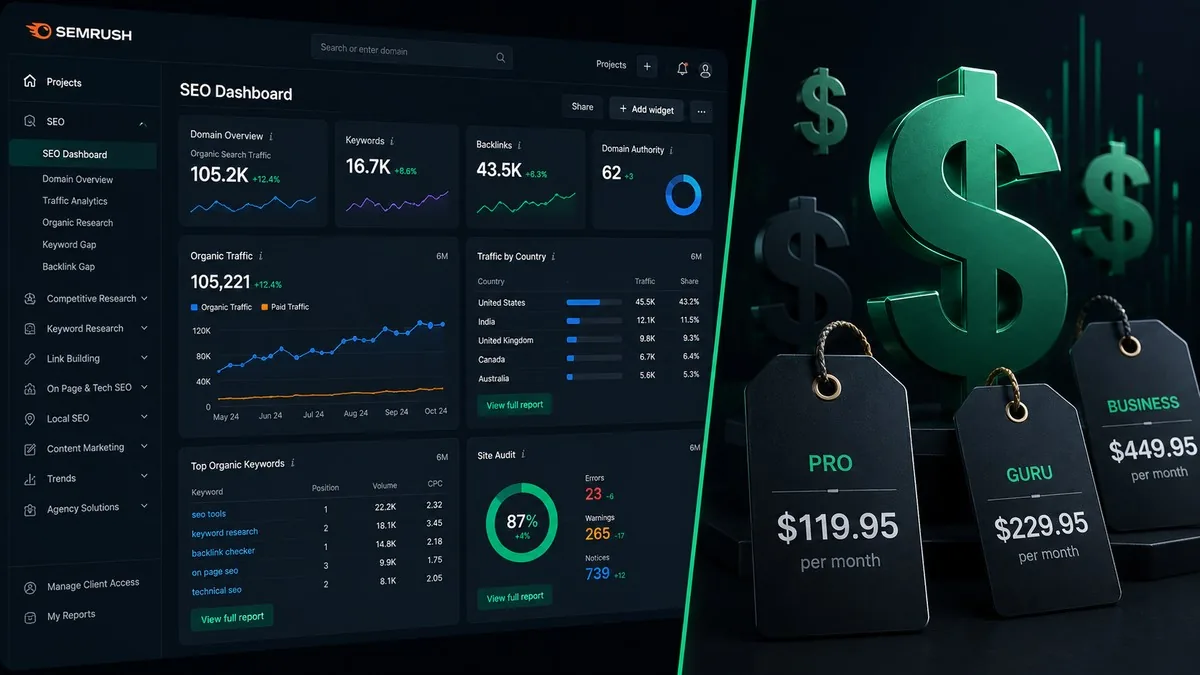
SEMrush Pricing 2026 — Every Plan Explained
Pricing has shifted upward since 2024. The entry point is now $139.95/month, not the $99 many long-time users remember.
| Plan | Monthly Price | Annual Price | Projects | Keywords Tracked | Users |
|---|---|---|---|---|---|
| Pro | $139.95 | $117.33/mo | 5 | 500 | 1 |
| Guru | $249.95 | $208.33/mo | 15 | 1,500 | 3 |
| Business | $499.95 | $416.66/mo | 40 | 5,000 | 5 |
| Semrush One | from $199 | Custom | Custom | Custom | Custom |
Pricing verified June 2026 on the SEMrush official pricing page. For user reviews, see SEMrush on G2 (4.5/5 stars, 2,300+ reviews).
Annual billing saves ~16% — roughly two months free. The hidden cost trap: extra user seats, API access, and AI visibility add-ons can push real annual spend to $9,900–$15,800 for a mid-sized team. Price this out before committing.
A 14-day free trial (no credit card required on some landing pages) lets you test the full Pro feature set.
Core Features We Tested
Keyword Magic Tool
This is SEMrush’s strongest card. Enter a seed keyword and it generates thousands of related queries, grouped by topic, with search volume, keyword difficulty, CPC, and search intent. The interface filters by question-type keywords, long-tail variants, and SERP features your target keyword triggers. For content teams building topic clusters, it’s the fastest workflow in the industry.
Site Audit
The crawler checks up to 100,000 pages per month on the Pro plan and flags technical issues across 140+ SEO factors — broken links, missing meta tags, Core Web Vitals failures, duplicate content, and crawl depth problems. Results are prioritized by impact score. We found it caught several redirect chain issues that Google Search Console missed entirely.
Position Tracking
Tracks daily ranking changes for up to 500 keywords (Pro) across desktop and mobile, by location and device. Particularly useful for local SEO — you can set it to a specific city or ZIP code and see real SERP positions at that granularity. Competitor tracking is included by default.
Backlink Analytics
SEMrush indexes 43 trillion backlinks from 390 million referring domains. That’s impressive in raw volume but trails Ahrefs’s 500 million referring domain index — the gap matters most when auditing very large or very new link profiles. For most users, 390M domains is more than sufficient for disavow workflows and competitor link-gap analysis.
AI Visibility Toolkit (New in 2026)
The standout 2026 addition. Semrush One’s AI Visibility dashboard tracks how often your brand gets mentioned and cited across ChatGPT, Google AI Overviews, AI Mode, and Gemini, using a database of 130+ million prompts updated monthly. You can benchmark your brand’s AI presence against up to four competitors and see which topics your brand “owns” in AI responses versus where it’s invisible.
This is the only tool we’ve tested that gives this data at scale. For brands investing in AEO/GEO (answer engine and generative engine optimization), it’s already essential. Check our Best AI SEO Tools 2026 guide for how SEMrush ranks against standalone AI SEO tools.
Content Marketing Platform
Available from Guru tier upward. Includes a Topic Research tool (find content gaps and question-based angles), an SEO Writing Assistant (live content grade as you write, similar to Surfer but lighter), and a Content Audit tool that identifies your weakest pages by traffic and backlink value. The writing assistant is useful but lags behind Surfer SEO’s real-time optimization for pure content work.
SEMrush vs Ahrefs — The Key Differences
These two tools dominate the market. The right choice depends on what you do most. See our full Ahrefs vs SEMrush comparison for a deep analysis — but here’s the short version:
| Feature | SEMrush | Ahrefs |
|---|---|---|
| Starting price | $139.95/mo | $129/mo |
| Referring domains indexed | 390M | 500M ✅ |
| Keyword database | 35B ✅ | ~29B |
| PPC / paid search research | ✅ Yes | Limited |
| Content Marketing tools | ✅ Guru+ | Basic |
| AI Visibility Tracking | ✅ Yes (Semrush One) | ❌ No |
| 14-day free trial | ✅ Yes | ❌ No |
| Best for | All-in-one marketing | Backlink analysis |
Bottom line: If your work is 80% link building and backlink auditing, Ahrefs has the better data. If you do SEO + PPC + content + want AI visibility, SEMrush is the stronger platform.
Pros and Cons
What We Liked
- Keyword Magic Tool is the best in class for topic discovery and intent filtering.
- AI Visibility Toolkit is genuinely unique — no competitor tracks brand mentions across ChatGPT, AI Mode, and Gemini at this scale.
- 14-day free trial lets you evaluate before paying.
- PPC research tools that Ahrefs lacks entirely — essential for teams running paid and organic together.
- Site audit catches issues Google Search Console doesn’t surface, particularly redirect chains and internal link depth problems.
What Needs Improvement
- Price has increased significantly — Pro jumped from $119.95 to $139.95, squeezing solo operators and small businesses.
- Billing and cancellation friction is the most-documented complaint across G2 and Capterra reviews. Users report difficulty cancelling and unexpected charges for add-ons.
- Add-ons add up fast — extra users ($45/user/month), local SEO ($20/location/month), and Social Media Toolkit are all separate line items. Real cost for a 3-person team can exceed $800/month.
- Backlink index trails Ahrefs — 390M vs 500M referring domains matters for heavy link-building work.
- Steep learning curve — 55+ tools is powerful but overwhelming for new users. Expect 2–3 weeks before the workflow feels natural.
Getting Started: Your First 30 Minutes in SEMrush
New users often get lost in the menu. Here’s the fastest path to value on day one:
1. Run a Domain Overview on your site. Navigate to Competitive Research → Domain Overview, enter your URL. You’ll see your organic traffic estimate, top organic keywords, top competitors, and backlink profile — all on one screen. This single report tells you where you stand in your niche and which competitors to watch.
2. Set up Position Tracking immediately. Go to Projects → Create Project → Position Tracking. Enter the keywords you care about (even 10–20 is useful to start). SEMrush will begin pulling daily ranking data. Within 48 hours you have a baseline — this becomes your source of truth for measuring SEO progress.
3. Run a Site Audit on your domain. Under Projects, launch Site Audit for your domain. Set crawl limit to your full page count. The audit takes 10–60 minutes depending on site size. When it finishes, sort issues by “Error” type first — these are the highest-impact fixes. Ignore the long warning list initially; address errors first.
4. Use Keyword Magic Tool for one target topic. Enter your main topic, filter by your target country, then use the “Groups” view to see semantic clusters. This is where SEMrush genuinely outpaces most competitors — the grouping logic is excellent for building topic silos.
My Practical SEMrush Workflow for a Small Content Team
For a team of 2–3 people managing a content site, here’s the workflow we use and recommend:
- Monday: Check Position Tracking for ranking movements week-over-week. Flag any pages dropping more than 5 positions — these need review.
- Tuesday: Keyword Magic Tool session for the week’s content calendar. Identify 3–5 topics with KD under 30 and at least 300 monthly searches. Add them to the content queue.
- Wednesday–Thursday: Write content using the SEO Writing Assistant (Guru+ only) or export keyword targets to your preferred editor.
- Friday: Check Site Audit for new issues flagged that week. Also review the Backlink Audit for any new potentially toxic links.
- Monthly: Pull the Traffic Analytics report on 2–3 competitors to see which pages they grew. Add any uncovered gaps to the content calendar.
This workflow requires the Guru plan for the SEO Writing Assistant and historical data access — the Pro plan covers everything else listed.
SEMrush Free vs Paid: What You Actually Get
SEMrush has a limited free tier — 10 analytics requests per day. In practice, you can run a domain overview, check a handful of keywords, and see a partial backlink list before hitting the wall. It’s useful for a one-off check but not for any ongoing SEO work. The 14-day Pro trial is the right way to evaluate the tool — it gives full Pro access, and you can run your full audit workflow in that window to decide if it’s worth the subscription.
Who Should Use SEMrush?
- Digital marketing agencies managing 5+ client sites (Guru plan is the sweet spot)
- In-house teams running SEO, PPC, and content under one roof
- Enterprises that need AI visibility monitoring alongside traditional rankings
- B2B SaaS companies investing in GEO/AEO as AI search grows
Who Should Skip It?
- Solo bloggers or single-site owners — Ahrefs Lite ($129/mo) or even a combination of free tools gives 80% of the value at a fraction of the cost
- Pure link builders — Ahrefs’s larger index makes it the better tool for this specific workflow
- Budget-constrained startups — NeuronWriter ($23/mo) or SE Ranking ($65/mo) cover content SEO basics without the price shock
SEMrush earns its position as the category leader, but the value calculation changed in 2026. The AI Visibility Toolkit is a genuine differentiator that no competitor offers at scale — for any brand taking AEO and GEO seriously, that alone justifies the Guru tier. For pure organic SEO, though, Ahrefs now starts $10/month cheaper and has a stronger backlink database. The honest answer: if you only do SEO, evaluate both with their trials. If you do SEO + PPC + content + need AI visibility data, SEMrush wins without close competition.
SEMrush Review 2026: Final Verdict
Best overall: Agencies and in-house marketing teams. SEMrush is the only platform combining best-in-class keyword research, PPC tools, content marketing, and AI visibility tracking in one subscription. At $208.33/month (annual Guru), it is expensive — but defensible for teams using all pillars.
Best budget alternative: Ahrefs Lite ($129/mo) for link-focused SEOs. Surfer SEO ($89/mo) for content-only teams. NeuronWriter ($23/mo) for budget-constrained content operators.
Skip it if: You run a single blog below ~10,000 monthly visits. The depth exceeds what a solo operator can realistically use, and the price is hard to justify at that scale.
Try SEMrush free for 14 days at semrush.com.
Frequently Asked Questions
How much does SEMrush cost in 2026?
SEMrush pricing in 2026 starts at $139.95/month for the Pro plan (billed monthly) or $117.33/month on annual billing. The Guru plan is $249.95/month, and Business is $499.95/month. Semrush One, which adds the AI Visibility Toolkit, starts at $199/month. Note that additional users, local SEO, and other add-ons are charged separately.
Does SEMrush offer a free trial?
Yes. SEMrush offers a 14-day free trial on the Pro plan, giving full access to the core toolkit including the Keyword Magic Tool, Site Audit, and Position Tracking. No credit card is required on certain landing pages — check the official SEMrush trial page for current conditions, as they vary.
Is SEMrush better than Ahrefs in 2026?
It depends on your use case. SEMrush is better for all-in-one digital marketing — keyword research, PPC, content marketing, and the new AI visibility tracking. Ahrefs is better for backlink analysis, with 500 million referring domains indexed versus SEMrush’s 390 million. For pure link-building workflows, Ahrefs is stronger. For everything else, SEMrush is the more complete platform.
What is Semrush One?
Semrush One is the 2025–2026 rebranded bundle that combines the classic SEMrush SEO toolkit with the new AI Visibility Toolkit. It tracks how your brand appears in ChatGPT, Google AI Overviews, Google AI Mode, and Gemini using a database of 130+ million prompts updated monthly. Pricing starts at $199/month and scales with usage.
What is SEMrush best used for?
SEMrush is best used for keyword research (its Keyword Magic Tool is the strongest in the industry), competitor SEO analysis, technical site audits, PPC research, and content marketing planning. In 2026, its AI Visibility Toolkit — which tracks brand mentions inside AI chatbots and AI search — is its biggest differentiator over competitors like Ahrefs and Surfer SEO.
Is there a cheaper alternative to SEMrush?
Yes. Ahrefs Lite starts at $129/month with a stronger backlink database. Surfer SEO ($89/month) focuses purely on content optimization and outperforms SEMrush for that specific task. NeuronWriter ($23/month) is the most affordable SERP-based content optimizer. SE Ranking ($65/month) covers most SEO basics at roughly half the SEMrush Pro price. The right choice depends on which specific features matter most to your workflow.
Last Updated: June 2026. Prices verified against SEMrush.com official pricing page.
