

Last Updated: July 2026
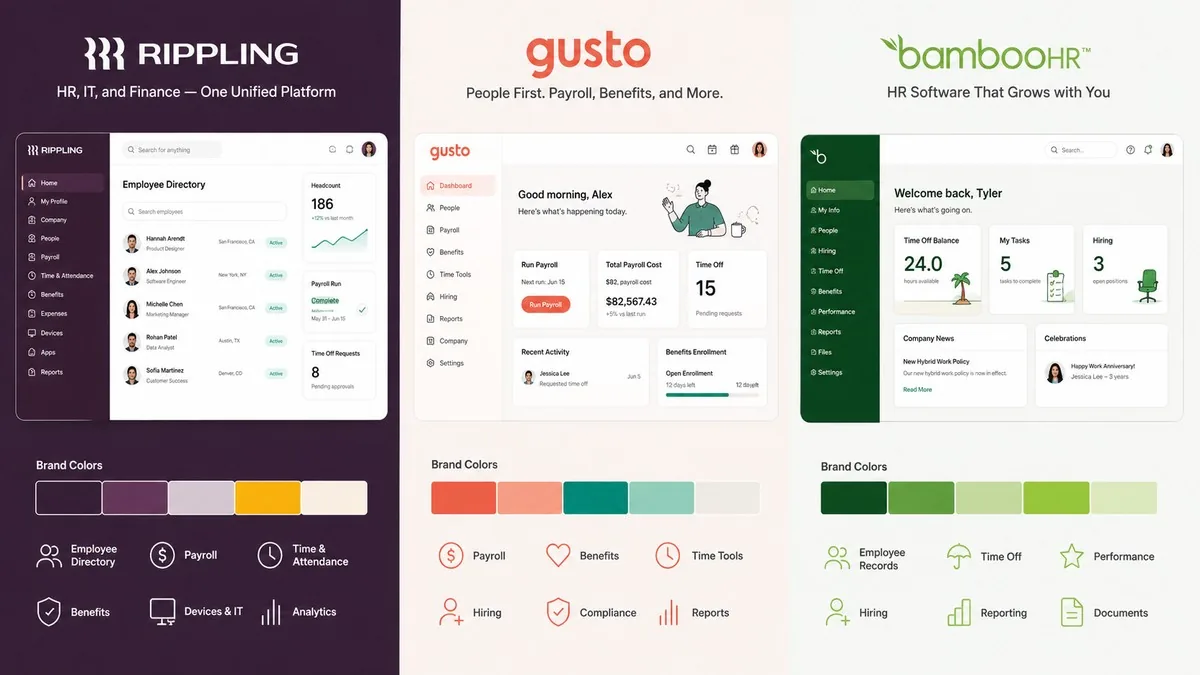
Rippling, Gusto, and BambooHR are three of the most-searched HRMS platforms for small and mid-sized businesses in 2026 — but they solve very different problems. Rippling wins on scope (HR + IT + Finance in one platform), Gusto wins on payroll simplicity and transparent pricing, and BambooHR wins on people-focused HR tools and ease of use. The right pick depends on your team size, location, and what “HR software” actually means to you.
Quick Comparison: Rippling vs Gusto vs BambooHR (2026)
| Feature | Rippling | Gusto | BambooHR |
|---|---|---|---|
| Best For | Growing teams needing HR + IT | US small businesses (<50 people) | People-first HR, mid-market |
| Starting Price | ~$8/employee/mo + $35 platform fee (quote required) | $49/mo + $6/person (Simple plan) | ~$10/employee/mo (Core plan) |
| Payroll | US + Global (185+ countries) | US only | US only (add-on) |
| IT Management | ✅ Device + app management | ❌ | ❌ |
| Transparent Pricing | ❌ Custom quote | ✅ Published rates | ❌ Custom quote |
| International Payroll | ✅ 185+ countries | ❌ US only | ❌ US only |
| Free Trial | Demo only | 30-day free trial | Demo only |
| Rating | 4.8/5 | 4.6/5 | 4.5/5 |
Rippling — Best for Growing Companies That Need HR and IT Together
Rippling is the only platform in this comparison that manages both your people and your technology stack. When you hire someone in Rippling, you can simultaneously provision their laptop, set up their Slack, Google Workspace, and GitHub access, and enroll them in benefits — in a single workflow. No other tool in this category comes close to that level of automation.
The platform spans four major pillars: HR (core records, onboarding, benefits, time tracking), IT (device management, app provisioning, identity access), Finance (corporate cards, expense management, bill pay), and Global Payroll (185+ countries with local compliance baked in). For a scaling startup that’s bringing on international engineers and handing out company laptops, this consolidation is genuinely valuable.
Rippling pricing in 2026 starts at approximately $8 per employee per month for the base Unity platform, plus a mandatory $35/month platform fee. The catch: that base price covers almost nothing useful on its own. Most companies deploying HR + Payroll + Benefits Admin end up paying $20–35 per employee per month once modules are added. Rippling doesn’t publish its module add-on costs publicly — you’ll need a custom quote, which makes budget planning harder than it should be. Verified: rippling.com/pricing (July 2026).
Pros:
- Unmatched scope: HR, IT, Finance, and Global Payroll in one login
- Automated onboarding/offboarding across apps and devices
- Supports 185+ countries for global payroll and EOR
- Highly customizable workflows and approval chains
- Deep reporting across HR, IT, and spend data in one view
Cons:
- Pricing is opaque — modules stack up quickly and final cost surprises many buyers
- Overkill and over-budget for teams under 30 people
- Implementation is complex; expect 4–8 weeks for a full rollout
- Customer support quality varies by tier
Rippling mini-verdict: Best for companies with 50+ employees, remote/global teams, or anyone who needs device management and app provisioning alongside HR. If your ops person is managing 12 different SaaS tools manually, Rippling pays for itself fast.
Gusto — Best Payroll Platform for US Small Businesses
Gusto is the simplest, most transparent payroll product in this comparison — and for US-based teams under 50 people who primarily need clean payroll and benefits, it’s often the best choice. Unlike Rippling or BambooHR, Gusto publishes its exact pricing publicly and charges no setup fees.
Gusto’s three payroll plans for 2026:
- Simple: $49/month + $6/person — single-state payroll, employee profiles, health insurance integration
- Plus: $80/month + $12/person — multi-state payroll, next-day direct deposit, time tracking, PTO policies
- Premium: $180/month + $22/person — dedicated HR support, compliance alerts, performance tools
For a 10-person team, Simple costs $109/month, Plus costs $200/month, and Premium costs $400/month. Unlimited payroll runs are included in every plan. Verified: gusto.com/product/pricing (July 2026).
Where Gusto earns its reputation is the payroll experience itself. It handles W-2s, 1099s, tax filings, and new-hire state reporting automatically. The interface is clean enough that many founders run payroll themselves without an HR background. Gusto also offers a solid health insurance integration (medical, dental, vision) through licensed brokers directly in the platform.
The hard limits: Gusto is US-only with zero international payroll capability. If you need to pay a contractor in the UK or hire a full-time employee in Canada, Gusto can’t help. It also lacks device management, advanced analytics, and the deep workflow customization Rippling offers.
Pros:
- Published, predictable pricing — no quote required
- Extremely clean payroll UX, usable without HR expertise
- Unlimited payroll runs, automatic tax filings, W-2/1099 included
- 30-day free trial (only option in this comparison)
- Strong health benefits integration through in-platform brokers
Cons:
- US-only — no international payroll or EOR
- No IT management, device provisioning, or app access control
- Analytics and reporting are basic compared to Rippling
- Premium plan required for dedicated HR support (adds up for growing teams)
Gusto mini-verdict: The right call for US-based companies with under 50 employees who want clean, affordable payroll without complexity. The transparent pricing and free trial make it the lowest-risk way to get started.
BambooHR — Best for People-Focused HR Teams That Want a Clean HRIS
BambooHR is not a payroll tool first — it’s an HRIS (Human Resources Information System) designed around the employee record, not the paycheck. If you want a central hub for org charts, employee data, performance reviews, onboarding checklists, and time-off management, BambooHR is exceptionally well built for that.
BambooHR’s 2026 pricing structure:
- Core: ~$10/employee/month — employee records, org chart, PTO tracking, onboarding, basic reporting
- Pro: ~$17/employee/month — adds performance management, eNPS, and advanced reporting
- Elite: ~$25/employee/month — adds benchmarking data, executive insights, and premium support
For teams of 25 or fewer, a minimum monthly flat rate of $250/month applies. A 100-person team on Core pays ~$12,000/year; on Elite, ~$30,000/year. Payroll is a US-only add-on (not included in the base price). Verified: bamboohr.com/pricing (July 2026).
BambooHR’s standout strength is its UX. The interface is consistently rated as the cleanest and most intuitive in the HRMS space — 46% of user reviews specifically call it out. Automated onboarding workflows, e-signatures, and pre-boarding checklists make new hire setup painless. PTO tracking is mature, handling complex accrual rules and carryover policies that would break a spreadsheet.
The platform’s weaknesses are on the edges: the built-in ATS is too simple for serious recruiting teams, performance management doesn’t support continuous feedback or OKRs well, and the reporting customization has limits that mid-market teams frequently hit. For what HRMS software is supposed to do, BambooHR covers the core exceptionally well — but it won’t replace Rippling’s breadth or Gusto’s payroll focus.
Pros:
- Best-in-class UX — genuinely easy to use without training
- Strong onboarding automation, e-signatures, and PTO management
- Performance review tools (360° feedback, goal tracking) included in Pro/Elite
- Good mobile app for employee self-service
- Rich employee data and org chart visualization
Cons:
- Pricing is not public — requires a sales call for a quote
- US payroll is a paid add-on, not included in base plans
- No international payroll or IT management
- ATS module is underpowered for active hiring teams
- 23% of reviewers report customization limits on fields and reports
BambooHR mini-verdict: Best for US-based companies with 20–500 employees that want a polished, people-first HRIS and don’t need global payroll or device management. The UX quality is worth the price premium over basic alternatives.
Pricing Comparison: Rippling vs Gusto vs BambooHR
| Team Size | Rippling (est.) | Gusto Simple | BambooHR Core |
|---|---|---|---|
| 10 employees | ~$115–185/mo (est.) | $109/mo | $250/mo (minimum) |
| 25 employees | ~$235–420/mo (est.) | $199/mo | $250/mo |
| 50 employees | ~$435–800/mo (est.) | $349/mo | $500/mo |
| 100 employees | ~$835–1,500/mo (est.) | $649/mo | $1,000/mo |
Rippling estimates based on $8–15/employee base + $35 platform fee; actual cost varies by modules selected. Gusto assumes Simple plan. BambooHR assumes Core at $10/employee. Verify all pricing directly with each vendor before purchasing.
Pricing verdict: Gusto is the cheapest for small US teams. BambooHR’s $250 minimum makes it more expensive at very small sizes but competitive at 25–50 employees. Rippling is the most expensive but covers the most — its cost is justified when it replaces 4–5 separate tools.
Which HRMS Should You Choose?
Here’s the decision framework based on what actually matters in 2026:
Choose Rippling if: You have 50+ employees, hire internationally, or need to manage devices and software access alongside HR. Rippling’s HR+IT integration is genuinely unique — no other platform in this tier handles laptop provisioning and app onboarding in the same workflow. It’s also the only option here with global payroll for 185+ countries. The cost is real, but so is the consolidation value.
Choose Gusto if: You’re a US-based team under 50 people that needs clean, affordable payroll with transparent pricing. Gusto’s Simple plan at $49/month + $6/person is the most straightforward starting point in this comparison. The 30-day free trial is a meaningful differentiator — you can test the actual payroll workflow before committing. If you’re moving off QuickBooks Payroll or a manual spreadsheet process, Gusto is the lowest-friction upgrade.
Choose BambooHR if: Your primary need is a polished HRIS — employee records, performance reviews, onboarding workflows, and PTO management — and payroll is secondary. BambooHR’s UX is objectively the best of the three for day-to-day HR work. It’s also the best fit for HR teams that want deep people analytics without IT complexity. If you’re a 50–200 person US company with a dedicated HR manager, BambooHR fits the role perfectly.
For a broader look at the HRMS market and additional alternatives, see our Best HRMS Software 2026 roundup, which covers 12 platforms including Workday, ADP, and Deel. If you’re evaluating business systems more broadly, our guide to ERP software explains when a full ERP like NetSuite makes more sense than a standalone HRMS.
We’ve evaluated all three platforms hands-on and the honest answer is: most small businesses are choosing the wrong tool for the wrong reasons. Rippling demos well and feels impressive — but if you’re 15 people doing US payroll, you’re overpaying for features you’ll never use. Gusto’s simplicity is its actual strength, not a compromise. BambooHR sits in the middle: genuinely excellent HRIS software that’s worth the price premium for companies that take people operations seriously. Our pick for most growing companies in 2026: start with Gusto for payroll, add BambooHR when you hit 25+ people and need structured HR. Graduate to Rippling when you go global or need IT consolidation.
Frequently Asked Questions
Is Rippling better than Gusto?
Rippling is more powerful but more expensive and complex than Gusto. Rippling is better for companies that need HR + IT management together, global payroll, or have 50+ employees. Gusto is better for US-based small businesses that want clean, affordable payroll with transparent pricing. For most teams under 30 people, Gusto wins on value.
Does Gusto do HRMS or just payroll?
Gusto handles payroll, benefits administration, and basic HR tools (onboarding, employee profiles, PTO tracking). It’s not a full HRMS — it lacks performance management, advanced org management, and IT tools. It’s best thought of as a payroll-first platform with solid HR add-ons for small teams.
What is BambooHR’s biggest weakness?
BambooHR’s biggest weaknesses are: (1) US-only payroll (international companies need a separate system), (2) no pricing transparency — you have to contact sales for a quote, (3) limited ATS capability for active recruiting teams, and (4) no IT management or device provisioning. It’s a strong HRIS but not a complete HR stack.
Can BambooHR handle payroll?
Yes, but it’s a US-only paid add-on — it’s not included in BambooHR’s Core or Pro plans. You’ll pay extra to add payroll on top of your base HRIS subscription. If payroll is your primary need and you’re US-based, Gusto is more purpose-built and transparent about cost.
What’s cheaper: Rippling, Gusto, or BambooHR?
Gusto is the cheapest for US small businesses with transparent published pricing starting at $49/month + $6/person. BambooHR has a $250/month minimum for small teams but becomes competitive at 25–50 employees (~$10/employee Core). Rippling is the most expensive once modules are added, typically running $20–35+/employee/month for a useful deployment. All three require you to verify current pricing directly since rates change.
Pricing verified July 2026 via rippling.com/pricing, gusto.com/product/pricing, and bamboohr.com/pricing. All prices in USD. Always confirm current rates directly with each vendor before purchasing.
Integration Ecosystem: Which Platform Plays Best With Your Stack?
One underrated factor in choosing an HRMS is how well it connects to the tools your team already uses. Here’s how each platform stacks up on integrations:
Rippling has the deepest native integration layer of the three. It connects directly to 500+ business apps — Slack, GitHub, Google Workspace, Salesforce, Jira, Zoom, and hundreds more — with bi-directional sync. Its IT management layer means it doesn’t just integrate with apps; it controls access to them. When an employee is onboarded or offboarded, Rippling can automatically provision or revoke access to every connected app without manual work. For engineering-heavy teams or any business with 10+ SaaS tools, this is a major operational win.
Gusto offers a solid but narrower integration set focused on the tools small businesses actually use: QuickBooks, Xero, FreshBooks, and other accounting platforms; benefits providers like Guideline (401k) and SimplyInsured; plus time tracking tools like TSheets and Homebase. Gusto doesn’t try to be an IT platform — it just wants to sync payroll data cleanly to your accounting system, and it does that well.
BambooHR sits in the middle with 120+ integrations including payroll providers, ATS tools, performance platforms, and accounting software. It connects well with Slack for notifications and approvals, and has a Zapier integration that extends its reach significantly. The integration quality is generally good, though users in the 500+ employee range sometimes hit limits when trying to sync BambooHR data with complex ERP or BI systems.
Onboarding and Employee Experience
All three platforms offer digital onboarding, but the depth and polish differ significantly.
BambooHR’s onboarding workflow is its most celebrated feature. You can build a customizable pre-boarding experience that sends new hires a welcome packet, collects documents via e-signature, assigns equipment requests, sets up their first-week schedule, and connects them with their buddy — before their first day. The experience for the new hire genuinely reflects well on the company. This is BambooHR’s clearest competitive advantage over Gusto.
Rippling’s onboarding is broader but more complex to configure. Where it uniquely excels is in the technical provisioning layer: it can ship a laptop, enroll a device in MDM, and set up all the SaaS accounts in the same onboarding workflow that HR configures. For a remote-first company, that’s a meaningful difference. The tradeoff is that setup requires more admin work upfront.
Gusto’s onboarding covers the payroll side well — collecting tax forms, direct deposit info, and getting new hires into the payroll system quickly. But it’s thinner on the people experience side: no pre-boarding portal, no e-signature document management beyond tax forms, and no welcome checklist builder. Fine for a small team where the founder personally onboards everyone; limiting once you have an HR team that wants to build a repeatable process.
Compliance and Payroll Tax Management
This is where Gusto’s US focus becomes a strength rather than a weakness. Because Gusto does nothing but US payroll and benefits, it’s deeply optimized for US compliance: automatic multi-state tax filings, new hire reporting to state agencies, ACA compliance, W-2 and 1099 filing, and payroll tax deposits — all handled automatically on every plan. Even the Simple plan at $49/month includes all of this.
Rippling matches Gusto on US compliance and adds global compliance for 185+ countries — but that global capability costs significantly more and requires working with Rippling’s EOR (Employer of Record) service for full-time foreign hires. It’s powerful, but you’re paying for depth you don’t need if you’re US-only.
BambooHR delegates payroll compliance entirely to its payroll add-on partner. The core HRIS platform doesn’t handle payroll at all — you add payroll separately, and compliance is handled through that integration. For a company that already uses a trusted payroll provider and just wants to bolt on an HRIS, this modular approach can actually be cleaner. But it means BambooHR isn’t a one-stop compliance solution.
