

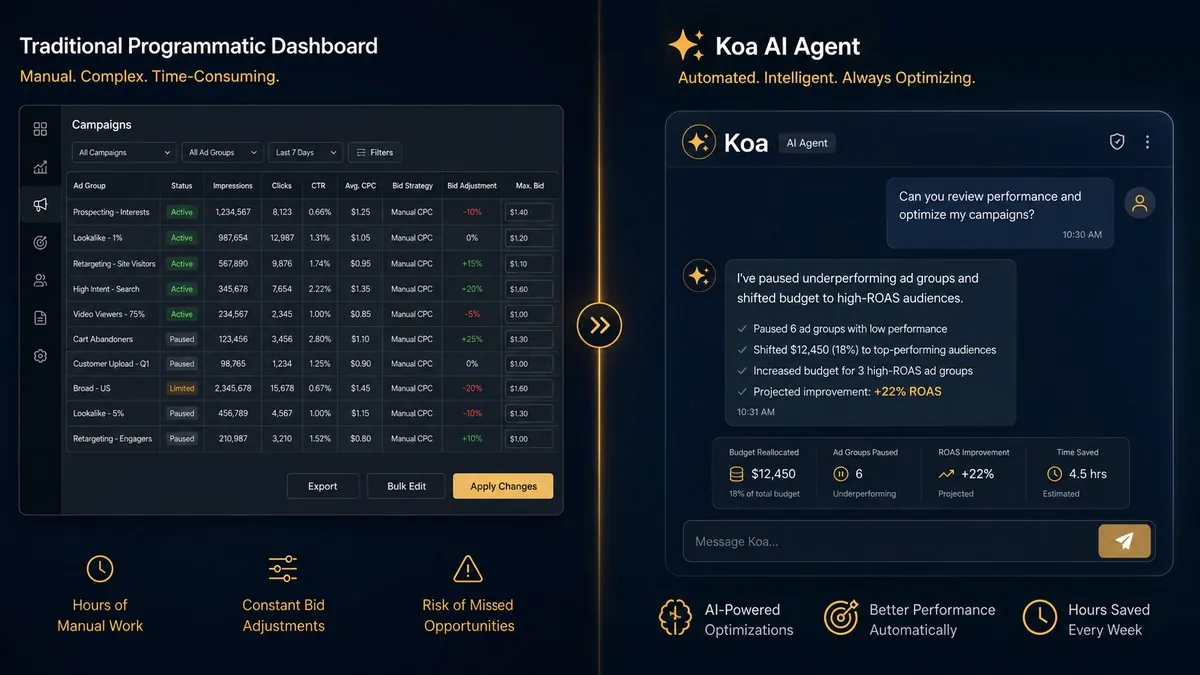
The Trade Desk launched Kokai Zuma on August 27, 2026, adding a conversational AI assistant called Koa and four specialized AI agents to its programmatic advertising platform, with initial results across 62 campaigns showing a 32% average improvement in cost-per-acquisition.
What Kokai Zuma Adds to the Platform
Kokai Zuma is the latest release of The Trade Desk’s Kokai platform, introducing Koa — a conversational AI assistant — and four specialized Koa Agents that handle discrete campaign tasks. The four agent types cover audience creation, campaign optimization, performance troubleshooting, and campaign insights. Buyers issue natural-language instructions to the Koa Assistant, which routes each request to the appropriate specialized agent.
Two additional capabilities ship with Zuma: bulk changes across multiple ad groups simultaneously, and a modeling feature that estimates expected impact before a buyer applies changes. Both were unavailable in prior Kokai releases, according to The Trade Desk’s official press release. The periodic-table view that characterized earlier Kokai interfaces is now optional rather than the default, per Ad Age’s coverage of the launch.
The 32% CPA Claim: What the Data Shows
The Trade Desk reports a 32% average improvement in cost-per-acquisition across 62 campaigns in initial Zuma testing. The figure comes from The Trade Desk’s own internal research and has not been independently audited. A 32% CPA gain at this sample size is significant for the programmatic industry — most demand-side platforms report click-through rate or return-on-ad-spend improvements rather than CPA at this campaign scale.
“Zuma makes Kokai easier to navigate, learn and use, bringing together new agentic AI capabilities and a simpler measurement framework,” The Trade Desk stated in its official August 27 press release. Kokai Zuma is available to Trade Desk buyers now, with no waitlist mentioned in the announcement.
Where Kokai Zuma Sits in Programmatic Advertising
The Trade Desk is the leading independent demand-side platform (DSP) — it operates outside the inventory ecosystems of Google Display & Video 360 and Meta Advantage+, both of which have shipped AI-automated campaign tools within their own walled gardens. Kokai Zuma positions The Trade Desk as the agentic AI layer for open-internet inventory that Google and Meta do not control.
Earlier Kokai versions automated bid optimization in the background; Zuma is the first version to surface AI agents that buyers interact with directly through conversation. The Trade Desk has operated Kokai as an AI-powered bidding and optimization layer since 2023.
Kokai Zuma is part of a broader pattern of agentic tools entering marketing platforms in H2 2026. The X Ads MCP for campaign management enables advertisers to control X campaigns through Claude or ChatGPT via the Model Context Protocol. Bloomreach’s AI shopping agent converts commerce search bars into conversational agents. Kokai Zuma extends agentic automation into open-web programmatic display. Separately, Meta Business Agent pricing has changed in the same period, giving direct-response advertisers new cost variables to weigh across platforms.
The Strategic Bet
The Trade Desk is targeting the open internet — the segment of ad inventory outside Google and Meta’s ecosystems — with the same conversational AI interface those platforms offer buyers inside their walled gardens. If the 32% CPA improvement holds under independent measurement at scale, open-web programmatic advertising becomes more competitive for direct-response advertisers whose volume needs exceed what walled-garden inventory alone can supply. The near-term question is whether agencies report similar results once Zuma runs beyond the initial 62-campaign cohort that generated TTD’s own baseline figure.
For Context: Our earlier coverage of agentic AI tools entering ad platforms: X Ads MCP: Manage X Campaigns with Claude or ChatGPT · Bloomreach Turns the Search Bar into an AI Shopping Agent.
