

AI orchestration tools coordinate multiple AI agents, models, and automation steps into a single workflow. The orchestrator holds the state of the job, decides which agent or step runs next, and passes each result forward, so a multi-step task finishes without a person supervising every handoff. This guide compares 10 orchestration platforms by architecture, technical level, and price so you can choose the one that fits your team, and it follows the same evaluation approach we use for the best AI agents for business tasks, where the agent itself, not the pipeline around it, is the product.
What Is an AI Orchestration Platform?
An AI orchestration platform is a system that sequences, routes, and monitors work across several AI agents or automation steps. It keeps a record of what each agent has completed and what still has to run. That state is what separates orchestration from a single prompt: when step 4 of a 9-step pipeline fails, the orchestrator retries step 4 rather than restarting from step 1.
Business examples of orchestrated work include a sales pipeline that researches an account, drafts an email, and logs the touch in the CRM; a support flow that classifies a ticket, routes it to a specialist model, and escalates to a human above a confidence threshold; and an HR onboarding sequence that provisions accounts, schedules training, and reports completion. Each of those spans multiple systems, and each needs the handoffs managed.
The 10 platforms below fall into three groups. Developer frameworks (LangGraph, CrewAI, Microsoft Agent Framework, Google ADK) give engineers full control in code. Visual builders (n8n, Zapier, Make, Copilot Studio) let operations teams assemble workflows on a canvas. Managed runtimes (Amazon Bedrock AgentCore, Temporal) run and persist the workflows that the first two groups produce.
10 Best AI Orchestration Tools in 2026
1. LangGraph
LangGraph is LangChain’s Python and JavaScript framework for building multi-agent workflows as directed graphs. Each node is an agent or a function; each edge defines a routing decision. LangGraph supports cyclical graphs, so an agent can loop back to review its own output, ask for clarification, or retry a failed subtask, which a linear pipeline cannot express. The library is MIT-licensed. LangChain sells hosting and observability separately through LangSmith.
Pricing: the LangGraph library is free. LangSmith’s Developer plan costs $0 for 1 seat with 5,000 base traces a month. The Plus plan costs $39 per seat per month with 10,000 base traces and one free serverless deployment, then bills consumption at $1.50 per compute unit (LCU) and $1.00 per storage unit (LSU). Enterprise pricing is custom and adds self-hosted or hybrid deployment, SSO, and SLAs.
Best for: engineering teams building custom agent systems with complex, non-linear branching that need deep tracing in production.
2. CrewAI
CrewAI is an open-source Python framework that structures a multi-agent system as named roles, such as a researcher, a writer, and a reviewer, and routes tasks between those roles in a defined sequence. Setup needs less graph configuration than LangGraph, which makes CrewAI the fastest framework entry point for sequential pipelines. CrewAI’s commercial layer, the Agent Management Platform (AMP), adds hosted deployment, monitoring, and governance for platform teams.
Pricing: the framework is MIT-licensed and free. CrewAI’s Basic cloud plan costs $0 and includes 50 workflow executions and 2 automations a month. There is no self-serve paid tier between Basic and Enterprise: the Enterprise plan is custom-priced, sizes executions to the workflow, and adds SSO, role-based access, PII redaction, and cloud, VPC, or on-premises deployment.
Best for: teams new to multi-agent development who want a readable, role-based structure and a direct path to an enterprise-managed runtime.
3. n8n
n8n is a visual workflow automation tool with dedicated AI agent nodes that connect to OpenAI, Anthropic, Google, and other model providers, alongside more than 400 integrations for CRMs, databases, and communication tools. An AI step in n8n can read external data, call tools, and return structured output into the rest of the automation. The Community Edition is self-hostable under n8n’s Sustainable Use License (a fair-code license, not Apache or MIT), and n8n also runs a managed cloud.
Pricing: self-hosting the Community Edition is free. n8n Cloud publishes prices in euros, billed annually: Starter costs €20 a month for 2,500 executions and 5 concurrent runs; Pro costs €50 a month for 10,000 executions and 20 concurrent runs; Business costs €667 a month for 40,000 executions, 30 concurrent runs, and SSO. Monthly billing adds 17%. Enterprise pricing is custom with 200+ concurrent executions and an SLA.
Best for: operations and RevOps teams automating cross-system workflows without a dedicated engineering team, and any company that wants to self-host.
4. Microsoft Agent Framework (successor to AutoGen)
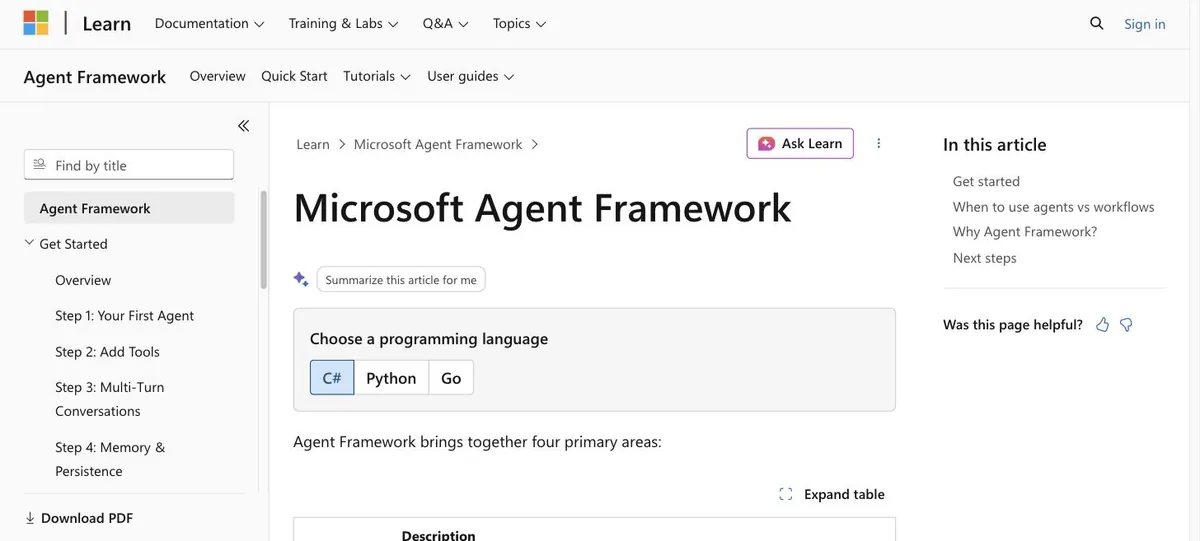
AutoGen, the Microsoft Research framework that modelled multi-agent workflows as conversations between agents, is now in maintenance mode. Microsoft merged AutoGen with Semantic Kernel into the Microsoft Agent Framework, announced on October 2, 2025, and the AutoGen README directs new users there. Agent Framework ships in C#, Python, and Go and covers single agents, multi-agent workflows, and graph-based orchestration, with a migration guide for existing AutoGen code.
Pricing: the framework is MIT-licensed and free. There is no paid tier; you pay only for the models and Azure services the agents call.
Best for: .NET and Azure shops that want a Microsoft-supported open-source framework, and existing AutoGen users who need a maintained upgrade path.
5. Microsoft Copilot Studio
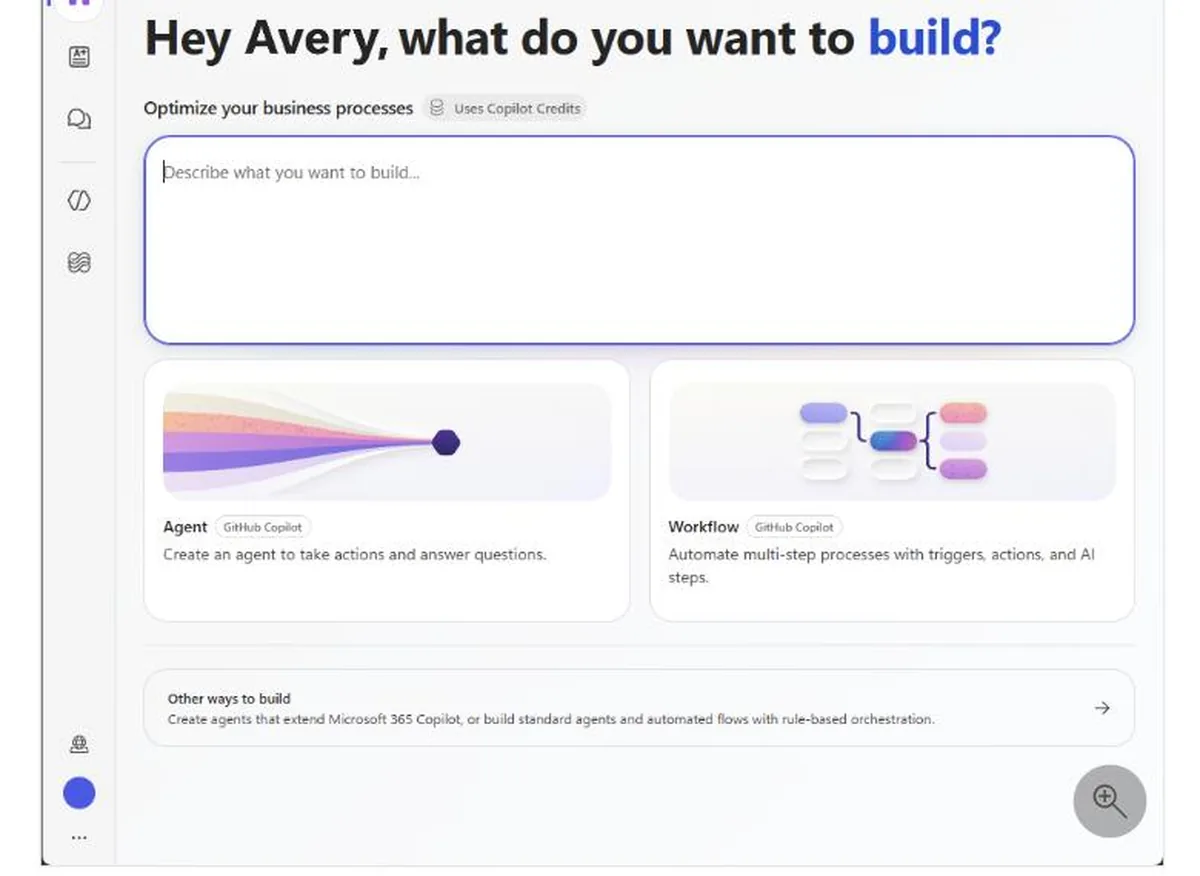
Copilot Studio is Microsoft’s low-code studio for building agents and workflows inside Microsoft 365 and Azure, with native access to SharePoint, Dataverse, and Microsoft Graph. Builders describe what they want in natural language or assemble it on a visual canvas; complex branching hands off to Power Automate or Azure Logic Apps. Finished agents publish directly into Teams, Outlook, and Microsoft 365 Copilot.
Pricing: Copilot Studio bills in Copilot Credits. A prepaid pack costs $200 a month for 25,000 credits, and pay-as-you-go billing is available through an Azure subscription. Microsoft 365 Copilot, at $30 per user per month on an annual plan, includes Copilot Chat and the standard Copilot Studio harness. A free trial is available.
Best for: enterprises standardised on Microsoft 365 that need business agents built and deployed without developer involvement.
6. Amazon Bedrock AgentCore
Amazon Bedrock AgentCore is AWS’s managed runtime for production agents. It is framework-agnostic: agents built with LangGraph, CrewAI, or Strands run on AgentCore Runtime, and AgentCore adds a tool Gateway, Memory, Identity, a managed Browser and Code Interpreter, and observability through CloudWatch. It replaces the earlier Bedrock Agents action-group model as AWS’s recommended orchestration layer.
Pricing: AgentCore is consumption-billed with no platform fee. Runtime, Browser, and Code Interpreter cost $0.0895 per vCPU-hour plus $0.00945 per GB-hour. Gateway costs $0.005 per 1,000 invocations. Memory costs $0.25 per 1,000 short-term events and $0.75 per 1,000 long-term records stored per month. New AWS customers get up to $200 in Free Tier credits.
Best for: teams already on AWS that want a managed, serverless agent layer without operating their own orchestration infrastructure.
7. Google Agent Development Kit (ADK)
Google ADK is an open-source framework for building multi-agent systems on Gemini and other models. Agents communicate through standardised event streams and support sequential, parallel, and loop execution patterns. ADK deploys to Vertex AI Agent Engine for managed hosting and to Cloud Trace for observability, so the path from prototype to production stays inside Google Cloud.
Pricing: ADK is Apache 2.0-licensed and free. Vertex AI Agent Engine bills compute at $0.085 per vCPU-hour and memory at $0.009 per GiB-hour, with a monthly free tier of 50 vCPU-hours and 100 GiB-hours. Sessions and Memory Bank storage costs $0.30 per GiB-month, with billing that started on September 1, 2026.
Best for: teams building on Google Cloud that want an open framework with a native path to managed deployment.
8. Zapier
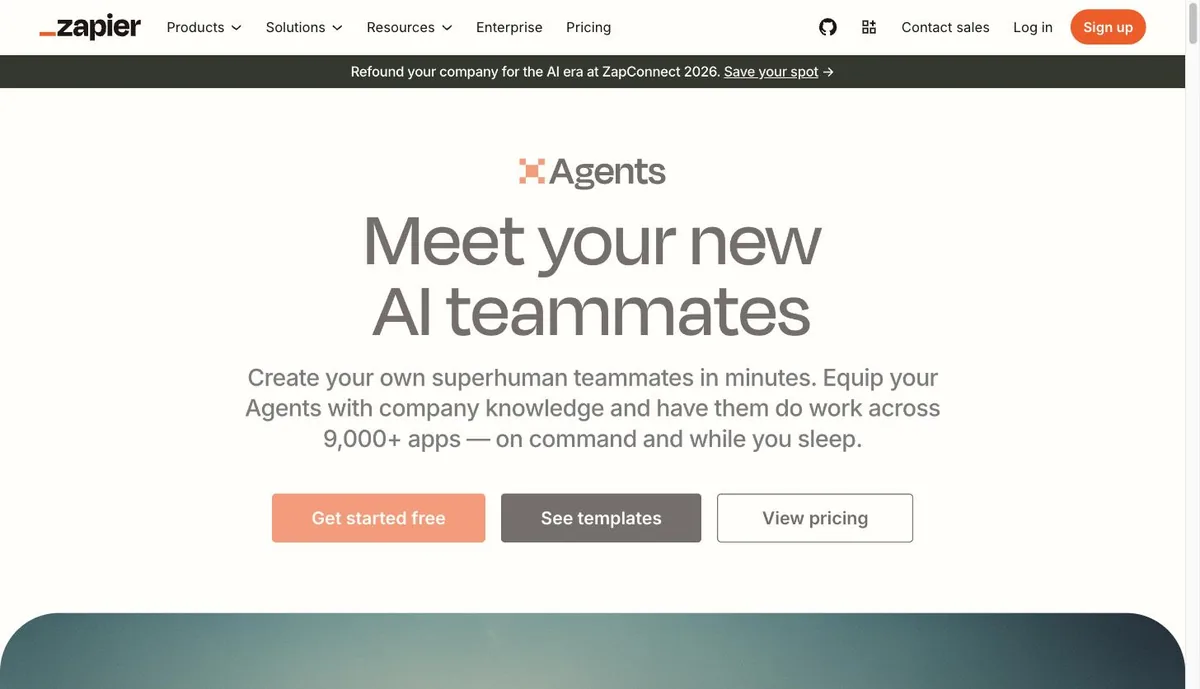
Zapier has the widest integration library on this list, with more than 9,000 apps, and it added Zapier Agents so a team can build AI agents that work across those apps without code. A Zap can call a model, process the result, and trigger downstream actions in one run; an Agent goes further by deciding which actions to take from a goal and a knowledge base.
Pricing: Zapier’s Free plan includes 100 tasks a month and two-step Zaps. The Professional plan starts at $19.99 a month for 750 tasks, and the Team plan starts at $69 a month for 25 users with SSO. Zapier Agents is priced separately: the free tier includes 400 activities a month, Agents Pro costs $33.33 a month on an annual plan for 1,500 activities, and Agents Enterprise is custom.
Best for: non-technical teams that need AI-assisted automation across many SaaS tools and will not build a custom integration layer.
9. Make
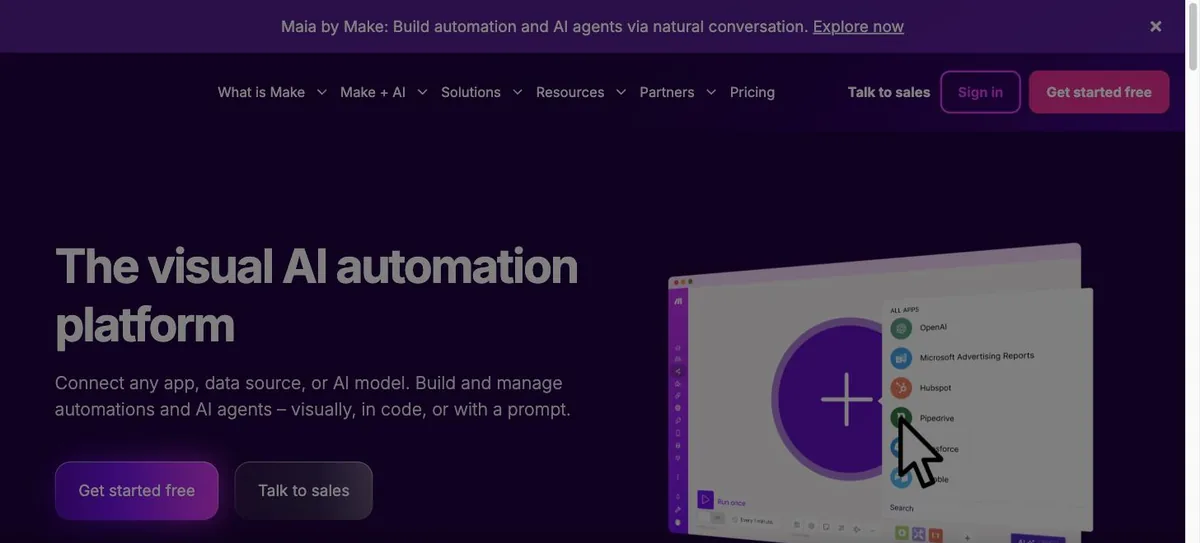
Make (formerly Integromat) is a visual scenario builder that competes directly with Zapier and offers stronger support for branching, iterators, data transformation, and error handling. Make’s AI modules connect to OpenAI, Anthropic, and Mistral, and its Maia assistant builds automations and AI agents from a plain-language description.
Pricing: Make now bills in credits, where one credit equals one module operation. The Free plan includes 1,000 credits a month with a 15-minute minimum interval. At 10,000 credits a month, Core costs $12, Pro costs $21, and Teams costs $38 on monthly billing; annual billing saves 15% or more. Enterprise is custom.
Best for: operations teams that need Zapier-level integration coverage with more control over workflow structure and a lower cost per run.
10. Temporal
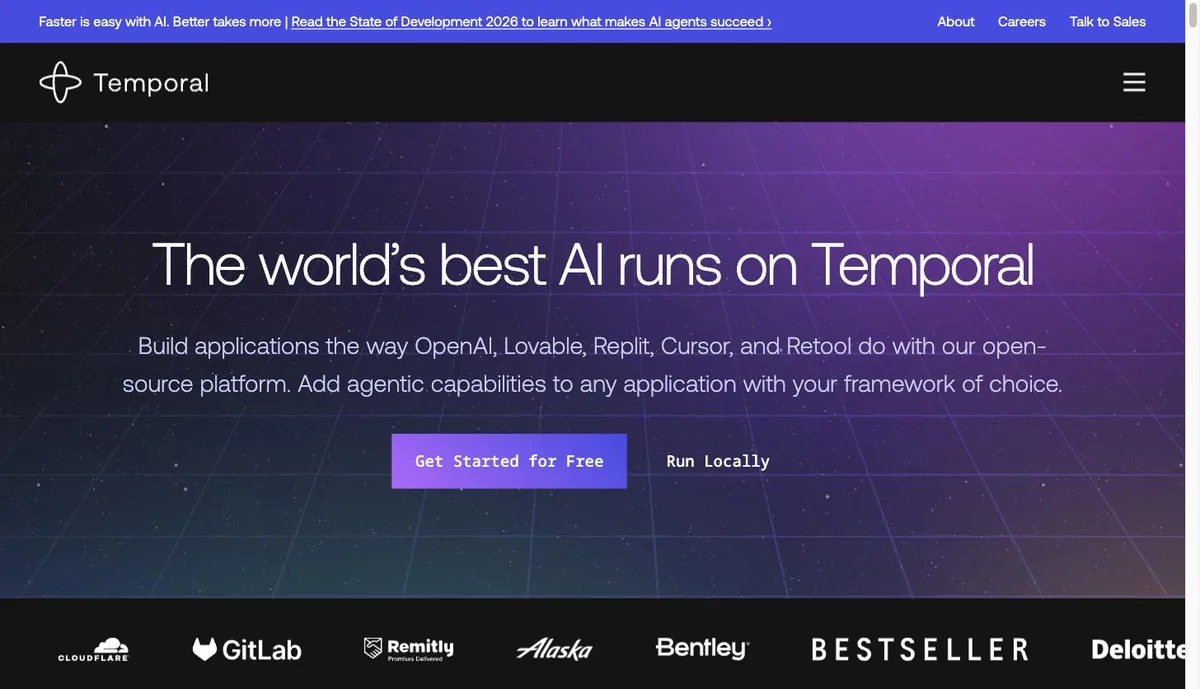
Temporal is an open-source durable execution engine for long-running processes that span hours, days, or weeks. It persists workflow state, so if a step fails, times out, or a downstream service is unavailable, the workflow resumes from the last successful checkpoint. Temporal is infrastructure for running AI pipelines reliably rather than an AI-native tool, and OpenAI, Replit, and Cursor build on it according to Temporal’s own customer list.
Pricing: the Temporal server, SDKs, CLI, and UI are MIT-licensed and free to self-host. Temporal Cloud’s Essentials plan starts at $100 a month for 1 million actions; Business starts at $500 a month for 2.5 million actions; Enterprise and Mission Critical are custom. Additional actions cost $50 per million for the first 5 million over the plan, falling to $25 per million above 100 million. New Cloud accounts receive $1,000 in trial credits.
Best for: engineering teams running production multi-agent pipelines where fault tolerance is the primary requirement.
AI Orchestration Tools Compared at a Glance
| Tool | Type | Technical level | Best for |
|---|---|---|---|
| LangGraph | Framework | Developer | Custom cyclical multi-agent logic |
| CrewAI | Framework | Developer | Role-based sequential pipelines |
| n8n | Visual builder | Low-code | Cross-system operations automation, self-hosted |
| Microsoft Agent Framework | Framework | Developer | .NET/Azure multi-agent builds; AutoGen migration |
| Copilot Studio | Managed platform | No-code | Microsoft 365 enterprise agents |
| Bedrock AgentCore | Managed runtime | Developer | Serverless agents on AWS |
| Google ADK | Framework | Developer | Gemini-native multi-agent builds |
| Zapier | Visual builder | No-code | Widest SaaS integration coverage |
| Make | Visual builder | Low-code | Complex branching at low cost per run |
| Temporal | Workflow engine | Developer | Fault-tolerant long-running pipelines |
AI Orchestration Tools: Pricing Compared
Prices below are the published figures on each vendor’s pricing page as of September 2026. Frameworks are free; you pay for the models they call and for optional hosting.
| Tool | Free tier / open source | Entry paid plan | Billing unit |
|---|---|---|---|
| LangGraph + LangSmith | MIT library; Developer plan $0 (1 seat, 5K traces) | Plus $39/seat/month | Seats + traces + compute/storage units |
| CrewAI | MIT library; Basic cloud $0 (50 executions) | Enterprise, custom | Workflow executions |
| n8n | Community Edition self-hosted, free | Starter €20/month (2,500 executions) | Workflow executions |
| Microsoft Agent Framework | MIT, free | None | Model/Azure usage only |
| Copilot Studio | Free trial | $200/month for 25,000 Copilot Credits | Copilot Credits |
| Bedrock AgentCore | Up to $200 Free Tier credits | Pay-as-you-go from $0.0895/vCPU-hour | vCPU-hours, GB-hours, invocations |
| Google ADK + Agent Engine | Apache 2.0; 50 vCPU-hours/month free | Pay-as-you-go from $0.085/vCPU-hour | vCPU-hours, GiB-hours |
| Zapier | Free: 100 tasks/month; Agents free: 400 activities | Professional from $19.99/month | Tasks (Zaps) and activities (Agents) |
| Make | Free: 1,000 credits/month | Core $12/month (10,000 credits) | Credits (1 = 1 module operation) |
| Temporal | MIT, self-host free; $1,000 Cloud trial credits | Essentials $100/month (1M actions) | Actions + storage GB-hours |
How to Choose an AI Orchestration Tool
Four questions settle most decisions.
Who builds the workflow? If the builder cannot write Python, the choice is Zapier, Make, n8n, or Copilot Studio. If the builder is an engineer, the four frameworks give more control at zero licence cost.
Where does your data already live? Native services cut setup and governance work: Copilot Studio for Microsoft 365, AgentCore for AWS, ADK with Agent Engine for Google Cloud. A framework is the better choice when you want to avoid locking the orchestration layer to one cloud.
Do workflows loop or run in a straight line? Cyclical logic (an agent reviewing and revising its own output) needs LangGraph, Agent Framework, or ADK. Straight-line role handoffs are simpler in CrewAI, and any visual builder handles linear sequences.
How long does a run last, and what happens if it fails? A pipeline that runs for hours or days, or that must never lose a step, needs durable execution. Temporal is built for that, and AgentCore and Agent Engine provide persistence in their managed runtimes. A five-second Zap does not need it.
Which AI Orchestration Tool Should You Choose?
Non-technical teams automating cross-tool processes should start with Zapier or n8n. Both need no code for most workflows, and n8n adds self-hosting for teams that keep data in-house. Engineering teams building custom agentic logic have four free frameworks to evaluate: LangGraph for graph-based workflows with cycles, CrewAI for role-based sequential pipelines, Microsoft Agent Framework for .NET and Azure environments, and Google ADK for Gemini-native builds. Enterprises with existing cloud commitments should test the native service first, because native identity, data access, and billing reduce both setup overhead and governance work. Temporal belongs in any architecture where an AI pipeline must run reliably over hours or days regardless of individual step failures.
Our take: the pricing table shows where the money goes. The frameworks are free, and the cloud runtimes bill per vCPU-hour in cents, so the real cost of orchestration is model tokens and engineering time, not the orchestrator. That argues for choosing on fit, not licence price: a team that picks a visual builder it can operate will ship more workflows than a team that picks the most capable framework it cannot staff.
FAQ
What is the difference between an AI agent and an AI orchestration tool?
An AI agent is a single model-driven program that takes a goal, chooses tools, and acts. An orchestration tool coordinates several agents or automation steps, holds the shared state, and routes work between them. Most production systems use both: agents do the work, the orchestrator sequences it.
Is AutoGen still maintained?
AutoGen is in maintenance mode and is community-managed. Microsoft merged it with Semantic Kernel into the Microsoft Agent Framework, announced on October 2, 2025, and publishes a migration guide for AutoGen code. New projects should start on Agent Framework.
Which AI orchestration tools are free?
LangGraph, CrewAI, Microsoft Agent Framework, and Temporal are MIT-licensed; Google ADK is Apache 2.0; n8n’s Community Edition is free to self-host under the Sustainable Use License. Zapier, Make, and CrewAI Cloud have free tiers with monthly usage caps, and Copilot Studio offers a free trial.
Do I need Temporal if I already use LangGraph?
Only when workflows run long enough or matter enough that losing state is unacceptable. LangGraph handles the agent logic; Temporal makes the run durable across failures, restarts, and multi-day waits. Teams combine them, with LangGraph nodes executing as Temporal activities.
Zapier or Make for AI workflows?
Zapier has more integrations (9,000+ apps) and a separate Agents product for goal-driven automation. Make costs less per run at volume (Core is $12 a month for 10,000 credits) and handles branching and data transformation better. Pick Zapier for coverage and Make for complex, high-volume scenarios.
Related Coverage
- Best AI Tools for Business in 2026 — productivity, sales, and operations AI tools compared
- AI Agents Hit Death Valley: 99% Plan Them, Only 10% Ship — why most multi-agent builds stall and what separates those that ship
- 8 in 10 Engineers Now Use AI Agents Daily — Temporal’s 2026 Report — the survey behind the durable-execution demand
