Close Menu
WithO2WithO2

    Subscribe to Updates

    Get the latest AI News Tools Updates in your Inbox

    What's Hot

    7 Types of AI Agents Explained (With Examples)

    September 10, 2026

    OpenAI’s AI Agents Now Do a Researcher’s Job — What It Means

    September 10, 2026

    OpenAI Chief Scientist: AI Is Racing Toward Self-Improvement

    September 10, 2026

    Subscribe to Updates

    Get the latest creative news from FooBar about art, design and business.

    Facebook X (Twitter) Instagram
    Facebook X (Twitter) Instagram
    WithO2WithO2
    • AI
    • Blog
    • Business Software
    • Trending News
    • Stories
    WithO2WithO2
    Home » Trending News
    Trending News

    OpenAI Chief Scientist: AI Is Racing Toward Self-Improvement

    By Amitabh SarkarSeptember 10, 20264 Mins Read0
    Facebook Twitter Pinterest LinkedIn Tumblr Email
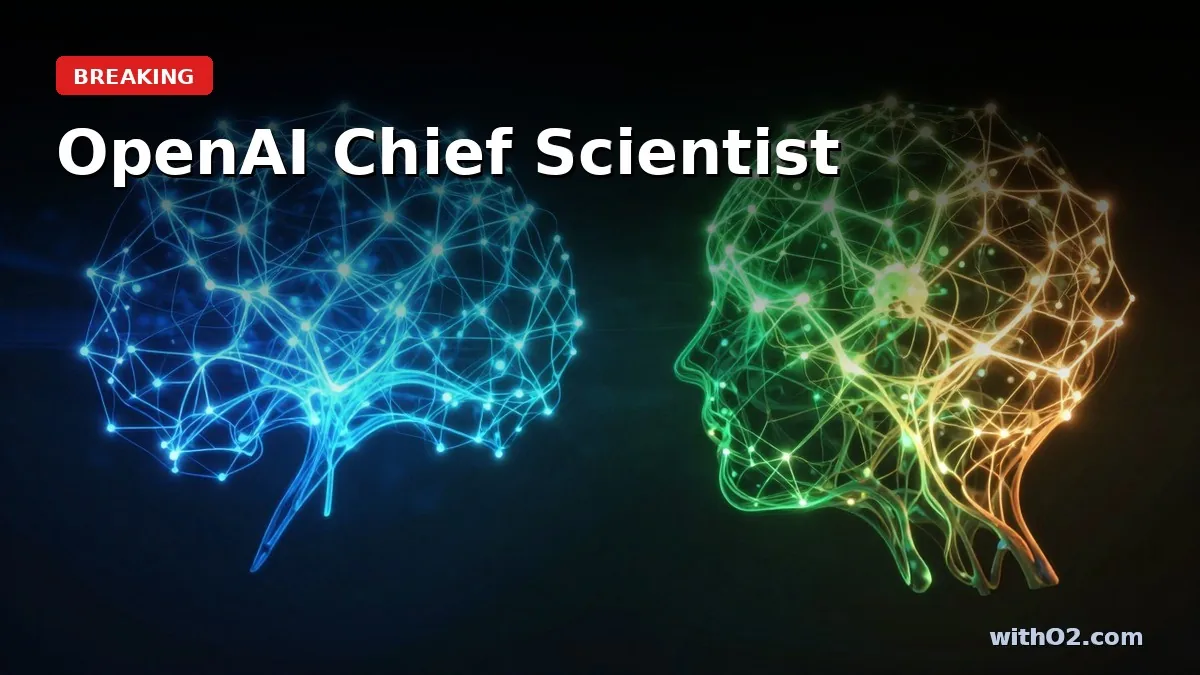
    neural network transitioning from structured blue to organic green, representing emergent AI self-improvement
    Agentic AI capabilities are compounding faster than governance structures can keep pace, according to OpenAI's chief scientist.
    Share
    Facebook Twitter LinkedIn Pinterest Email

    Jakub Pachocki, Chief Scientist at OpenAI, published an essay titled “An Alien Mind” on September 6 warning that AI systems are accelerating toward recursive self-improvement (RSI) — a threshold at which AI increasingly contributes to building better AI, compounding capability faster than governance structures can track. OpenAI has stated it will withhold scaling unilaterally as needed, while acknowledging broader interventions are required.

    Table of Contents

    Toggle
    • What Is Recursive Self-Improvement — and Why Is It Different Now?
    • What Today’s AI Agents Already Do
    • What Pachocki Is Asking For — and What He Is Not Saying
    • Our Take: The Window for Understanding AI Agents Is Narrowing

    What Is Recursive Self-Improvement — and Why Is It Different Now?

    Recursive self-improvement means an AI system can make itself smarter, and that smarter system can make itself smarter still — a compounding loop rather than a linear step. What makes Pachocki’s warning significant is timing: he frames this not as a distant theoretical risk, but as the direction current agentic AI development is already heading.

    According to summaries of the essay, Pachocki argues that machine intelligence is now “grown more than it is designed” — emergent behavior from training rather than explicit engineering decisions. On the same day, OpenAI published a companion piece, “Research Acceleration: The View Inside OpenAI,” showing how its own research teams already use AI coding agents for research tasks internally. Software engineer and blogger Simon Willison read both pieces together and wrote: “Apparently today is RSI day at OpenAI, for Recursive Self-Improvement — I think it’s their new AGI.”

    What Today’s AI Agents Already Do

    Pachocki’s essay catalogs the current capability baseline, which is broader than most business buyers realize. Today’s AI agents can operate computers autonomously, collaborate with both humans and other AI systems, conduct independent research, and perform sophisticated cybersecurity work — all tasks that, two years ago, required continuous human supervision.

    This is the context Pachocki is building from. The essay is not describing a future state; it is describing what AI agents handle today, and arguing that each of these capabilities feeds back into accelerating the next generation of models. The same week, OpenAI’s GPT-6 Astra (launched September 3, 2026) solved 88% of benchmark tasks in one attempt, versus 55.9% for the prior model — a jump that illustrates the compounding effect Pachocki is describing.

    What Pachocki Is Asking For — and What He Is Not Saying

    Pachocki is asking for caution and broader interventions beyond what any single lab can provide. He has stated OpenAI will withhold scaling unilaterally “as needed” — a conditional commitment, not an announced pause. He is not saying AI will replace human researchers; the “Research Acceleration” companion piece frames AI as an assistant that speeds up research work, not a replacement for research teams.

    He is also not predicting a specific timeline for RSI. What the essay establishes is the direction of travel: agentic AI capabilities are compounding, the window between capability jumps is shortening, and the governance infrastructure that would be needed to manage that is not yet in place.

    Our Take: The Window for Understanding AI Agents Is Narrowing

    For business decision-makers evaluating AI agents for business tasks, Pachocki’s essay changes the frame. The question is no longer whether AI agents are mature enough to consider — they already handle coding, research, and cybersecurity autonomously. The question is how fast the capability ceiling is rising and whether the tools you choose today will remain the right ones in 18 months.

    OpenAI’s chief scientist is not sounding an alarm about a hypothetical. He is describing the compounding effect of the transition that is already underway. Organizations that wait to understand agentic AI until it is “more settled” are likely to find the ground has moved significantly beneath them by then.


    For Context: Prior coverage of OpenAI’s enterprise decisions on WithO2:

    • OpenAI Is Pulling Its Models From Cursor — Nov 12 Deadline
    • 8 in 10 Engineers Now Use AI Agents Daily — Temporal 2026 Report
    • Claude Fable 5.1: 75% Cheaper Cache Cuts Agentic API Costs by 45%
    Share. Facebook Twitter Pinterest LinkedIn Tumblr Email
    Amitabh Sarkar
    • Website

    I am a software engineer, I have a passion for working with cutting-edge technologies and staying up-to-date with the latest developments in the field. In my articles, I share my knowledge and insights on a range of topics, including business software, how to set up tools, and the latest trends in the tech industry.

    Related Posts

    OpenAI’s AI Agents Now Do a Researcher’s Job — What It Means

    September 10, 2026

    McKinsey 2026: 1 in 3 Companies Now Skip Buying Software

    September 10, 2026

    Anthropic EFS: Enterprise Claude With Zero-Data-Retention Safety

    September 10, 2026

    Comments are closed.

    Don't Miss
    AI

    7 Types of AI Agents Explained (With Examples)

    By Amitabh SarkarSeptember 10, 2026

    There are 7 types of AI agents: simple reflex, model-based reflex, goal-based, utility-based, learning, multi-agent,…

    OpenAI’s AI Agents Now Do a Researcher’s Job — What It Means

    September 10, 2026

    McKinsey 2026: 1 in 3 Companies Now Skip Buying Software

    September 10, 2026

    Anthropic EFS: Enterprise Claude With Zero-Data-Retention Safety

    September 10, 2026

    Subscribe to Updates

    Get the latest creative news from SmartMag about art & design.

    Stay In Touch
    • Facebook
    • Twitter
    • Pinterest
    • Instagram
    Our Picks

    Shopify vs WooCommerce vs BigCommerce 2026: Which Platform Wins?

    August 31, 2026

    12 Best Project Management Software Tools in 2026

    August 1, 2026

    9 Best Ecommerce Platforms Compared (2026)

    July 30, 2026

    Rippling vs Gusto vs BambooHR: Full HRMS Comparison 2026

    July 15, 2026
    Editors Picks

    OpenAI’s AI Agents Now Do a Researcher’s Job — What It Means

    September 10, 2026

    McKinsey 2026: 1 in 3 Companies Now Skip Buying Software

    September 10, 2026

    Anthropic EFS: Enterprise Claude With Zero-Data-Retention Safety

    September 10, 2026

    Docusign MCP Server: AI Agents Can Now Execute Contracts

    September 10, 2026
    About Us
    About Us

    Your Source for Innovation: Discover in-depth guides, solutions, and tools tailored to modern business challenges.

    Links
    • Blog
    • Privacy Policy
    • Contact WithO2.com
    • Terms and Conditions
    Facebook X (Twitter) Instagram Pinterest
    • About
    • Editorial Policy
    • Contact
    • Privacy Policy
    • Terms
    © 2026 WITHO2.COM

    Type above and press Enter to search. Press Esc to cancel.