

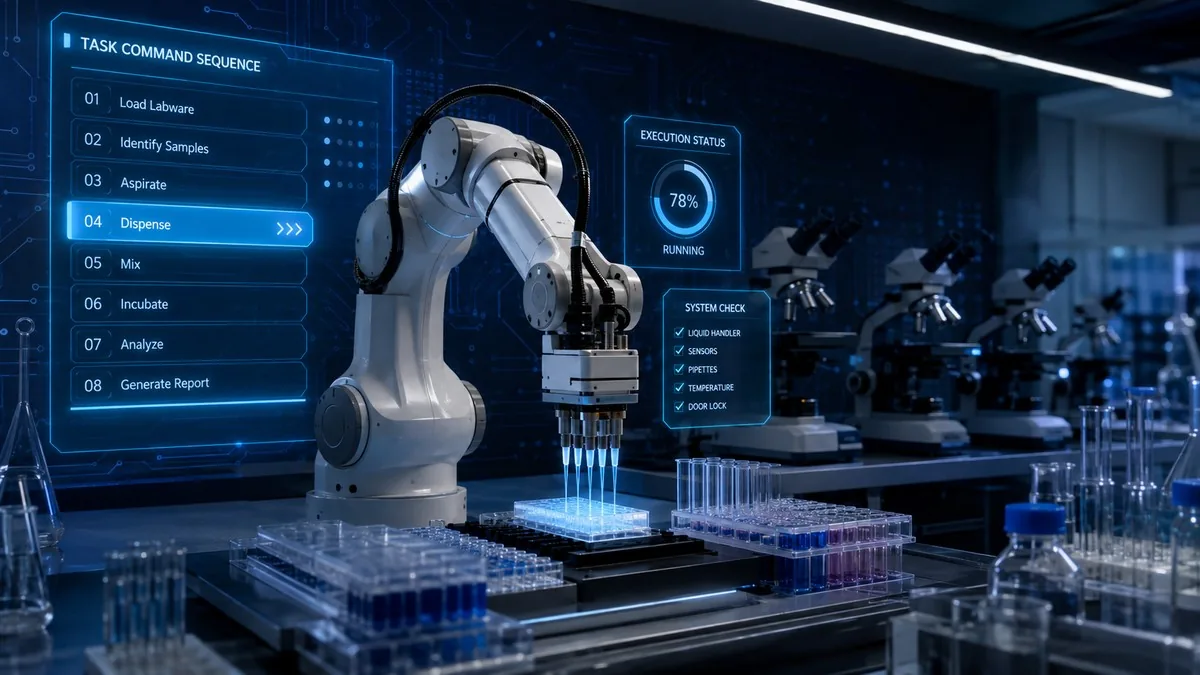
Anthropic launched a research preview of the Model Hardware Standard (MHS) on August 27, 2026 — a shared specification that lets AI agents safely operate physical lab instruments, including microscopes, liquid handlers, and robotic arms, reducing integration time from weeks to hours.
What Is the Model Hardware Standard?
The Model Hardware Standard is an open communication protocol that gives AI agents a standardized interface to control physical devices, such as microscopes, robotic arms, liquid handlers, and quantum computers. MHS extends Anthropic’s Model Context Protocol (MCP) — already widely adopted for software tool access — into the physical world. Where MCP standardizes how AI agents call software tools, MHS standardizes how agents command hardware instruments.
Before MHS, connecting an AI agent to a laboratory instrument required custom API development for each device — a process that took weeks or months per integration. MHS reduces that to hours or minutes, according to Anthropic’s launch announcement and reporting by CNBC and Fortune covering the August 27 preview release.
Who Developed It and Who Is Testing It?
Anthropic developed MHS in collaboration with HHMI Janelia Research Campus, a leading biomedical research institution. The first group of scientific research labs and advanced manufacturers are now in the research preview. Raspberry Pi and Hugging Face are among the early testers listed on the official Anthropic announcement page.
MHS is model-agnostic: it is not locked to Claude. Any MHS-compatible AI agent can operate MHS-enabled hardware, regardless of which underlying model powers that agent. Anthropic has stated plans to open source MHS in the future, with no specific release date announced at preview launch.
How MHS Differs from Robotics AI
MHS is a software communication standard for existing lab and factory instruments — not an embodied AI or robotics platform. It operates closer to industrial automation protocols such as OPC-UA than to robotics companies such as Figure, Physical Intelligence, or Boston Dynamics, which build AI-powered robot bodies from the ground up. MHS targets instruments that already exist in labs and factories, enabling any compatible AI agent to command them through a shared interface without replacing the hardware itself.
The standard carries potential regulatory significance. The Next Web reports that MHS could align with the EU Machinery Regulation taking effect in 2027, which requires software-based safety verification for industrial equipment — making MHS potentially relevant for European manufacturers planning compliance ahead of that deadline.
What This Means for Businesses Using AI Agents
For organizations evaluating best AI agents for business, MHS changes the hardware integration calculus. Equipment vendors that adopt MHS expose their instruments to any MHS-compatible agent, creating a plug-and-play ecosystem for lab automation, quality control, and advanced manufacturing. Businesses that already run MCP-compatible agent workflows can extend the same agent infrastructure to physical hardware without rebuilding separate integrations per device.
The model-agnostic design reduces vendor lock-in: an organization can switch AI models while keeping existing hardware integrations intact. This follows the same architectural direction as Anthropic’s MCP stateless roadmap for AI agents — MHS is the physical-world extension of that infrastructure strategy.
For Context: Anthropic’s Physical-World Agent Push
MHS arrives as Anthropic’s agentic AI portfolio accelerates. The Claude Sonnet 5 agentic model launch earlier this year established Anthropic’s focus on multi-step, tool-using agent tasks in software environments. MHS extends that push into physical environments — the same agent infrastructure designed for software tasks can now interface with lab instruments and manufacturing equipment through a common protocol layer.
MCP’s rapid adoption across software tooling since its 2024 release provides a precedent for how quickly AI infrastructure standards can achieve ecosystem-wide reach when major platforms back them as open standards. MHS is at the same early-adoption stage MCP was in late 2024.
Our Take
Anthropic is building horizontal infrastructure: MCP for software interfaces, MHS for hardware interfaces. If both become industry standards, Anthropic earns adoption-level influence regardless of which AI model wins the commercial market — similar to how TCP/IP benefits from internet adoption irrespective of which applications run on top. For businesses evaluating physical-world AI automation timelines, MHS is the clearest indicator yet that lab and factory AI agent deployments are moving from proof-of-concept to production-ready infrastructure. Organizations that standardize on MHS-compatible agents now will avoid the custom integration rebuild costs that proprietary hardware APIs will eventually require.
