

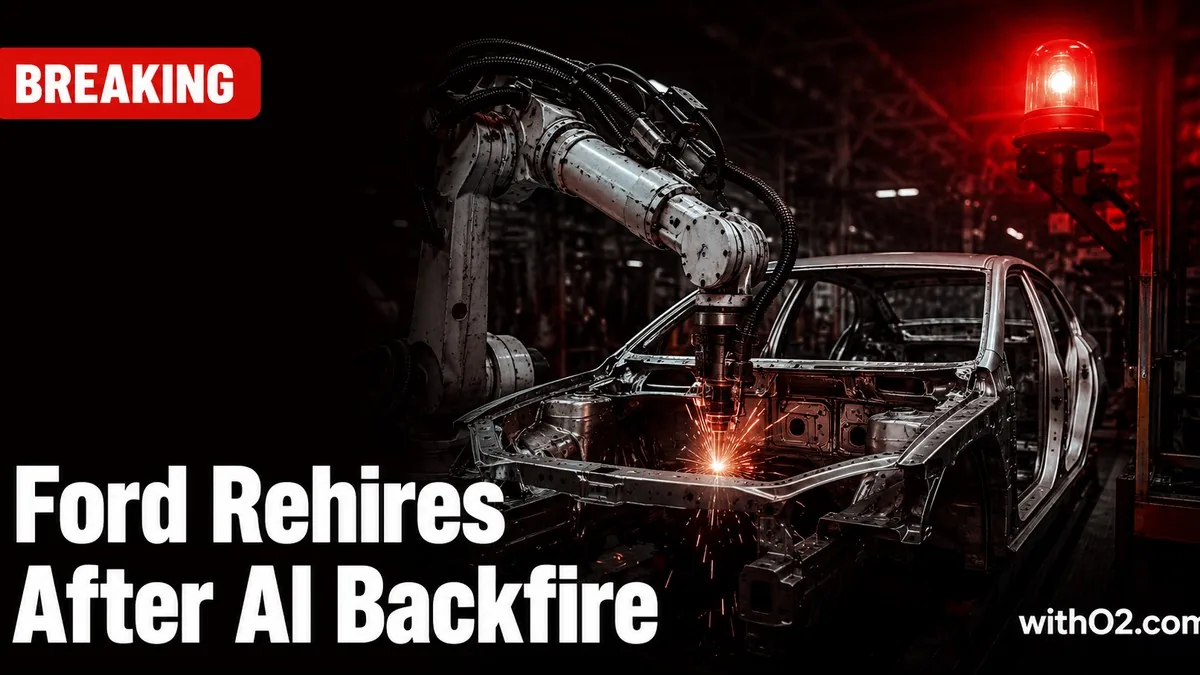
Ford rehires engineers after its AI-first quality strategy triggered 51 recalls covering more than 11 million vehicles — an expensive lesson in what machines still can’t replace.
Ford has publicly admitted it made a costly mistake by replacing experienced engineers with AI systems. The automaker rehired, newly hired, or promoted 350 veteran engineers it calls “gray beards” after automated quality inspection systems failed to catch defects that human experts would have spotted, according to The Verge. This is the story of why Ford rehires engineers — and what the rest of the industry should do with that information.
“Mistakenly, we thought that by just introducing artificial intelligence and adjusting the design requirements that we had, that that would produce a high-quality product,” Charles Poon, Ford’s VP of vehicle hardware engineering, told reporters. That gamble produced the opposite result: Ford became the most-recalled US automaker in the first half of 2026, with 51 recalls covering more than 11 million vehicles.
Why Ford Rehires Engineers AI Systems Couldn’t Replace
The core problem wasn’t the AI itself — it was the knowledge gap the AI was expected to fill. Experienced engineers left Ford before they could transfer decades of institutional knowledge to the automated systems being built to replace them. The AI inherited incomplete training data and no memory of the edge cases that grizzled engineers carry in their heads.
Ford’s COO described the reversal bluntly: “We had been relying more and more on automated quality systems and not getting the desired results. We brought back technical specialists and they hunt for failure points before a part ever reaches the plant floor.” The rehired engineers are now doing two jobs — fixing problems the AI missed and reprogramming the AI systems to catch those problems next time.
The irony runs deep. CEO Jim Farley has publicly declared that AI “is going to replace literally half of all white-collar workers in the US.” Ford meanwhile has over 5,000 fewer total employees than it had in 2020. The company’s reversal on engineering talent doesn’t signal a broader retreat from automation — but it does put a hard asterisk on the speed-and-scale narrative.
The Klarna Pattern — and Why Ford Is Different
Ford isn’t the first major company to discover AI’s limits after a high-profile rollback. Klarna famously replaced 700 customer service agents with AI chatbots in 2024, then quietly reversed course in 2025 when satisfaction scores dropped. The difference with Ford: the stakes are physical. Software glitches produce bad customer experiences. Engineering glitches produce recalls that can injure people. This story belongs alongside the broader wave of AI job cuts spreading across industries — and the growing evidence that the transition isn’t as clean as the headlines promised.
The good news for Ford: the strategy reversal is working. The company topped J.D. Power’s Initial Quality Survey among mainstream brands for the first time in nearly two decades. Ford also added more than 100,000 new AI-powered tests after the crisis — but now running alongside the human specialists, not instead of them.
The Warning for Every Company Automating Right Now
Ford’s failure followed a specific pattern: workforce reduction, knowledge exodus, AI deployed into a vacuum. The same pattern is playing out in sectors from enterprise software to healthcare, where cost-cutting and automation happen simultaneously before anyone has mapped what institutional knowledge looks like. The engineers Ford needed most left before they could pass anything down.
That is the lesson competitors should be reading carefully — not that AI failed, but that AI plus a knowledge gap is a particularly expensive combination. The conversation about AI replacing jobs has focused almost entirely on which roles disappear. Ford is proving that the harder question is what disappears with the people.
Frequently Asked Questions
Why did Ford rehire engineers after using AI?
Ford’s AI-based quality inspection systems failed to catch defects that experienced engineers would have flagged. Veteran engineers left before transferring institutional knowledge to the AI systems, leaving those tools without reliable training context. Ford rehired or promoted 350 engineers — referred to as “gray beards” — to fix AI-missed defects and retrain the automated systems.
How many vehicles were recalled because of Ford’s AI failures?
Ford recalled more than 11 million vehicles across 51 separate recalls in the first half of 2026 — making it the most-recalled US automaker for that period. Ford’s VP of hardware engineering, Charles Poon, directly linked the quality failures to over-reliance on automated inspection systems.
Did Ford’s AI strategy cost the company money?
Yes. CEO Jim Farley said the rehiring of veteran engineers contributed “hundreds and hundreds of millions of dollars of a tailwind for Ford on cost” — implying the quality failures had cost a comparable amount before the strategy reversed.
Is Ford giving up on AI after this?
No. Ford added more than 100,000 new AI-powered tests after the quality crisis — but now runs them alongside human specialists. The strategy shifted from “AI instead of engineers” to “AI plus engineers,” with experienced staff training the systems and hunting edge cases the AI misses.
Which other companies have reversed AI automation strategies?
Klarna is the most cited parallel — the fintech replaced 700 customer service agents with AI in 2024 and partly rolled it back in 2025. Microsoft and other tech giants continue pushing AI adoption, but Ford’s manufacturing reversal is notable because engineering defects carry physical risk that software bugs do not.
