

Google has extended Gemini Enterprise’s pricing model since this post’s original publication, adding a zero-base-subscription consumption edition, Flexible Savings Plans with up to 20% token discounts, and deprecating the gemini-omni-flash-preview API endpoint on September 30, 2026. Details in the new section below.
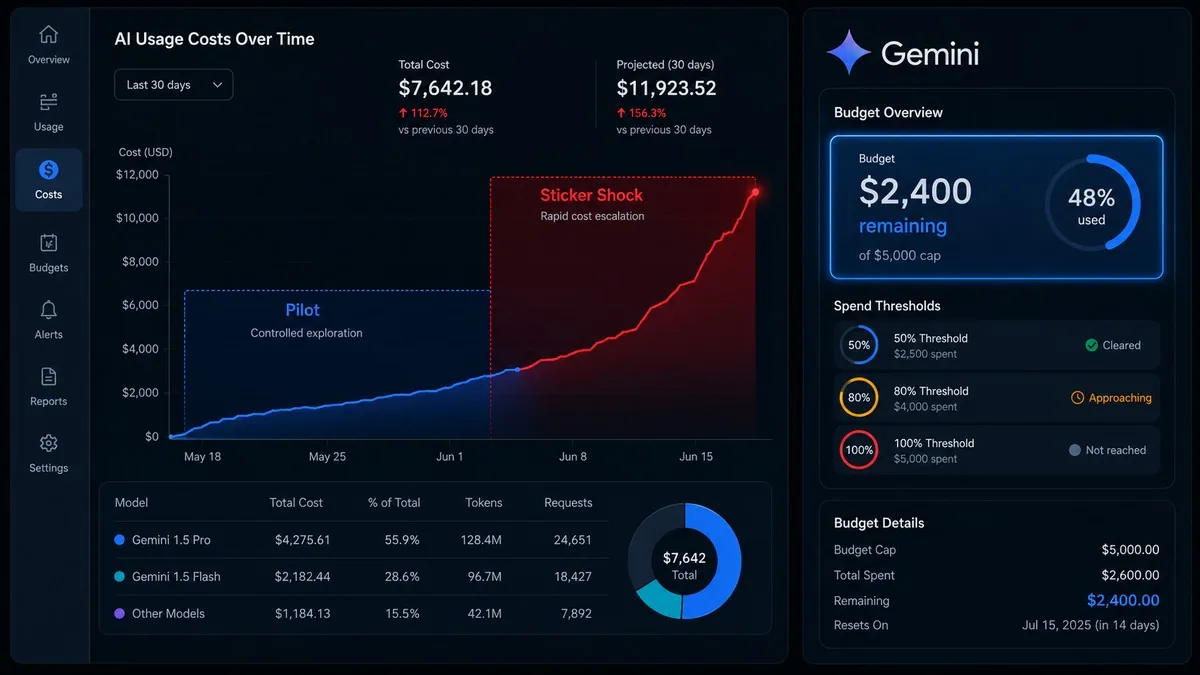
Google is rolling out pay-as-you-go billing, monthly spend caps, and off-peak task discounts of up to 50% for Gemini Enterprise, according to an Axios exclusive published August 26, 2026 — directly targeting the cost shock that is causing 1 in 4 businesses to delay or cancel AI projects.
The Three Cost Controls Google Is Adding
Google is introducing 3 billing changes to Gemini Enterprise that run alongside its existing per-seat subscription model. The first is a pay-as-you-go option with no minimum spend requirement, letting businesses pay only for the compute they use rather than committing to per-seat licensing. The second is monthly project spending limits that automatically pause agent API calls when a preset budget is exhausted; the caps trigger alerts at 50%, 80%, and 100% of the set limit before services pause. The third is off-peak task deferral: businesses that route deferrable workloads — such as nightly data analysis, report generation, or batch reconciliation — to off-peak processing windows receive up to a 50% token discount. Commitment discounts also apply under the new model: a 1-year commitment earns a 10% discount and a 3-year commitment earns a 20% discount, according to CIO’s reporting on the announcement.
September 2026 Update: Zero-Base Subscription, Token Discounts, and API Deprecation
Google confirmed 3 additional changes to Gemini Enterprise pricing and APIs in September 2026 that business buyers and developers should factor into their evaluations.
Zero-dollar base subscription. The pay-as-you-go option has no base subscription fee at all — Google is calling it the “consumption edition.” Organizations pay nothing to enable Gemini Enterprise access and are billed only for tokens, memory, compute, and storage consumed. Non-global token rates through December 31, 2026 are $0.825 per million input tokens and $4.125 per million output tokens; those rates rise to $1.65 and $8.25 per million, respectively, on January 1, 2027. This makes Gemini Enterprise accessible to teams that cannot justify a fixed per-seat spend but want enterprise-grade controls and spend caps.
Flexible Savings Plans — up to 20% token discounts. Google introduced Flexible Savings Plans alongside the consumption edition: a 1-year commitment delivers a 10% discount on token costs and a 3-year commitment delivers a 20% discount. These discounts layer on top of the existing off-peak deferral discounts (up to 50%), meaning organizations routing batch workloads to off-peak windows and committing for 3 years can stack both types of savings. Unlike the per-seat commitment model, Flexible Savings Plans discount token consumption directly rather than locking to a headcount.
gemini-omni-flash-preview deprecated September 30, 2026. Google released Gemini Omni 1.1 Flash as generally available on August 27, 2026, with the stable API model ID gemini-omni-1.1-flash. The older gemini-omni-flash-preview endpoint is scheduled for deprecation on September 30, 2026, according to the Gemini API changelog. The migration is typically a one-line model string change, but developers should verify resolution defaults and response sizes when migrating, as the 1.1 release added scene extension to 40 seconds, first-and-last-frame control, 360p draft mode, and 4K upscaling. Any enterprise team using the preview endpoint for production agentic workflows — video summarization, multimodal document processing — must migrate before month end.
Why AI Cost Controls Matter in 2026
Mavvrik research cited by CIO Dive found that 1 in 4 businesses are delaying or cancelling AI projects specifically because of poor cost visibility. The gap between pilot costs and production costs is the core problem: AI tools run at proof-of-concept scale in 2024 and 2025 generated bills that were a fraction of what the same tools cost when pushed into production workflows in 2026. “AI tools that were piloted in 2024 and 2025 are being pushed into production environments in 2026, and production costs dwarf pilot costs,” CIO Dive’s market analysis noted. Some enterprises have reported production AI costs running 3–5 times over pilot-phase estimates.
HBR published a piece in August 2026 titled “How to Respond to the Coming AI Cost Shock,” independently validating that the cost-predictability problem is widespread enough to have reached mainstream business media. These cost concerns directly affect how business decision-makers evaluate the best AI tools for business — budget predictability has become a first-tier purchase criterion alongside capability.
Competitive Position: Google vs. Microsoft and Anthropic
Google’s spend-cap approach targets the CFO objection that has stalled enterprise AI deals — “we cannot predict what this will cost.” Microsoft Copilot uses per-seat pricing at $30 per user per month, which is predictable but expensive for organizations with uneven AI usage across teams. Anthropic Claude Enterprise uses consumption-based pricing but does not include built-in project-level caps, leaving teams exposed to overruns before billing is reconciled. Google’s PAYG model with explicit cap thresholds and automatic pausing gives finance teams a mechanism to authorize AI spending with a defined ceiling rather than an open-ended estimate.
This position connects to a broader shift in AI enterprise spending patterns: even as total AI spend rises, procurement decisions are concentrating around platforms that can demonstrate cost accountability. Companies already tracking enterprises switching AI models over cost will find Google’s controls directly relevant to that evaluation.
What Business Buyers Should Evaluate
Google Gemini Enterprise’s new controls are most valuable for 2 scenarios. The first is organizations with variable AI workloads — teams where AI usage spikes during specific projects and drops otherwise will pay less under PAYG than a fixed per-seat subscription sized for peak demand. The second is organizations running batch-processing AI workflows that are not time-sensitive, such as nightly document review, reconciliation, or data enrichment — the off-peak deferral discount up to 50% is material for these use cases. Per-seat pricing from Microsoft Copilot remains more predictable for organizations with uniform, high-frequency AI usage across all seats.
Businesses evaluating enterprise AI tool integrations alongside Gemini Enterprise should factor the new billing structure into total cost of ownership comparisons, particularly where AI agent workloads are expected to scale significantly beyond the pilot footprint. Developer teams building on the Gemini API have an additional near-term action item: migrate off gemini-omni-flash-preview before September 30, 2026 to avoid service disruption on agentic workflows.
Frequently Asked Questions
What is the zero-dollar base subscription option for Gemini Enterprise?
Google launched a “consumption edition” of Gemini Enterprise in August 2026 with no base subscription fee. Organizations pay only for tokens, memory, compute, and storage consumed, at rates of $0.825 per million input tokens and $4.125 per million output tokens through December 31, 2026. This replaces the previous requirement to commit to per-seat licensing before accessing Gemini Enterprise features.
What is the Gemini Enterprise Flexible Savings Plan discount?
Flexible Savings Plans offer up to 20% off token costs: a 1-year commitment earns 10% off and a 3-year commitment earns 20% off. These discounts apply to token consumption, not seats. They stack with off-peak deferral discounts (up to 50%), allowing organizations to combine both for batch workloads that are not time-sensitive.
When is gemini-omni-flash-preview being deprecated?
The gemini-omni-flash-preview API endpoint is deprecated on September 30, 2026. The replacement is gemini-omni-1.1-flash, which Google released as generally available on August 27, 2026. The migration is typically a one-line change to the model string in API calls.
How does Gemini Enterprise PAYG compare to Microsoft Copilot pricing?
Microsoft Copilot charges $30 per user per month under a fixed per-seat model, which is predictable but expensive when AI usage is uneven across teams. Gemini Enterprise’s PAYG consumption edition charges only for actual token usage with no minimum, making it cheaper for organizations where AI adoption is concentrated in a smaller group of heavy users. For teams with uniform, high-frequency AI usage across all seats, Copilot’s per-seat predictability may still be preferable.
What is Gemini Enterprise’s off-peak task deferral discount?
Gemini Enterprise offers up to 50% off token costs for workloads deferred to off-peak processing windows. Eligible workloads include nightly document review, batch data reconciliation, report generation, and other tasks that are not time-sensitive. The discount applies automatically when organizations configure their agent API calls to route through the off-peak scheduler.
For Context: Related coverage on enterprise AI spending and platform decisions: Anthropic Hits $6.5B Revenue but Fable 5 Grabs Only 11% of Enterprise Spend · Fable 5 vs. DeepSeek: Why Enterprises Are Switching AI Models.
