Close Menu
WithO2WithO2

    Subscribe to Updates

    Get the latest AI News Tools Updates in your Inbox

    What's Hot

    Shopify Acquires Tailwind Labs — New Paid Sign-Ups Closed as Revenue Fell 80%

    September 11, 2026

    Workflow Automation Software: How to Choose the Right Tool

    September 11, 2026

    Mercury 2.5 Hits 1,107 Tokens/Sec — Claude Haiku-Class AI at $0.04 per Million Tokens

    September 11, 2026

    Subscribe to Updates

    Get the latest creative news from FooBar about art, design and business.

    Facebook X (Twitter) Instagram
    Facebook X (Twitter) Instagram
    WithO2WithO2
    • AI
    • Blog
    • Business Software
    • Trending News
    • Stories
    WithO2WithO2
    Home » Trending News
    Trending News

    Salesforce Data: Enterprise AI Agents Tripled in a Year

    By Amitabh SarkarAugust 23, 2026Updated:September 3, 20264 Mins Read9
    Facebook Twitter Pinterest LinkedIn Tumblr Email
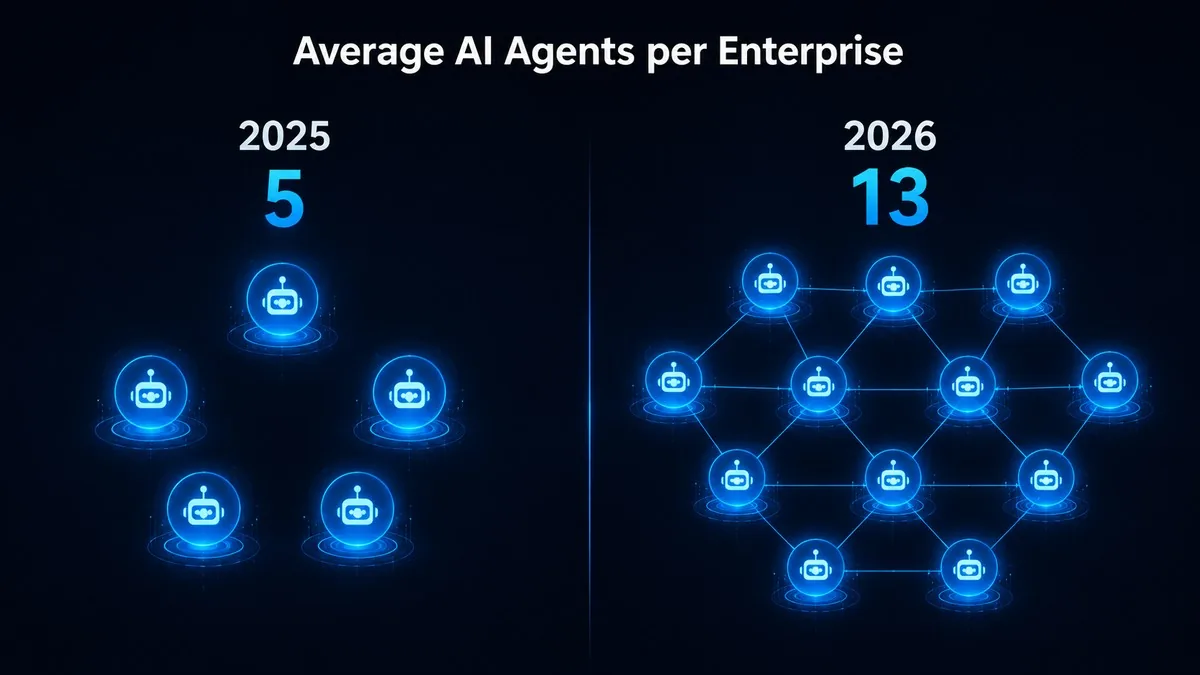
    Average AI agents per enterprise: 5 nodes in 2025 vs 13 nodes in 2026 network, Salesforce Agentic Enterprise Index data
    Salesforce's second Agentic Enterprise Index tracked 15 months of Agentforce platform data, showing average agents per organization nearly tripled from 5 to 13.
    Share
    Facebook Twitter LinkedIn Pinterest Email

    Salesforce’s second Agentic Enterprise Index, covering February 2025 through April 2026, shows the average enterprise now runs 13 active AI agents — nearly three times the 5 agents recorded at the start of the tracking period. The report, published August 10, 2026, introduces a new productivity metric called the Agentic Work Unit (AWU) and finds that retailers who deployed AI agents during the 2025 holiday season grew sales 4 times faster than non-deployers.

    Table of Contents

    Toggle
    • What the Salesforce Agentic Enterprise Index Found
    • Why the 70% Autonomous Customer-Service Rate Is the Most Significant Data Point
    • What the Agent Growth Pattern Means for Different Sectors
    • Our Take
    • For Context

    What the Salesforce Agentic Enterprise Index Found

    The Agentic Enterprise Index tracks aggregated output data from Salesforce Agentforce platform customers. The second edition covers 15 months — from February 2025 to April 2026 — making it the first edition built on a full year of deployment data rather than early adoption signals.

    Key figures from the index:

    • Average agents per organization rose from approximately 5 in February 2025 to approximately 13 in April 2026, a 2.6× increase.
    • AWU output — where one Agentic Work Unit equals one discrete task completed by an AI agent — is growing at a 15% compound monthly rate as of April 2026.
    • Time to first agent deployment fell 53% across the analysis period; organizations now activate their first agent within an average of 2 days.
    • 7 in 10 customer-service sessions in the Agentforce dataset are handled fully autonomously, with escalation rates holding steady despite the volume shift.
    • Retailers that deployed AI agents during the 2025 holiday season saw 4× higher sales growth compared to retailers that did not deploy agents.

    Why the 70% Autonomous Customer-Service Rate Is the Most Significant Data Point

    Seven in ten customer-service sessions resolving without a human handoff — while escalation rates stay flat — is the first large-scale quantified answer to the primary objection against AI agent deployment in customer-facing roles: that customers will reject autonomous handling and drive up escalation costs. This data, drawn from Salesforce’s own Agentforce platform customers, shows that autonomous resolution volume and escalation rate are not correlated in this dataset.

    Businesses comparing the best AI agents for business tasks should treat the 70% figure as platform-specific — it reflects Agentforce deployments only, not AI agents running on other platforms or deployed in-house.

    What the Agent Growth Pattern Means for Different Sectors

    Salesforce’s index data reflects two distinct deployment profiles. Consumer-facing sectors — retail and e-commerce — deploy high volumes of task-specific agents that handle returns, cart abandonment, and order status lookups. Complex sectors — manufacturing and financial services — deploy fewer agents per organization but configure them for multi-step workflows spanning multiple internal systems. A business evaluating an agent platform should identify which profile matches its operations before comparing vendor benchmarks.

    The AWU metric Salesforce introduces is an attempt to give enterprises a standard unit for measuring agent productivity, analogous to a completed-task count. No equivalent cross-platform metric currently exists, which limits direct comparison of AWU figures against agent output data from other platforms.

    Our Take

    Salesforce is measuring its own platform’s customers, so every figure in the index represents Agentforce deployments — not enterprise AI agent adoption broadly. The AWU metric is useful for tracking internal Agentforce productivity trends, but Salesforce does not commit to dollar-per-agent ROI figures, which limits its usefulness for cross-vendor business cases. The finding worth acting on: if escalation rates stayed flat while 7 in 10 customer-service sessions turned fully autonomous, the argument that customers reject AI-handled service does not hold in Salesforce’s dataset. That is the most credible third-party objection to AI CRM deployment, and this index provides its first large-scale quantified counter-evidence.


    For Context

    Salesforce has been expanding its Agentforce capabilities throughout 2025 and 2026. The company integrated Agentforce into commerce workflows earlier this year — see our earlier coverage of Agentforce for commerce. Salesforce also updated its CRM data integration for Slack users: Salesforce AI CRM updates.

    Last Updated: August 2026

    Share. Facebook Twitter Pinterest LinkedIn Tumblr Email
    Amitabh Sarkar
    • Website

    I am a software engineer, I have a passion for working with cutting-edge technologies and staying up-to-date with the latest developments in the field. In my articles, I share my knowledge and insights on a range of topics, including business software, how to set up tools, and the latest trends in the tech industry.

    Related Posts

    Shopify Acquires Tailwind Labs — New Paid Sign-Ups Closed as Revenue Fell 80%

    September 11, 2026

    Mercury 2.5 Hits 1,107 Tokens/Sec — Claude Haiku-Class AI at $0.04 per Million Tokens

    September 11, 2026

    Meta Muse App Launches: Personal AI Agent at $20–$100/Month

    September 11, 2026

    Comments are closed.

    Don't Miss
    Trending News

    Shopify Acquires Tailwind Labs — New Paid Sign-Ups Closed as Revenue Fell 80%

    By Amitabh SarkarSeptember 11, 2026

    Shopify acquired Tailwind Labs, the Canadian company behind the Tailwind CSS framework, on 9 September…

    Workflow Automation Software: How to Choose the Right Tool

    September 11, 2026

    Mercury 2.5 Hits 1,107 Tokens/Sec — Claude Haiku-Class AI at $0.04 per Million Tokens

    September 11, 2026

    Meta Muse App Launches: Personal AI Agent at $20–$100/Month

    September 11, 2026

    Subscribe to Updates

    Get the latest creative news from SmartMag about art & design.

    Stay In Touch
    • Facebook
    • Twitter
    • Pinterest
    • Instagram
    Our Picks

    Workflow Automation Software: How to Choose the Right Tool

    September 11, 2026

    Shopify vs WooCommerce vs BigCommerce 2026: Which Platform Wins?

    August 31, 2026

    12 Best Project Management Software Tools in 2026

    August 1, 2026

    9 Best Ecommerce Platforms Compared (2026)

    July 30, 2026
    Editors Picks

    Shopify Acquires Tailwind Labs — New Paid Sign-Ups Closed as Revenue Fell 80%

    September 11, 2026

    Mercury 2.5 Hits 1,107 Tokens/Sec — Claude Haiku-Class AI at $0.04 per Million Tokens

    September 11, 2026

    Meta Muse App Launches: Personal AI Agent at $20–$100/Month

    September 11, 2026

    OpenAI’s AI Agents Now Do a Researcher’s Job — What It Means

    September 10, 2026
    About Us
    About Us

    Your Source for Innovation: Discover in-depth guides, solutions, and tools tailored to modern business challenges.

    Links
    • Blog
    • Privacy Policy
    • Contact WithO2.com
    • Terms and Conditions
    Facebook X (Twitter) Instagram Pinterest
    • About
    • Editorial Policy
    • Contact
    • Privacy Policy
    • Terms
    © 2026 WITHO2.COM

    Type above and press Enter to search. Press Esc to cancel.