

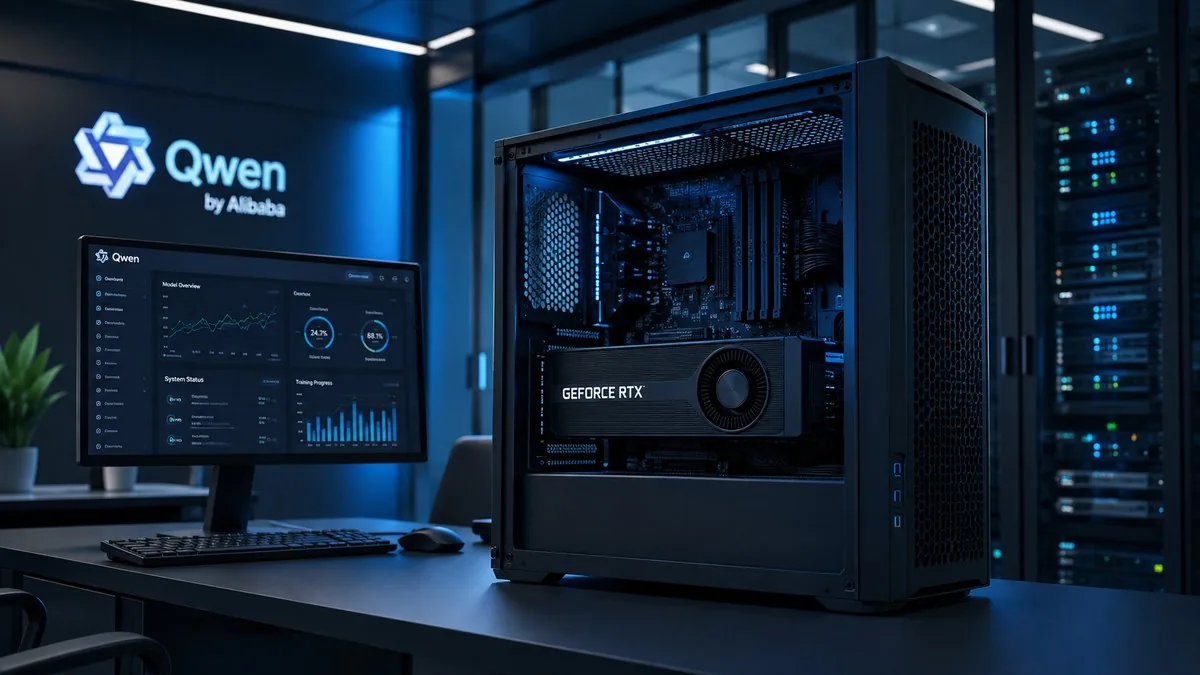
Alibaba’s Qwen team released Qwen3.8-27B on August 14, 2026 — a 27.78-billion-parameter dense model licensed under Apache 2.0 that runs on 17GB of VRAM at 4-bit quantization, making it the strongest self-hostable open-weight AI agent in its size class at release.
The model supports text, image, and video inputs, carries a native 262,144-token context window (extendable to 1 million tokens via YaRN), and generates 131 tokens per second on a single RTX 5090. Unlike its companion model Qwen3.8-Max — a 2.4-trillion-parameter mixture-of-experts model available via cloud API — the 27B is built for private, on-premise deployment with zero marginal inference cost.
What Is Qwen3.8-27B?
Qwen3.8-27B is a dense transformer model with 27.78 billion active parameters in every forward pass, released by Alibaba’s Qwen research team on August 14, 2026 under the Apache 2.0 license. “Dense” means all parameters engage for every token, which trades per-token compute efficiency for architecture simplicity and straightforward local deployment. The model accepts text, images, and video natively — vision is built into the architecture, not added via a separate plugin.
The release completes the Qwen3.8 family announced at WAIC 2026 in July: the 2.4T Qwen3.8-Max handles cloud API use cases at full frontier scale; the 27B delivers a near-frontier capability profile on commodity hardware. The distinction matters for enterprise procurement — Max requires a cloud subscription and routes data to Alibaba’s servers; the 27B runs entirely inside a corporate data center.
Benchmark Performance
Qwen3.8-27B scored 61.7% on SWE-Bench Pro, 42.2% on DeepSWE 1.1, and 79.0% on QwenSWEBench — all representing gains over Qwen3.6-27B in agentic coding, computer use, and vision-language tasks, according to Kingy.ai’s benchmark summary from August 2026. Alibaba frames the model’s capacity around “10+ days of autonomous coding, 500+ turns of chip design optimization, and 365 days of e-commerce strategy” (latent.space, August 2026).
These SWE-Bench scores are self-reported by the Qwen team. No independent third-party SWE-Bench evaluation of this specific release had been published at the time of writing.
Hardware Requirements
Qwen3.8-27B requires approximately 17GB of VRAM at 4-bit quantization, 28GB at FP8, or 56GB at BF16, according to Yottalabs’ hardware analysis. A single RTX 4090 (24GB VRAM) fits the FP8 version, placing it within reach of enterprise workstations. The model runs on llama.cpp, Ollama, Unsloth, and LM Studio Bionic, covering all major local inference frameworks.
What It Means for Business AI Deployment
Qwen3.8-27B is the first near-frontier-class agentic model to fit a single consumer-grade GPU at near-full precision. For regulated industries — healthcare, finance, legal — this directly addresses the data-sovereignty and compliance concerns that block cloud AI adoption. Zero marginal inference cost is also a material budget difference for businesses running thousands of agent calls per day.
The direct rival in the local open-weight agent category is Meta Muse Glimmer, a 30B Apache 2.0 model released on August 4, 2026. Qwen3.8-27B differentiates through native multimodal architecture and its 262,144-token context window, which Meta Muse Glimmer does not match. Businesses evaluating local AI agent alternatives now have at least three viable open-weight options across different size and hardware profiles.
For a structured comparison of AI agents built for business use cases, see: 12 Best AI Agents for Business Tasks — covering evaluation criteria for procurement decisions, including on-premise deployment options.
- July 2026 — Qwen3.8 announced at WAIC 2026: Alibaba’s 2.4-trillion-parameter cloud-scale flagship and its planned open-weight release.
- Meta Muse Glimmer: Open 30B AI Agent That Runs Without Cloud — the direct rival in the local open-weight agent category, released August 4, 2026
- Nvidia Nemotron 3.5 Lightning Cuts Agent Costs 74% vs Opus 4.8 — cloud-hosted agent option for cost-sensitive deployments
- Needle 2: The 14MB AI Agent That Runs on Any Phone or Device — ultra-lightweight end of the local-agent spectrum
