

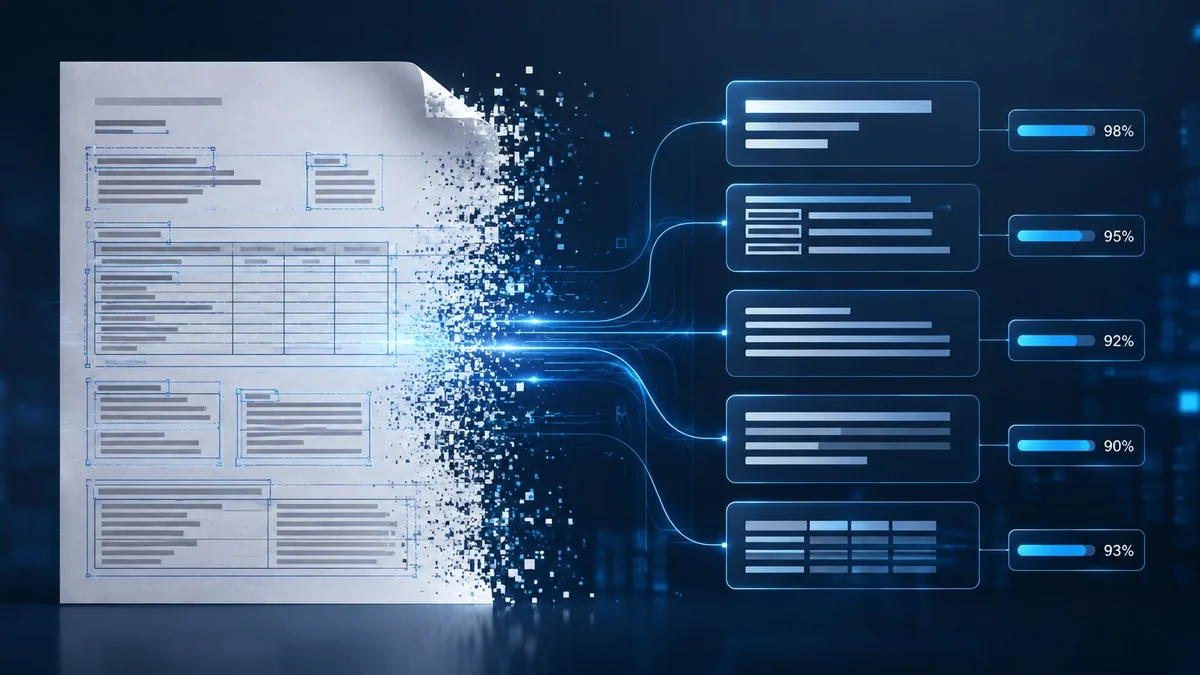
Mistral released OCR 4.1 on August 14, 2026, adding block-level confidence scores to its document AI stack and setting a top score of 85.20 on the OlmOCRBench leaderboard — the highest published result among commercial document extraction APIs. The model processes up to 2,000 pages per minute on a single GPU and is priced at $4 per 1,000 pages via API, or $2 per 1,000 pages through the batch API. A self-hosted single-container deployment is available for organizations that cannot route sensitive documents to third-party APIs.
What OCR 4.1 Adds Over Version 4.0
Mistral OCR 4.0 launched in June 2026 with paragraph-level bounding box extraction, structural block labels, and per-word confidence scores across 170 languages. OCR 4.1 adds block-level confidence scores on top of those per-word scores, enabling document pipelines to flag and route low-confidence blocks for human review without processing the entire document manually. According to Mistral’s official documentation at docs.mistral.ai/models/ocr-4-1, the model achieves a 72% average win rate over 600+ annotated documents compared to competing OCR and document AI systems. That win rate reflects Mistral’s own testing methodology, not an independent third-party benchmark.
Three Business Use Cases Where Confidence Scoring Changes the Workflow
Block-level confidence scores alter how document automation pipelines are built in 3 specific contexts.
Contract processing. Legal and procurement teams can extract clause-level structured data and route only low-confidence blocks to human review, rather than reviewing every extracted field. This reduces review time proportionally to the document’s extraction accuracy.
Invoice and receipt automation. Finance teams can pipe OCR 4.1 output directly into accounting AI agents. High-confidence extractions clear automatically; low-confidence line items flag for approval. The $2 batch-API rate makes high-volume financial document processing cost-competitive with in-house tooling.
Regulated-industry document processing. Industries in financial services, healthcare, and legal sectors that cannot send documents to external cloud endpoints can deploy OCR 4.1 in a self-hosted container. The self-hosted option carries no per-page API billing; infrastructure costs apply instead.
Pricing and Availability
Mistral OCR 4.1 is available through Mistral’s direct API at $4 per 1,000 pages, or $2 per 1,000 pages via the batch API. The self-hosted container is available for enterprise deployment at no per-page cost. The model is also available inside Microsoft Azure AI Foundry alongside Mistral Medium 3.5, according to the Azure AI Foundry blog. Pricing through Microsoft Foundry may differ from Mistral’s direct API rates.
The HN submission for OCR 4.1’s release reached 293 points and 115 comments on August 14, 2026, indicating significant developer interest in the throughput and pricing claims.
For Context: AI Agent Infrastructure in 2026
Document extraction has become a foundational layer for AI agent pipelines — agents require structured, machine-readable input to act on business data. Mistral positions OCR 4.1 explicitly as an ingestion layer for RAG systems, AI agents, and enterprise search. Earlier this year, Cloudflare introduced Kitesurf as AI agent infrastructure targeting cost reduction for web-based agent tasks; Mistral’s OCR 4.1 addresses the document-input side of the same infrastructure need.
Mistral’s 2026 release cadence spans the full enterprise stack: Shieldstral (content moderation, August 4), Medium 3.5 (July), OCR 4.0 (June), OCR 4.1 (August). For a broader view of how AI agents interact with enterprise tools today, see our guide to enterprise AI workflow tools.
Related: 15 Best AI Tools for Business in 2026 · 12 Best AI Agents for Business Tasks
