

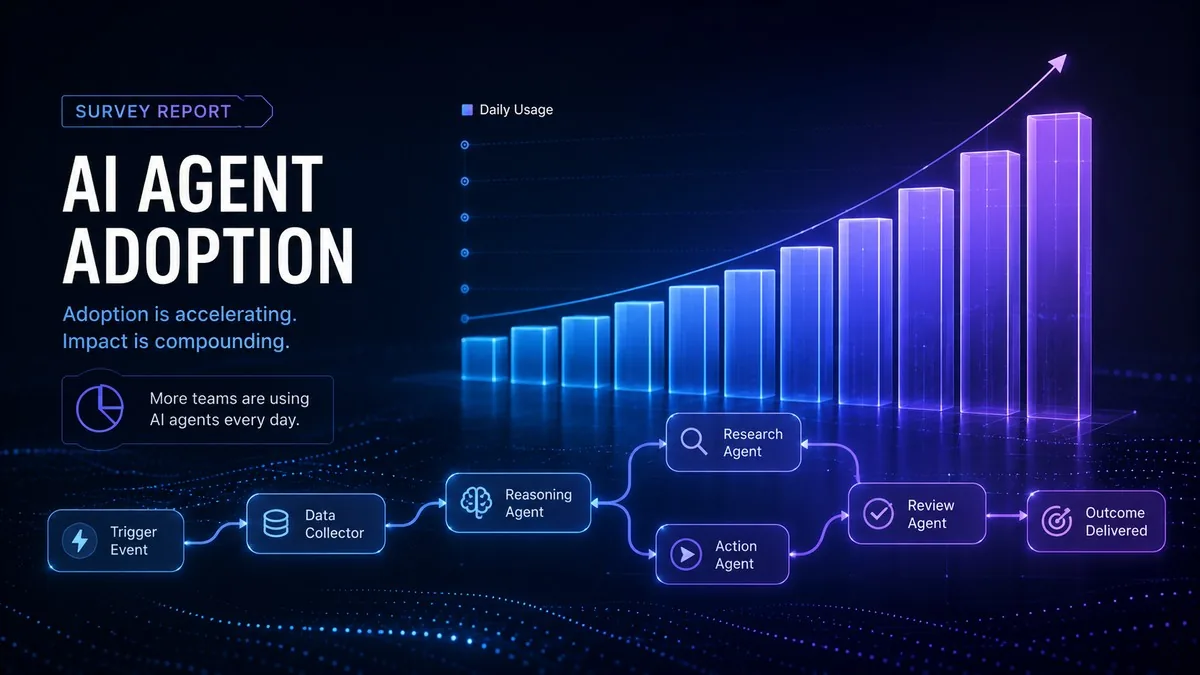
Temporal published its 2026 State of Development Report on August 25, 2026, setting the AI agents adoption 2026 baseline at 80.8% of surveyed engineers using AI agents daily or more often, up from 47.3% a year earlier — a 70.8% relative increase in frequent use. The workflow-orchestration company surveyed 554 software engineers, architects, and engineering leaders across the US, UK, and EMEA between April 29 and May 25, 2026, screening for respondents who already use AI agents. The same respondents report that 41.1% hit agent-related issues daily or more, placing reliability, not adoption, as the open problem.
AI Agents Adoption 2026: What Temporal’s Survey Measured
Temporal’s report measures how often engineers run AI agents, what they run them for, and where agent deployments break. Temporal commissioned Qualtrics to field the survey to 650 respondents who already use AI agents, then removed low-quality responses to reach a final sample of 554. Two-thirds of respondents work in the US and one-third in the UK and EMEA. Temporal defines an AI agent as an LLM instance capable of taking multi-step actions on its own. The agent-user screen matters for reading every figure below: the 80.8% describes engineers who had already adopted agents, not the engineering population as a whole.
The sample skews mid-to-senior and mid-market: 48.4% of respondents have 11 or more years of coding experience, and 29.2% work at companies with 251 to 1,000 employees. Software is the largest industry represented at 37.5%, followed by manufacturing and professional services at 9.7% each. The survey covers engineers and technology leaders only — it does not measure agent use among the general workforce.
How Many AI Agents Teams Run in 2026
The median respondent runs 5 AI agents, while the mean is 10.7 — a 2.1x gap that indicates a small group of outlier teams, with respondents reporting as many as 256 agents. Only 2.2% of teams run 51 or more agents. Agent work concentrates on five tasks: writing code (62.6% of respondents), testing code (52.7%), analyzing (51.4%), generating ideas (50.5%), and debugging (47.1%).
Agents have also moved out of the sandbox. Temporal reports that 49.1% of teams now describe agents as “in production” or “core to how we build and ship”, against 25.5% still experimenting and 25.5% using assistants such as GitHub Copilot and ChatGPT only. Business buyers evaluating which systems to deploy can compare shipping options in our ranking of the 12 Best AI Agents for Business Tasks, which covers the same production-grade category this survey measures.
Why 41.1% of Engineers Hit Agent Issues Every Day
Reliability is the survey’s counterweight to adoption: 41.1% of respondents encounter agent issues daily or more, and 9.0% encounter them continuously. Temporal reports that teams running dozens of agents do not necessarily encounter more issues than teams running five. Temporal qualifies that finding: respondents define “issue” differently, issues vary in severity, and teams watching their agents more closely record more of the granular ones. The named blockers are operational rather than model-quality issues: tracking state across services (35.7%), isolating and debugging issues (30.9%), and managing token and compute costs (30.7%).
Autonomy is where trust stops. While 85.5% of respondents trust agent outputs at least somewhat, 39.5% cite security concerns as a blocker to fully autonomous agents, 33.6% cite lack of reliability or invented results, and 24.4% cite limited observability. Cost is a live constraint for 79.8% of respondents, who say token and compute spend limits how far they push agents. Concrete deployments across sectors are catalogued in our guide to 15 AI Agent Examples Across Industries.
Our Take: The Buying Question Has Moved to Reliability
Adoption is settled for engineering teams — 91.1% say agents improved or revolutionized their productivity, and only 1.8% say agents worsened it. The purchasing question has shifted one layer down the stack. A buyer choosing agent tooling in late 2026 is choosing between orchestration, state management, and observability layers, because those are the three problems this survey names as daily friction. Temporal sells workflow orchestration and therefore has a commercial interest in that framing; the underlying blocker rankings come from respondent selections, not from Temporal’s positioning. The report contains no revenue or cost-savings data, so it supports no ROI claim in either direction.
Frequently Asked Questions
How often do engineers who use AI agents run them in 2026? 80.8% of the 554 agent-using engineers Temporal surveyed run AI agents daily or more often, including 21.8% who run them continuously and 11.2% who run them hourly. The comparable figure for the same cohort one year earlier was 47.3%.
How reliable are AI agents in production? 41.1% of surveyed engineers encounter agent issues daily or more often, and 9.0% encounter them continuously. The three most-cited operational blockers are tracking state across services (35.7%), isolating and debugging issues (30.9%), and managing token and compute costs (30.7%).
For Context: Our earlier coverage of enterprise AI agent adoption and its failure rate: Salesforce Data: Enterprise AI Agents Tripled in a Year · AI Agents Hit Death Valley: 99% Plan Them, Only 10% Ship · OpenAI ChatGPT Work Turns Your AI Into a Full-Time Employee.
