

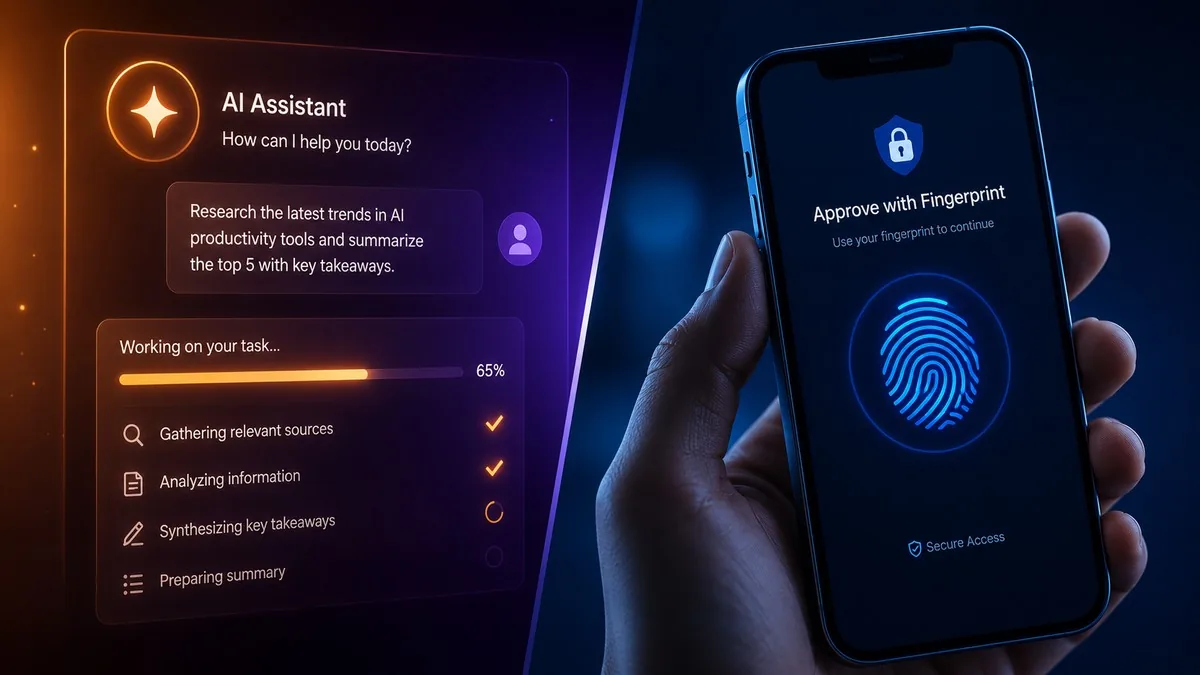
1Password launched a zero-exposure credential integration with Claude on July 16, 2026, letting the AI agent complete logins on business apps without the password or one-time code ever entering the model. When Claude needs to sign in during a browser task, 1Password prompts the user for a Touch ID approval, then injects the credential directly into the page.
1Password, the Toronto-based password manager, built the integration with Anthropic to close the authentication gap that has blocked businesses from letting AI agents act inside credentialed software. The pattern injects the secret at runtime, checks that it was not exposed on the page, and clears the filled values if submission fails. Claude receives confirmation that a login succeeded, not the login itself.
How does 1Password’s zero-exposure integration work?
1Password’s zero-exposure integration holds the credential and delivers it at runtime, so the AI agent never reads the secret. Claude requests a specific login during a task, 1Password shows the user which credential is being requested and why, the user approves with a biometric check such as Touch ID, and 1Password autofills the field directly.
After autofill, 1Password verifies that no secret was exposed in the page’s visible content. If the submission fails, 1Password clears the filled values before returning control to Claude. The architecture mirrors how OAuth scopes a token to a single task for human users, granting task-bound access rather than a full account credential.
“We need a new security model that is purpose-built for agents, not just humans. The answer isn’t handing agents your secrets. It is to let a user give an agent permission to use a credential without letting the agent see it. Claude knows it used your login; it does not need the password or one-time code in its context. That distinction is where trust in agents starts and the foundation we’re building with Anthropic.” — Nancy Wang, CTO of 1Password
Why does AI agent credential security matter for businesses?
AI agent credential security matters because agents now take actions inside business software — booking, updating records, and submitting forms — and every credentialed step forced a choice between exposing a password or stopping the task. 1Password’s runtime injection removes that choice for logins, letting a Claude task run through a sign-in without a human pausing it.
The authentication gap has been a documented enterprise objection to AI agent deployment, and it compounds a broader risk surface: attackers have targeted agent tooling directly, as seen in the prompt-injection flaw that exposed private repositories to AI coding agents on GitHub. Gartner projects 40% of enterprise applications will embed AI agents by the end of 2026, up from under 5% in 2025.
What can Claude access, and what it cannot
Claude can access logins and one-time passcodes through the integration, and it cannot access credit cards or identities, which 1Password excluded at launch. The feature is available to paid Claude subscribers — Pro, Max, Team, and Enterprise — on Mac using Claude Desktop, paired with 1Password individual, family, and business plans.
The integration runs on macOS only at launch, with no announced Windows support. 1Password built the same runtime-injection pattern in sequence across agent platforms: OpenAI Codex on May 20, 2026, Kiro on June 17, 2026, and Claude on July 16, 2026 — the highest-profile integration in the series.
What is 1Password’s Agentic Mode?
Agentic Mode is a new 1Password browser-extension feature that auto-locks the vault whenever any compatible AI agent takes control of the browser, then permits only the credentials explicitly approved for the current task. The lock triggers on agent control alone, protecting users who never configured the Claude integration.
Agentic Mode supports multiple agents beyond Claude and reaches qualifying enterprises with no new configuration, positioning 1Password as infrastructure-layer security for the agent era rather than a single-vendor add-on.
For Context
WithO2 has tracked the widening security questions around Anthropic’s agent tooling: a reported spike in CVEs tied to Claude-assisted code, Alibaba’s decision to ban Claude Code in favor of an in-house tool, and the practical trade-offs mapped in our Claude vs ChatGPT comparison for business users.
Our Take
1Password’s zero-exposure model may become the default standard for AI agent credential access, since every major password manager will need an equivalent or risk being sidelined as agents take on more logged-in work. Small businesses evaluating Claude for automation now have one fewer reason to wait.
