

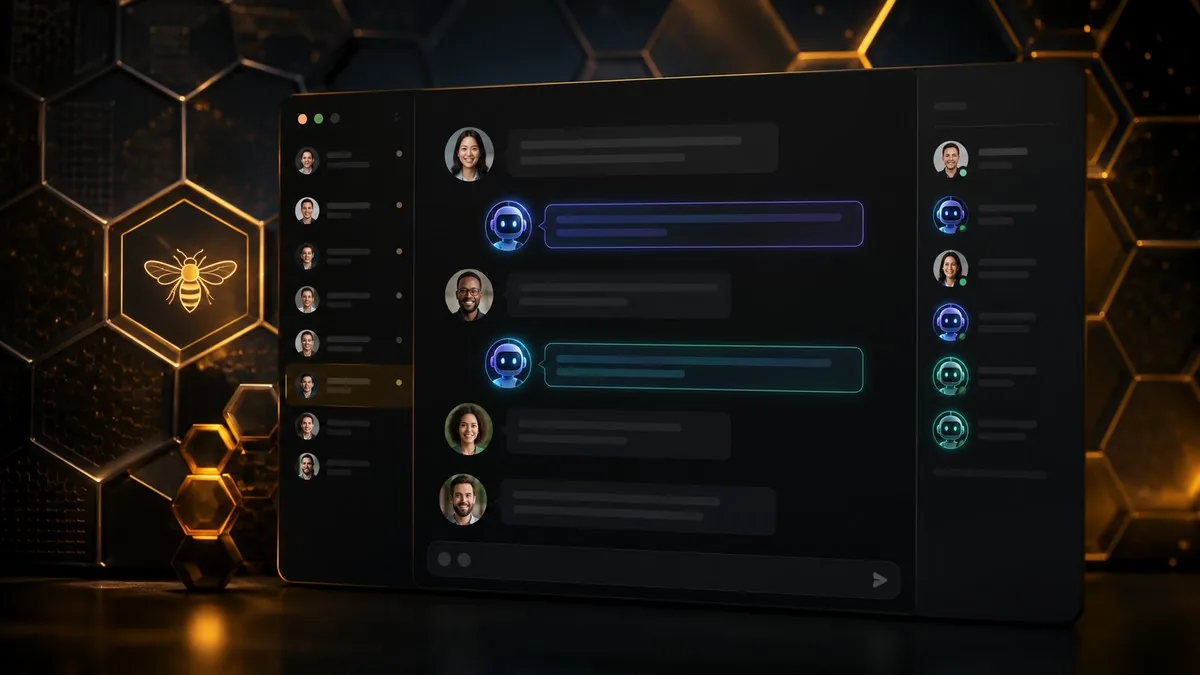
Jack Dorsey’s Block launched Buzz on July 21, 2026 — an open-source, model-agnostic workspace that places human workers and AI agents in the same group chat, with native Git hosting and workflow automation built in, aiming to replace Slack and GitHub at once for AI-first teams.
Block, the company behind Square, Cash App, Afterpay, and Tidal, shipped Buzz v0.4.21 with desktop builds for macOS, Windows, and Linux. Buzz is free, licensed under Apache 2.0, and built on Nostr, a decentralized protocol that gives every AI agent a cryptographic identity as a full workspace member. Dorsey announced it on X, writing that Buzz is “a new groupchat platform for teams of people and agents of all sizes, built to reduce our dependency on slack and github.” Buzz’s own website describes the product as “in its early stages.”
How Buzz Puts AI Agents on the Team
Buzz treats AI agents as first-class team members rather than bolt-on integrations, giving each agent a cryptographic identity and the same primitives human members use. Agents inside Buzz can search discussions, submit patches, review code, and run workflows using those shared primitives, according to daily.dev’s launch coverage. Because Buzz runs on Nostr, every action — human or agent — is cryptographically signed, producing a verifiable audit trail of who or what approved a commit.
The single-workspace design collapses three tools into one: Buzz combines team chat, Git hosting, and workflow automation in one environment, per TechCrunch. For teams running AI agents today, work is fragmented across separate systems — agents in coding tools, such as Cursor, Claude Code, and GitHub Copilot; conversation in Slack; and code in GitHub — and every handoff creates missed context and audit risk. Buzz’s proposition is that a shared identity system and message history remove those handoffs. For decision-makers mapping the best AI agents for business tasks, Buzz is the clearest attempt yet at an agent-native workspace.
What Buzz Means for Business Buyers
Buzz is worth watching but not ready for mission-critical production use today, a status its own “early stages” label makes explicit. This is a v0.4.x release from a company whose revenue comes from Square and Cash App, not enterprise SaaS, and Dorsey is betting on open-source community adoption to pull the roadmap. Slack, owned by Salesforce, holds deep enterprise relationships that an unproven v0.4 product does not threaten in the near term.
Buzz enters a forming category rather than an empty one. A competing product, Centaur — an open-source “virtual employee” from Paradigm CTO Georgios Konstantopoulos — runs inside Slack or via API, taking the integration path Buzz rejects. Established alternatives for agent-driven work include Slack’s AI agent integrations and Microsoft 365 Copilot’s workflow automation. For startups not yet locked into Slack, Buzz is worth a pilot; for enterprises, the prudent move is to wait for a v1.0 release. Teams weighing these choices can start with our guide to comparing AI productivity tools.
For context: Cryptographic identity for agents addresses a wider 2026 problem — how AI agents act inside business tools without over-broad access. Our coverage of AI agents accessing business tools securely tracks the same trust-and-audit question Buzz answers with signed events.
Our Take: Buzz is the clearest signal yet that the next battleground for AI adoption is the workspace layer, and Slack is the incumbent Dorsey wants to disrupt. The novel part is not the chat — it is the cryptographic identity: giving agents signed, auditable membership solves a real governance problem that Slack’s bolt-on bots do not. For startups that haven’t locked into Slack, Buzz is worth a pilot now. For enterprises in regulated industries, the audit trail is compelling, but a v0.4 product is not yet safe to standardize on — watch for v1.0.
