

Published:
Cursor (Anysphere) published research on July 20, 2026 showing its new multi-agent swarm rebuilt the SQLite database engine from scratch in Rust for $1,339 — compared to $10,565 using a single frontier model for the same task — by pairing an expensive frontier model for planning with a cheap, fast model for execution, according to Wilson Lin of Anysphere.
What Did Cursor’s Agent Swarm Build?
Cursor’s agent swarm implemented a complete SQLite-compatible database engine from an 835-page specification, with no source code, no existing test suite, and no internet access. The swarm passed 100% of the sqllogictest suite — the same benchmark SQLite itself uses — across multiple model combinations, including Opus 4.8 as planner paired with Composer 2.5 as worker, and Fable 5 as planner. Teams evaluating the best AI coding assistants for enterprise work should note that Composer 2.5 is Cursor’s internal model, not a publicly available product. The public codebase from the solo Opus 4.8 run is available at github.com/anysphere/minisqlite.
How Does a Planner-Worker Swarm Cut AI Agent Costs?
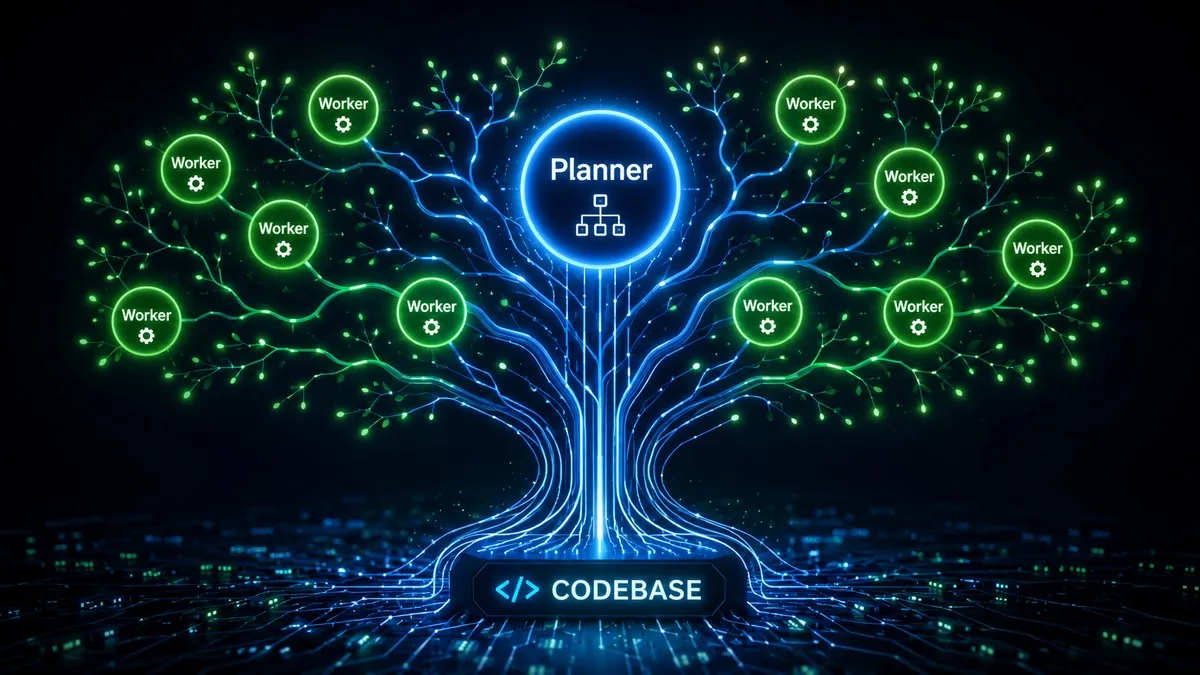
The planner-worker split assigns expensive thinking to a frontier model and cheap execution to a fast, low-cost model. In Cursor’s swarm, a frontier planner model (such as Opus 4.8) decomposes the task and records design decisions, while worker agents running Composer 2.5 handle the code-writing volume. Workers account for 69–90% of all tokens generated, but planners drive two-thirds of total cost per unit — so downgrading workers to a cheaper model cuts the total bill by roughly 8x for equivalent output quality.
Wilson Lin, writing on the Cursor blog, quantified the difference: “In the run that used GPT-5.5 for both planners and workers, the workers alone cost $9,373. In the run where Opus 4.8 did the planning and Composer 2.5 did the work, the entire worker fleet cost $411.”
Cost and output by model combination, all achieving 100% pass rate on sqllogictest:
| Planner | Worker | Total cost | Lines of engine code |
|---|---|---|---|
| Opus 4.8 | Composer 2.5 | $1,339 | 4,645 |
| Fable 5 (mix) | Composer 2.5 | intermediate | 9,908 |
| GPT-5.5 | GPT-5.5 | $10,565 | not reported |
What Four Coordination Problems Did the New Swarm Solve?
The previous Cursor swarm produced 68,000 commits and 70,000 merge conflicts in two hours and had to be paused. The new architecture resolved four failure modes that caused that collapse:
- Split-brain: Two planners independently chose incompatible solutions for the same subsystem. Fixed by prompting planners to record every design decision in a shared “Field Guide” folder, which is automatically injected into every new agent’s context at startup.
- Merge conflicts at scale: 1,000 commits per second made Git unusable — Git uses coarse file locks that serialise writes. Cursor built a custom version-control system and added a neutral “reconciler” agent that resolves conflicts the way a merge queue does.
- Megafiles: High-traffic source files grew too large for agents to modify safely. The swarm flags files above a size threshold and automatically decomposes them into smaller modules.
- Ossification: Agents hesitated to modify core code shared by many other agents. Fixed by explicitly authorising intentional breakage and using compile-checked cross-references to catch regressions automatically.
The result: fewer than 1,000 merge conflicts across the entire four-hour run, versus 70,000+ in the previous architecture. The new swarm also produced leaner output — 4,645 lines of engine code for the Opus 4.8 run that scored 100%, versus 19,013 lines with the previous architecture at 97%.
What Does the AI Agent Swarm Cost Proof Mean for Business Teams?
The planner-worker hierarchy that Cursor validated here is the same structure behind enterprise AI orchestration systems such as Salesforce Agentforce, Microsoft Copilot Studio, and Kimi Work’s 300-agent swarm. Cursor’s research adds verifiable cost data: a well-coordinated mixed-model swarm produces the same quality output as a homogeneous frontier-model stack at one-eighth the cost — on a task with a clear written specification. Businesses evaluating the best AI agents for business tasks can use this research as a cost-modelling baseline when comparing vendor pricing against self-managed orchestration.
Wilson Lin summarised the architectural shift: “With swarms, the unit of work becomes the spec.” That reframing changes how buyers should evaluate AI agent platforms — the relevant question shifts from “which model scores highest on a benchmark” to “how reliably can a swarm decompose and execute a specification.” Cursor also disclosed that it uses swarms internally for vulnerability scanning in open-source software, raising test coverage, and generating synthetic training data, not only for large construction tasks.
“The swarm starts to resemble a compiler. A compiler translates source code down to machine code through a series of intermediate steps. The swarm does something similar with intent.” — Wilson Lin, Cursor/Anysphere
The real story is not Cursor flexing engineering capability — it is the cost proof. A $1,339 Opus 4.8 + Composer 2.5 run matches a $10,565 GPT-5.5 solo run on a rigorous, specification-driven task. That makes the planner/worker split the canonical architecture for any business building multi-agent AI workflows at scale. The loser is the “throw one big frontier model at everything” approach; the winner is structured decomposition with model-tier matching. Any team building AI agent budgets for the next 12 months should price mixed-tier swarms as the baseline, not homogeneous frontier-model stacks.
Related Coverage
- Meta Muse Spark 1.1 extended Meta Muse Spark’s agentic capabilities with a new API tier aimed at enterprise agent pipelines — a direct competitor to the orchestration layer Cursor is building.
- OpenAI’s ChatGPT Work product positions AI as a full-time employee for business workflows — a consumer-facing framing of the same multi-step agentic execution this swarm research underpins.
For Context: Previous Cursor Coverage on WithO2
- Cursor 0-Day: Cloning a Repo Can Hack Your Computer — the security vulnerability that exposed Cursor users to malicious repository attacks earlier in 2026.
